"The peak is near"...Short-selling 'dry powder' nears record 160 trillion won
- Input
- 2026-04-16 18:09:38
- Updated
- 2026-04-16 18:09:38
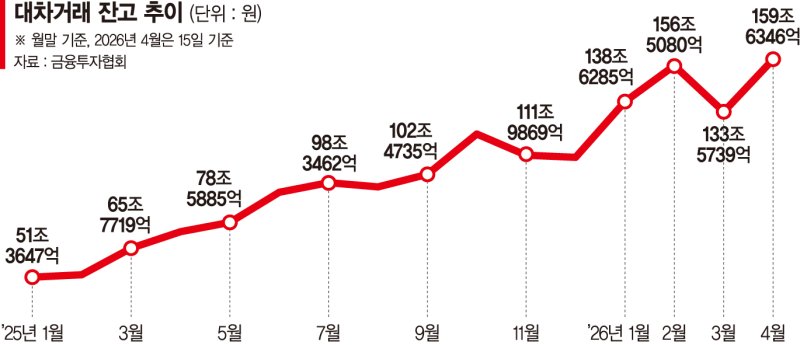
According to the Korea Financial Investment Association (KOFIA) on the 16th, the securities lending balance stood at 159.6346 trillion won as of the previous day, the highest level on record. It has increased by 26.0607 trillion won in just this month alone.
Securities lending is a transaction in which foreign or institutional investors lend shares to other investors for a fee, and it is widely viewed as a leading indicator of short selling. An increase in the securities lending balance means that the pool of shares that can be converted into short sales is expanding, suggesting that bearish bets on a market decline have strengthened.
The securities lending balance expanded rapidly during last year's stock market boom. It was only in the 40–50 trillion won range as of January last year, but surpassed 100 trillion won for the first time in September. The pace of growth has been even steeper this year. The balance was 110.9229 trillion won at the end of last year, and has already increased by more than 48 trillion won since the start of this year.
Actual short-selling balances are also rising sharply. On the 10th, net short positions on the main Stock Market Division amounted to 16.9279 trillion won, up more than 2 trillion won so far this month and marking a record high. The balance edged down slightly to 16.9225 trillion won on the 13th, but remains at an elevated level. Short interest first broke through 16 trillion won on the 25th of last month, then fell back into the 14 trillion won range on the 31st, only to turn upward again this month.
The expansion of short selling is seen as reflecting heightened concerns about additional corrections, even as the market recovers. Although the United States and the Islamic Republic of Iran are continuing peace talks following a ceasefire, the lack of a final agreement appears to be fueling caution.
Kim Kwang-rae, a researcher at Samsung Futures, said, "On the 19th, the waiver of sanctions on Iran will expire, and on the 21st, the two-week temporary ceasefire ends, so risks remain in place," adding, "The Trump administration plans to deploy one additional aircraft carrier and 10,000 troops to the Middle East this month, and if the peace agreement with Iran collapses, it is keeping open the possibility of further airstrikes and even a ground offensive."
Even so, some expect the rally to continue, supported by the low valuation of the KOSPI Composite Index and an accelerating "money move" into the stock market.
Kim Dong-won, head of research at KB Securities, noted, "This year, foreign investors continued large-scale selling through last month due to geopolitical uncertainty and profit-taking, but from the second quarter, when the Middle East situation is expected to ease, they are likely to expand their net buying," and predicted, "As corporate governance improves under amendments to the Commercial Act of the Republic of Korea and policies to channel more funds into the stock market are broadened, valuation multiples will expand rapidly."
He went on, "The KOSPI Composite Index currently trades at the lowest valuation relative to profitability among major global markets, and improving earnings in memory semiconductors are expected to bring in more dollars and stabilize the exchange rate," adding, "Given that the KOSPI Composite Index is on track to post record-high earnings this year and operating profit is projected to exceed 1,000 trillion won next year, this will likely act as a catalyst for the return of foreign investors and a shift of household funds into equities."
Lee Sung-hoon, a researcher at Kiwoom Securities, said, "The market is now focusing more on first-quarter earnings season than on war risks. From the end of this month to early next month, there is a high likelihood that the market will enter a rebound phase led by technology stocks on expectations for big tech earnings," and added, "As attention shifts to earnings, a portfolio strategy concentrated in fundamentally strong earnings plays appears favorable for boosting returns in the current environment."
[email protected] Reporter Seo Min-ji Reporter