China’s Q1 Economic Growth at 5% on Strong Exports, But H2 Uncertainty Deepens
- Input
- 2026-04-16 13:05:14
- Updated
- 2026-04-16 13:05:14
According to Financial News, China’s gross domestic product (GDP) in the first quarter of this year grew 5%, even though Beijing had set a lower annual GDP growth target than last year. The figure exceeded market forecasts.
Citing reports from CNBC and other foreign media in the United States of America (US), the National Bureau of Statistics of China (NBS) announced on the 16th that China’s first-quarter GDP reached 33.4193 trillion Chinese yuan (CNY) (about 7,201 trillion won), up 5% from a year earlier. This is higher not only than the 4.5% growth recorded in the fourth quarter of last year, but also above the 4.8% consensus forecast compiled by major foreign outlets.
In a statement released the same day, the NBS said, "Major macroeconomic indicators rebounded in the first quarter and new growth drivers emerged rapidly, giving the national economy a smooth start." At the same time, it cautioned, "However, the external environment has become more complex and volatile, and domestically, the imbalance of strong supply and weak demand remains pronounced."
Since lifting Coronavirus disease 2019 (COVID-19) lockdowns in 2022, China has continued to struggle with a property slump and weak consumption. At the fourth session of the 14th National People's Congress of the People's Republic of China (14th NPC) last month, the government set this year’s GDP growth target at 4.5–5%. That is not only below the 5% target of the past three years, but also the lowest level in 35 years. Quarterly GDP growth fell from 5.4% in the first quarter of last year to 5.2% in the second quarter. It then slowed to 4.8% in the third quarter and continued to decline into the fourth, before rebounding in the latest first-quarter reading.
By sector, China’s first-quarter GDP figures show that industrial value added rose 6.1% year-on-year. The services sector grew 5.2%, while agriculture expanded 3.7%.
However, as the NBS pointed out, the first-quarter economy remains unbalanced, with supply increasing while demand is insufficient. China’s retail sales in March came to 4.1616 trillion Chinese yuan, up 1.7% from a year earlier. The growth rate in retail sales fell short of both the 2.8% increase recorded in January–February and the 2.3% market forecast.
By contrast, industrial production in March rose 5.7% year-on-year. Although this was slower than the 6.3% growth in January–February, it still exceeded the 5.5% market expectation. Fixed asset investment in the first quarter increased 1.7% from a year earlier. Real estate development investment, a key gauge of China’s economic momentum, fell 11.2% year-on-year in the same period.
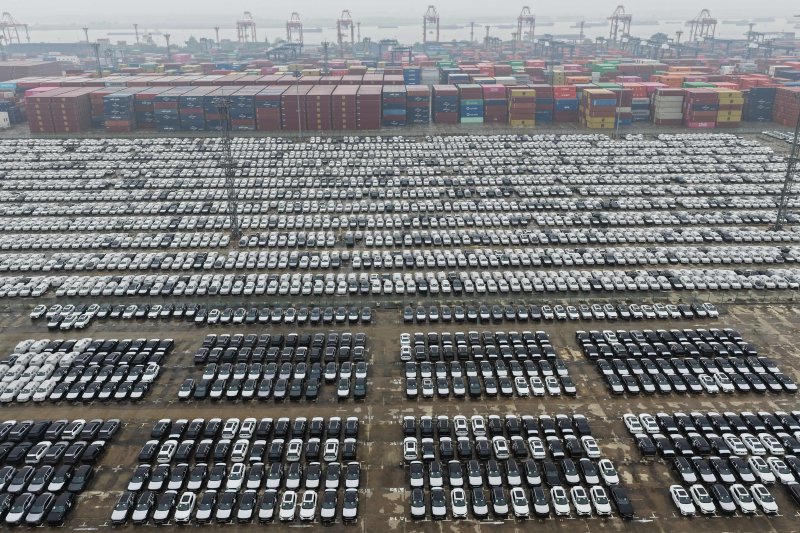
This persistent imbalance between supply and demand is largely due to strong exports. China’s exports in the first quarter jumped 14.7% from a year earlier, far outpacing last year’s full-year growth rate of 5.5%. Xu Tianchen, a senior economist at the Economist Intelligence Unit (EIU) in the United Kingdom, noted that China’s economic growth "still leans heavily on exports."
Experts warn that the Iran war could weigh on China’s economy and slow growth in the second half of the year. While export growth for the first quarter as a whole remained solid, March exports rose only 2.5% year-on-year, the lowest increase in five months.
As the world’s largest importer of crude oil, China has so far cushioned the impact of the Iran war, which began in February, with record crude oil reserves of about 1.2 billion barrels. But if international oil prices stay around 100 dollars per barrel, China’s economic expansion could run into limits. In its statement on the 16th, the NBS stressed, "We must continue to expand domestic demand, optimize supply, and implement stimulus measures to sustain stable growth."
[email protected] Park Jong-won Reporter