Dollar and euro shares fell, but the Korean won hit a record high in export settlements
- Input
- 2026-04-16 12:00:00
- Updated
- 2026-04-16 12:00:00
According to the Bank of Korea (BOK) report "Settlement Currency Composition of Exports and Imports in 2025" released on the 16th, the share of exports settled in Korean won (KRW) on a customs-cleared basis came to 3.4% last year. This was up 0.8 percentage points from a year earlier, marking a record high. The result contrasts with declines in all major currencies: United States dollar (USD) down 0.3 percentage points, euro down 0.1 percentage points, Japanese yen down 0.1 percentage points, and Chinese yuan (renminbi, RMB) down 0.2 percentage points.
The BOK attributed the higher share of Korean won settlements mainly to a 33.1% year-on-year increase in exports of passenger cars and semiconductor manufacturing equipment, which tend to have relatively high KRW settlement ratios. In fact, last year the share of exports settled in Korean won for these items was 10.5% and 6.2%, respectively.
Park Sung-gon, Head of the Balance of Payments Statistics Team, Economic Statistics Department 1, Bank of Korea, explained, "As exports of eco-friendly vehicles to the European Union (EU) and used cars to Russia increased, the share of their settlement currency, the Korean won, also rose." He added, "The share has been trending upward, indicating that the use of the Korean won is expanding in goods trade."
The impact of the higher won–dollar exchange rate in reducing the Korean won share was also limited. Normally, when a currency strengthens, its share in settlements tends to rise, but since last year the Korean won has weakened against the dollar. Under usual circumstances, this would have lowered the KRW share, but the increase in export volumes appears to have offset that effect.
For the United States dollar (USD), exports to the United States of America (U.S.) declined due to U.S. tariff policy, and exports of chemical products and petroleum products, which are typically settled in dollars, were sluggish. As a result, export growth in USD terms (3.4%) fell short of overall export growth (3.8%), leading to a smaller dollar share. Even so, USD still accounted for 84.2% of export settlements, remaining dominant.
Commenting on this, Park Sung-gon noted, "Semiconductor exports performed well last year, but weak exports of steel products and auto parts due to U.S. tariffs diluted that effect."
He went on, "Although exports of passenger cars increased, the euro’s share declined because exports of steel products and auto parts fell," adding, "The Japanese yen share also dropped as exports of steel products and machinery and precision instruments decreased." In particular, the share of the Japanese yen fell for a second consecutive year, hitting an all-time low.
Looking at import settlement shares by currency, the United States dollar (USD) also saw its share shrink by 1.1 percentage points. Park Sung-gon assessed, "As global oil prices fell, imports of energy such as crude oil, gas, and coal—which are typically settled in dollars—declined by 1.3%, reducing the dollar’s share."
By contrast, the shares of the euro, Japanese yen, and Korean won each rose by 0.3 percentage points. The share of the Chinese yuan (renminbi, RMB) also increased by 0.1 percentage points to 3.2%, the highest level on record. For the Korean won, a 4.8% increase in imports of passenger cars, information and communications equipment, and machinery and precision instruments settled in KRW played a key role in lifting its share. Higher imports of semiconductor manufacturing equipment were cited as a common factor behind the increased shares of the euro and Japanese yen.
Park Sung-gon projected that this year the share of the United States dollar (USD) will likely rise, as international oil prices and other energy prices are climbing due to tensions in the Middle East and semiconductor exports are recovering. Consequently, the shares of the Korean won and other currencies are expected to decline relatively.
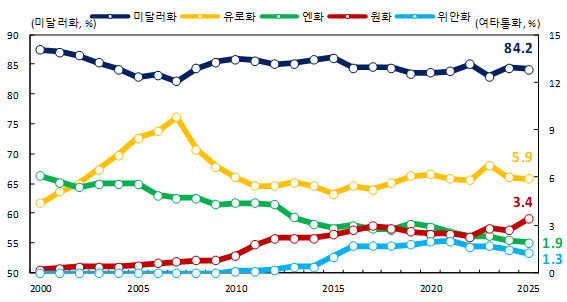
In the case of the EU and Japan, counterpart currencies other than the dollar accounted for a substantial portion of export settlements—47.1% for the euro and 39.2% for the Japanese yen. However, in the United States of America (U.S.), China, Southeast Asia, Latin America, and the Middle East, the share of USD exceeded 80% in all regions.
For imports by region, the share of euro settlements for imports from the EU rose by 2.2 percentage points, while the shares of USD and Korean won fell by 1.4 and 0.8 percentage points, respectively. For imports from Japan, the share of the Japanese yen increased by 1.9 percentage points, and the USD share decreased by 1.9 percentage points. In imports from China, the share of USD fell by 1.1 percentage points, whereas the shares of Korean won and Chinese yuan rose by 0.9 and 0.1 percentage points, respectively.
Similarly for imports, the shares of counterpart currencies in settlements with the EU and Japan were high at 48.0% and 45.4%, respectively, while in other regions—except for China at 79.8%—the share of USD was in the 90% range.
[email protected] Kim Tae-il Reporter