"War risk fading, 6,300 in sight"... Semiconductor supercycle poised to break through 7,500 this year
- Input
- 2026-04-16 08:24:21
- Updated
- 2026-04-16 08:24:21
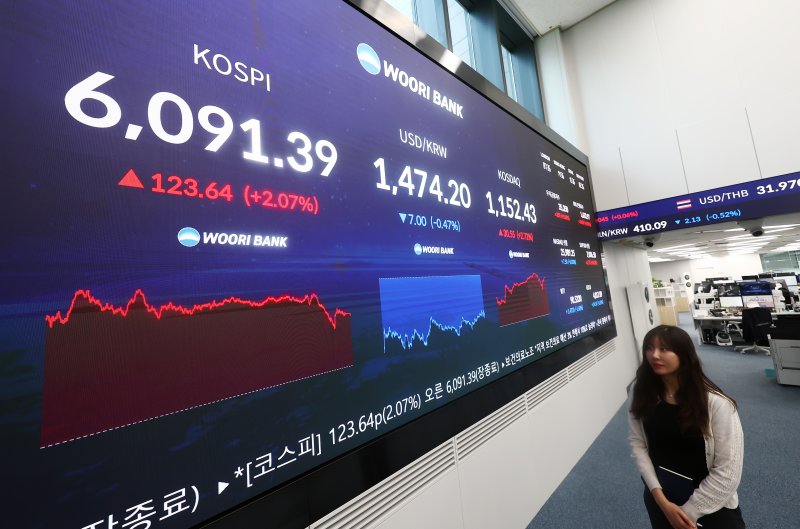
[Financial News] The S&P 500 Index and NASDAQ Composite Index, the key benchmarks of the New York stock market, closed at record highs for the first time since the outbreak of the U.S.-Iran war, fueling expectations for further gains in the KOSPI Composite Index. With earnings momentum still strong in semiconductor stocks, analysts are now saying the KOSPI Composite Index could climb to the 6,300 level.
On April 15 (local time), the S&P 500 Index rose 55.58 points (0.8%) to close at 7,022.95, setting a new all-time high. This surpassed the previous peak of 7,002.28 recorded in January and marked the first time the index has finished above the 7,000 level on a closing basis.
The NASDAQ Composite Index also gained 376.93 points (1.59%) to close at 24,016.02, breaking through the 24,000 mark and extending its impressive winning streak to 11 consecutive sessions. The Dow Jones Industrial Average (DJIA) slipped slightly by 72.27 points (-0.15%) to 48,463.72, but overall market sentiment has not only recovered losses from the shock of the U.S.-Iran war, it has shifted into a strong upward trend.
Will the KOSPI Composite Index break through 6,300 again... SK hynix earnings seen as the key
On April 15, the KOSPI Composite Index closed at 6,091.39, up 123.64 points (2.07%) from the previous session, firmly settling above the 6,000 level. The index opened at 6,141.60, up 2.91% from the prior close, immediately breaking through 6,100 at the start of trading. It then surged to as high as 6,183.21 before giving back some gains and finishing around the 6,000 level.
This was the first time since the outbreak of the U.S.-Iran war on February 28 that the KOSPI Composite Index has closed above the 6,000-point level. The move is widely attributed to improved investor sentiment on expectations for a second ceasefire agreement between the United States and Iran. With buying concentrated in large-cap semiconductor stocks, some analysts say that if this upward trend continues, the index could break through its previous peak around 6,300. The KOSPI Composite Index’s prior intraday high was 6,347.41, set on February 27, just before the U.S.-Iran war began.
Lee Kyung-min, an analyst at Daishin Securities, said, "The Korean stock market continued its strong performance on expectations for a second peace deal between the United States and Iran. As we saw the previous day, risk appetite that had been suppressed by uncertainty in the Middle East is expanding." He added, "In the semiconductor sector, earnings momentum remained intact as profit forecasts kept being revised upward, while in construction, expectations of benefiting from infrastructure reconstruction demand in the Middle East acted as upward pressure on share prices."
Brokerage houses estimate that operating profit for memory semiconductor companies on the KOSPI Composite Index, led by Samsung Electronics and SK hynix, will jump 165% year-on-year to 792 trillion won in 2026, with net profit surging 184% to 606 trillion won.
Kim Dong-won, an analyst at KB Securities, stated, "If we enter an earnings upcycle led by semiconductors, the Korean market will emerge as an attractive investment destination for global investors." He added, "Our KOSPI Composite Index target of 7,500 points for this year is already within sight."
Key variables: ceasefire outcome and exchange rate
However, the outlook is not uniformly optimistic. Some analysts argue that whether the market can rise further will depend on the sustainability of earnings and the broader macroeconomic environment. While expectations of profit improvement in the semiconductor sector are driving the index higher, they warn that cost factors such as a strong dollar–won exchange rate, high oil prices, and persistent inflation could still weigh on the market if fully priced in.
Junyeong Kim, an analyst at iM Securities, explained, "Rising energy prices are making the inflation path more uncertain and pushing back the timing of interest rate cuts, while war risks and a weaker won are overlapping." He predicted, "Foreign investors have consistently been net sellers during periods of won depreciation, so as long as the exchange rate stays above 1,400 won to the dollar, their structural incentive to initiate new buying will remain limited."
In addition, if the second round of U.S.-Iran talks proceeds as scheduled and produces an agreement, investors expect further foreign capital inflows as geopolitical risks ease. But if the negotiations break down again, uncertainty could quickly resurface, a risk that market participants need to keep in mind.
[email protected] Kim Hee-sun Reporter