Tiger Research: "A Five-Stage Framework Is Essential for Blockchain Business" [Crypto Briefing]
- Input
- 2026-04-16 06:00:00
- Updated
- 2026-04-16 06:00:00
[Financial News] While global financial giants such as BlackRock and JPMorgan are expanding into real-world asset tokenization (RWA) and stablecoin businesses, domestic institutions are seen as lacking clear entry strategies. As discussions continue on bringing digital assets into the regulatory mainstream, experts argue that institutions must move step by step—from validating their own business models to integrating into broader ecosystems—to concretize their businesses as soon as possible.
Yoon Seung-sik, director of Tiger Research Center, unveiled a five-stage framework for corporate entry into the blockchain business at the "The Frontier: Global Business Strategies in the Era of Stablecoins" summit, co-hosted by Tiger Research and Deloitte Korea Group in Seoul on the 15th.
Yoon stated, "Unlike the experimental phase in 2021, this year marks a commercialization phase driven by RWA and stablecoins on a regulatory foundation." BlackRock's U.S. Treasury tokenization product, BlackRock USD Institutional Digital Liquidity Fund (BUIDL), currently has assets under management (AUM) of 2.3 billion dollars. JPMorgan is operating a structure in which commercial paper is issued on-chain on Solana and settled using USD Coin (USDC). Goldman Sachs is jointly pursuing a Money Market Fund (MMF) tokenization business with The Bank of New York Mellon Corporation (BNY Mellon).
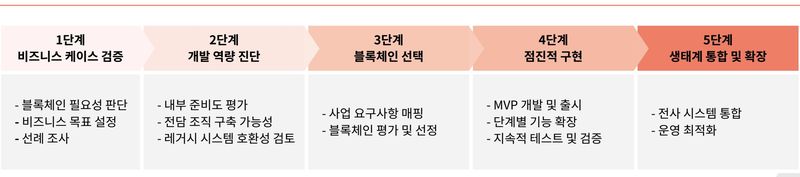
The five-stage framework presented by Yoon consists of: identifying the unique, irreplaceable value of blockchain and calculating a 3–5 year Return on Investment (ROI); establishing a dedicated blockchain organization and reviewing compatibility with legacy systems; conducting a comprehensive assessment of the cost structure; launching a Minimum Viable Product (MVP) first; and securing transparency and trust with external partners and client companies.
Yoon noted, "If you force blockchain into problems that can be solved with existing solutions, you only increase complexity, so you must first verify whether it is a use case that only blockchain can address." He added, "The clearest business areas at present include RWA involving stablecoins, as well as payments and remittances."
He stressed that the completeness of the blockchain infrastructure is particularly critical. Just as infrastructure was crucial when adopting cloud services such as Amazon Web Services (AWS), choosing a blockchain platform is also an infrastructure decision of great importance. "A wrong choice leads directly to massive migration costs and business risks," he explained, adding, "You need to comprehensively evaluate completeness, support staff, references, security, and cost structure, and then select a platform that balances these factors."
Regarding the fifth stage of ecosystem integration, he emphasized, "If you use blockchain in isolation, it is nothing more than a simple database," and continued, "The real value of adopting blockchain emerges only when you reach the stage of expanding the ecosystem to include external supply chain partners."
[email protected] Kim Mi-hee Reporter