Samsung Electronics and SK hynix Seen Posting Record Earnings, Market Cap Tops 2,000 Trillion Won Again
- Input
- 2026-04-15 18:25:45
- Updated
- 2026-04-15 18:25:45
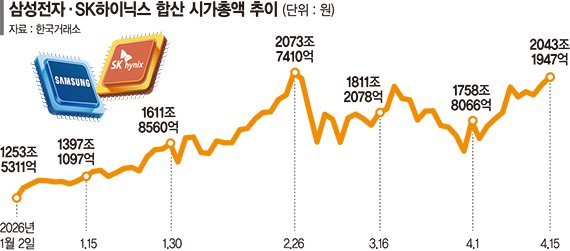
According to the Korea Exchange (KRX) on the 15th, the KOSPI Composite Index finished trading at 6,091.39, up 123.64 points (2.07%) from the previous session. This is the first time in 32 trading days that the index has closed above 6,000, since February 27, when it ended at 6,244.13. The sharp gains in Samsung Electronics and SK hynix fed directly into the KOSPI’s rise. On the day, Samsung Electronics climbed 2.18%, while SK hynix advanced 2.99%. SK hynix at one point jumped to 1,173,000 won during intraday trading, setting a new all-time high.
Based on the closing price that day, the combined market capitalization of Samsung Electronics and SK hynix reached 2,043.1947 trillion won, reclaiming the 2,000 trillion won mark after about a month and a half. The two companies’ combined market cap exceeded 2,000 trillion won for the first time ever on February 26, but the rally was cut short by the Middle East war last month, pushing the figure down into the 1,500 trillion won range. This month, however, sentiment has shifted. Hopes for an end to the conflict, together with expectations for peak earnings in the semiconductor sector, have improved investor appetite. From the start of this month through the 15th, Samsung Electronics has risen 26.20% and SK hynix 40.77%. In contrast, they fell 22.77% and 23.94%, respectively, last month, meaning they have fully recovered those losses in roughly two weeks.
The two companies’ weight in the KOSPI market has also increased significantly. Samsung Electronics and SK hynix now account for 40.90% of the KOSPI’s total market capitalization, a sharp rise from 34.04% at the end of last year. Their combined share of the index topped 40% for the first time last month, then briefly paused, and has remained in the 40% range since the 7th.
Samsung Electronics and SK hynix are expected to deliver record earnings not only this year but also next year, and their share prices are widely projected to remain on an upward trajectory. This year’s consensus forecast for annual operating profit, based on the average of securities firms’ estimates, stands at 297.5478 trillion won for Samsung Electronics and 105.3368 trillion won for SK hynix, more than double the levels projected three months ago.
Next year, Samsung Electronics is projected to post operating profit of 360.6812 trillion won, while SK hynix is expected to earn 237.33 trillion won. At the upper end of consensus, the figures rise to 515.723 trillion won and 423.98 trillion won, respectively, leading some to predict that the two companies’ combined operating profit could approach 1,000 trillion won.
Kim Dong-won, Head of Research at KB Securities, said, "Despite geopolitical uncertainty in the Middle East, shipments of artificial intelligence (AI) servers in the second quarter of this year are set to far exceed earlier expectations, sustaining a powerful growth momentum." He added, "AI server shipments this year are projected to increase 28% from a year earlier, outpacing the overall server market growth rate of 13%."
Cho Chang-min, a research analyst at Hyundai Motor Securities, noted, "The semiconductor sector now accounts for about 64% of the KOSPI Composite Index’s 12‐month forward operating profit, the highest level on record." He explained, "During the 2018 Supercycle, the share was around 40%, so the current figure is even higher." He went on to say, "A large part of the upward revisions to KOSPI earnings is being driven by semiconductors, and as we move through the first‐quarter earnings season, the pace of upgrades to semiconductor profit forecasts is likely to accelerate again."