Export and import prices see steepest rise in 28 years
- Input
- 2026-04-15 18:21:32
- Updated
- 2026-04-15 18:21:32
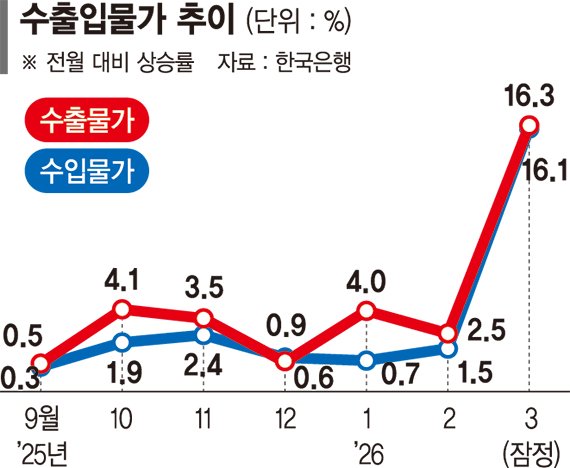
According to the "Export/Import Price Indexes and Trade Indexes – March 2026" released by the Bank of Korea (BOK) on the 15th, the export price index in won terms rose 16.3% in March from the previous month. It has been climbing for nine straight months since July last year, when it increased 0.8%. The latest monthly gain is the largest since January 1998, when the index jumped 23.2%, a span of 28 years and 2 months.
On a year-on-year basis, the export price index rose an even steeper 28.7%, marking its seventh consecutive monthly increase since September last year. The 16.3% month-on-month rise in manufactured goods played a major role. Within that category, coal and petroleum products soared 88.7%. Computers, electronic and optical equipment, which include semiconductors, also posted a high increase of 12.7%. Agricultural, forestry and marine products climbed 5.1% from the previous month.
When measured in contract currencies, excluding the impact of exchange rate movements, export prices in March rose 13.6% from February. Compared with a year earlier, they were up 25.9%.
The import price index also climbed 16.1% in March from the previous month, marking nine consecutive months of increases. This is likewise the highest monthly rise in 28 years and 2 months, since January 1998, when it advanced 17.8%. Compared with a year earlier, the index was up 18.4%.
The rise was driven by simultaneous increases in the won–dollar exchange rate and international oil prices. The average monthly exchange rate climbed from 1,449.32 won per dollar in February to 1,486.64 won in March. Over the same period, the price of Dubai crude oil jumped from 68.40 dollars per barrel to 128.52 dollars. As a result, prices of raw materials rose 40.2%, led by a 44.2% surge in mineral products such as crude oil. Within mineral products, crude oil prices alone jumped 88.5%, the highest increase in about 41 years since related statistics began in 1985. In contract currency terms, it was the largest rise since January 1974, during the first oil shock, when prices surged 98.3%, a span of 52 years and 2 months.
Moon-hee Lee, head of the Price Statistics Team at the Bank of Korea (BOK)'s Economic Statistics Department 1, said, "Export and import prices rose in March as international oil prices and semiconductor prices increased sharply." Lee added, "In April, oil prices based on Dubai crude oil are declining, but given the high uncertainty surrounding negotiations between the United States and Iran and the difficulty of fully resolving raw material supply disruptions in the near term, it is hard to predict the future path of prices."
[email protected] Tae-il Kim Reporter