Hyun-Song Shin: "Price stability is the top priority... If the war drags on, we will use monetary policy"
- Input
- 2026-04-15 18:18:21
- Updated
- 2026-04-15 18:18:21
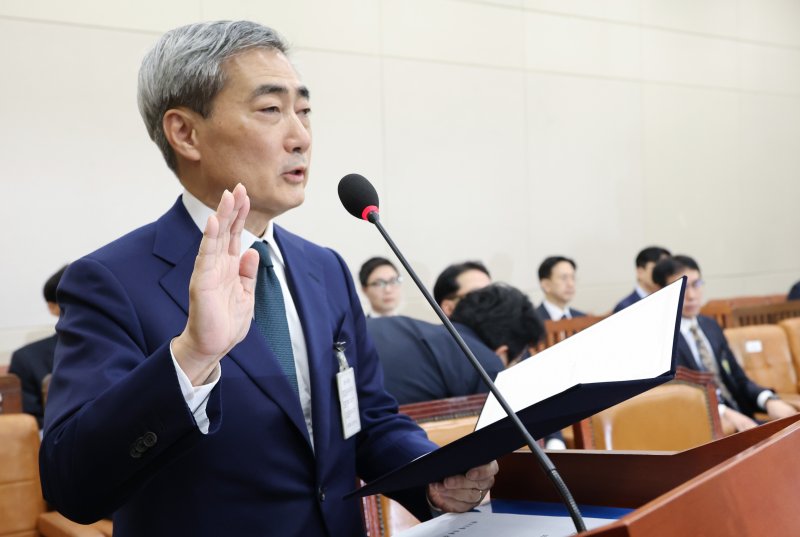
■ "If the war is prolonged, we must use monetary policy"
At the confirmation hearing before the National Assembly Planning and Finance Committee on the 15th, Shin stated, "The core of monetary policy is price stability. If the impact of Middle East risks spills over into core inflation or inflation expectations and creates second-round effects, that is the stage where we must use monetary policy."
Shin described the seven consecutive base rate freezes decided under Governor Rhee Chang-yong’s leadership at the BOK as "strategic patience." However, he also hinted that if a surge in international oil prices drives inflation out of control, the base rate could be raised.
At the same time, Shin noted, "The key question is whether the temporarily higher inflation will persist, or whether the shock will ease and inflation will return to the target." Last month, the Consumer Price Index (CPI) stood at 118.80, up 2.2% from a year earlier, and both the Export and Import Price Index figures released that day hit their highest levels since January 1998, a span of 28 years and two months.
Asked where he would place emphasis, given that monetary policy faces the conflicting tasks of price stability and economic growth, Shin replied, "In an economy like Korea’s, which is sensitive to oil prices and has a high share of manufacturing, price stability is important," while adding, "That does not mean I take growth lightly." He offered a positive outlook on Korea’s growth prospects. "Korea faces issues such as regional disparities and polarization, but it also has many dynamic aspects and outstanding technological capabilities," he said. "If we make good use of the broader shift driven by Artificial intelligence (AI), I judge that the potential growth rate is also promising."
Shin identified household debt as an issue directly tied to growth. "When household debt is high, consumption becomes less dynamic and the economy comes under pressure," he said. "If the ratio of household debt to gross domestic product (GDP) stays at 80% to 85% or higher for a prolonged period, monetary policy alone cannot solve the problem, and macroprudential policy and other measures are needed." At the end of last year, the ratio of household debt to nominal GDP stood at 88.6%, which, by Shin’s assessment, is at a level that restrains growth.
Shin also raised the need for additional monetary policy tools. "The BOK has a mandate for financial stability, but the only tool it has for that is monetary policy," he said. "It would be desirable to work with relevant agencies to improve this situation." However, securing additional policy instruments is likely to require amendments to the Bank of Korea Act.
■ The forward foreign exchange market should be formalized
Regarding the recent rise in the won–dollar exchange rate, Shin pointed not only to the Middle East conflict but also to structural features of the foreign exchange market. "When there is a shock that affects the financial system itself, such as last month’s rise in the exchange rate, there are aspects that are driven by the forward foreign exchange market, which is not fully captured in capital flow statistics," he explained. "This time as well, rather than actual capital outflows on the books, a large part of the move was driven by non-deliverable forwards (NDFs) traded as over-the-counter derivatives, a case of ‘the tail wagging the dog.’" Shin believes the NDF market should be brought into the formal system and properly regulated.
Without specifying an appropriate exchange rate level, Shin instead outlined the long-term direction for the foreign exchange market. "We need to expand liquidity through the internationalization of the Korean won and establish related systems within a macroprudential framework," he said. "One of the reasons for building an offshore payment system is to manage the status of the won in the overall financial system, including its impact on the exchange rate."
He again stressed that a won-denominated stablecoin would serve as a "complement" to the digital currency that the central bank is pursuing in the form of a Central Bank Digital Currency (CBDC). "Each instrument can have its own role depending on its use case," Shin said. "Given that Korea has foreign exchange controls and that banks are best positioned to carry out customer due diligence, the discussion about activating a deposit token based on CBDC has emerged on that premise."
[email protected] Kim Tae-il Reporter