Lee Chan-jin, FSS Governor, to Meet Chairs of Boards at Eight Major Financial Holding Companies Next Week, Raising Expectations of Direct Pressure
- Input
- 2026-04-15 16:45:42
- Updated
- 2026-04-15 16:45:42
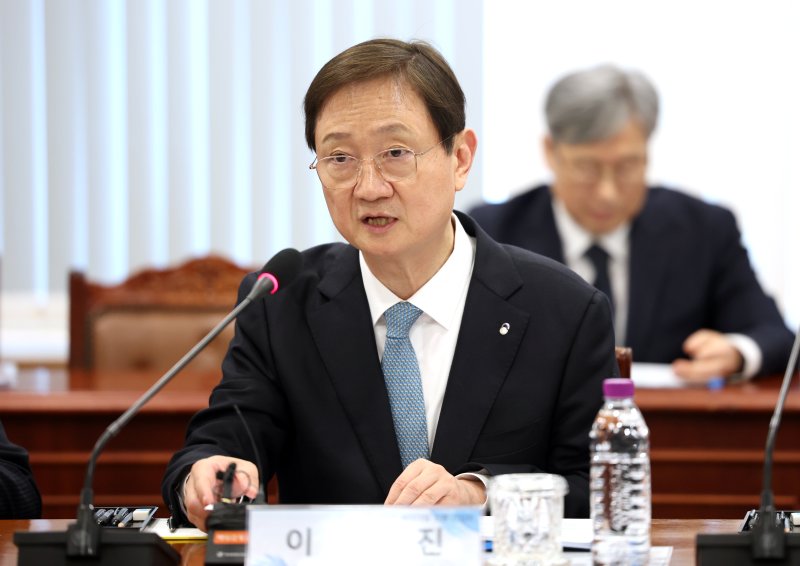
Lee Chan-jin, Governor of the Financial Supervisory Service (FSS), will meet with the chairs of the boards at the eight major Financial Holding Companies (FHCs) to discuss directions for improving corporate governance. As Lee is pushing measures such as allowing the National Pension Service (NPS) to recommend outside directors and disclosing detailed board minutes to strengthen the independence of outside directors, the financial sector is watching closely to see whether he will deliver direct pressure on the boards.
According to the financial sector on the 15th, Lee is scheduled to hold a regular first-half meeting around the 22nd with the board chairs of eight major FHCs: KB, Shinhan Financial Group, Hana Bank, Woori Financial Group, NH NongHyup, iM Financial Group, BNK Financial Group and JB Financial Group.
The FSS holds regular meetings twice a year, in the first and second half, with the board chairs of the eight major FHCs and 18 banks. This upcoming meeting has not yet been finalized, so there is still a possibility it could be postponed.
Attention is focusing on this meeting as it comes just before the financial authorities unveil their plan to advance the governance structure of FHCs. The Financial Services Commission (FSC) and the FSS formed a task force (TF) in January after President Lee Jae-myung of South Korea sharply criticized the long tenures of FHC chairmen as a "corrupt inner circle" during a policy briefing last December. The TF has been discussing various governance reforms to curb so-called self-extensions of FHC chairmen’s terms and to strengthen board independence, and is preparing to announce the results.
The financial authorities have been reviewing measures such as raising the requirement for reappointing a chairman from a simple majority of shareholders present to a "special resolution" requiring at least two-thirds approval of those present, introducing a three-year single term for outside directors, and adopting a clawback system for performance-based pay. However, after the authorities abruptly delayed the announcement of the governance reform package, expectations have grown that an even tougher set of measures may be forthcoming.
Recently, there has been speculation that the three-year single term for outside directors may be dropped, and instead a plan could be included to give the National Pension Service (NPS) the right to recommend outside directors. Lee Chan-jin has previously stated that the NPS, as a representative of shareholders, should be represented among outside directors, and he has brushed aside criticism of so-called pension socialism as unimportant. He has also publicly emphasized the need to appoint so-called "catfish-type" outside directors who can voice dissenting opinions, and to disclose board minutes in detailed form. As a result, there is keen interest in whether Lee will present concrete regulatory directions at the meeting.
At a press briefing held last month, Lee said, "We are considering elevating some of the somewhat strengthened improvements from best practices to statutory requirements," adding, "We expect to reach a conclusion around April and are working toward implementation in October."
However, as the FSC has made responses to the prolonged war in the Middle East its top priority and is focusing all its efforts there, the timing of the governance reform announcement remains undecided. This has led to expectations that Lee may limit himself to general remarks at the meeting. An FSS official said, "The schedule for the meeting has not yet been finalized," and added, "We may use the occasion to reiterate the basic point that, because boards make key management decisions and FHCs play a major role in the domestic market, their boards must have both expertise and independence."
[email protected] Park So-hyun Reporter