Securing Alternative Routes for Crude and Naphtha: Immediate Crisis Eased, but End of Conflict Uncertain
- Input
- 2026-04-15 16:44:42
- Updated
- 2026-04-15 16:44:42

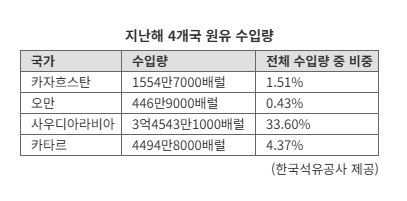
According to Financial News, the government’s move to secure additional crude oil and naphtha from the Kingdom of Saudi Arabia, Oman, Qatar and Kazakhstan is more than a simple increase in volume. It is significant because it effectively establishes an "alternative supply route bypassing the Strait of Hormuz." With the risk of a blockade becoming real amid a prolonged Middle East war, Seoul has now secured routes through which cargo can actually reach Korea. As supply concerns ease somewhat, the refining and petrochemical industries are seen as having gained some breathing room.
Focus on routes that can avoid the Strait of Hormuz risk
At the briefing on the 15th, Kang Hoon-sik said, "Our economy is highly dependent on the Strait of Hormuz, with 61% of our crude oil and 54% of our naphtha coming through this route." He explained, "We could not simply sit back and hope the Middle East situation would resolve itself, so we moved to secure alternative supply sources."
The newly secured supply routes are all concentrated on paths that can avoid the risk of a Strait of Hormuz blockade. Kazakhstan is a representative alternative supplier that does not require passage through the strait. Oman, which faces the Indian Ocean, is relatively free from the direct impact of a blockade. The Kingdom of Saudi Arabia can also use alternative ports on the Red Sea for loading, which helps reduce dependence on existing transport routes.
In particular, it is meaningful that Korea has secured volumes from the Kingdom of Saudi Arabia whose shipment had previously been uncertain.
Kang Hoon-sik noted, "About 50 million barrels of crude oil had been allocated to our companies, but actual supply was unclear. We have now received a firm commitment that these volumes will be shipped without disruption via alternative ports adjacent to the Red Sea between April and May." He added, "These cargoes are scheduled to arrive in Korea sequentially over May and June."
In addition, Korea has secured priority allocation for a total of 200 million barrels of crude oil from June through the end of the year. This effectively guarantees around 90% of the country’s annual import volume from the Kingdom of Saudi Arabia on a stable basis.
The secured volumes are being interpreted as a yardstick for how long Korea can endure in a crisis. The 273 million barrels of crude oil obtained by the government correspond to more than three months of consumption based on last year’s levels. The 2.1 million tons of naphtha are equivalent to about one month of imports.
However, significant uncertainties remain. Although expectations for a cease-fire in the Middle East have recently eased tensions to some extent, the possibility of a Red Sea blockade and the duration of the war are still unclear. If transport routes are disrupted again, there is a risk that the secured volumes may not be delivered as planned.
There are also clear structural limitations. While the latest measures have somewhat diversified supply routes, they do not fundamentally resolve Korea’s heavy dependence on the Middle East for crude oil and naphtha imports.
Petrochemical industry welcomes move, vows to keep seeking alternative crude
The refining and petrochemical industries, which urgently needed crude oil and naphtha, unanimously welcomed the government’s action. Crude from Oman, the Kingdom of Saudi Arabia and Qatar has a high share of heavy oil, which can be upgraded into high value-added products through advanced refining facilities. It is therefore considered an optimal feedstock for domestic refiners’ configurations.
By contrast, crude from Kazakhstan has a higher proportion of light oil. This yields more gasoline and naphtha but relatively less diesel and kerosene. Even so, industry officials explain that sufficient flexibility is possible when it is blended with heavy crude. Their assessment also reflects the reality that, at this point, securing volumes is more critical than the specific properties of the crude.
A representative of the refining industry said, "At a time when we need to secure even one additional barrel of crude, we appreciate the government’s success in obtaining crude oil and naphtha." The person added, "Companies will also continue to search for alternative crude sources and do their utmost to ensure a stable supply of petroleum products in the domestic market."
Operating rates at Naphtha Cracking Centers (NCCs) have also dropped sharply. The industry’s average utilization rate has fallen from around 80% before the Iran crisis to the 50–60% range recently. Some companies, including Yeochun NCC, have seen a slight recovery from the 50% range to about 60%, but utilization remains far below pre-war levels. The latest naphtha procurement measures are expected to support a rebound in operating rates.
A representative of the petrochemical industry said, "Anxiety was high not only among petrochemical companies but also across downstream sectors such as healthcare and construction, which were facing shortages of plastic feedstock." The official continued, "This move should help ease some of those concerns." The person added, "The newly secured volumes will help us hold out in the short term, and companies will keep working to obtain spot cargoes."
[email protected] Park Ji-young, Koo Ja-yoon Reporter