"Today Is the Cheapest" Chanel Bags Soar 80% in Five Years, Yet Koreans Keep Buying [Her-Lou-Cha: The Invincible Republic of Luxury]
- Input
- 2026-04-16 07:00:00
- Updated
- 2026-04-16 07:00:00
[The Financial News] "The white gold is 21.1 million won, and the beige gold is 20.1 million won."
On the 14th, a staff member at the Chanel boutique in the Shinsegae Department Store Main Branch in Jung District, Seoul, introduced the prices of the brand’s signature "No. 5 bangle" in this way. When asked how much the price had risen compared with last year, the staff member replied, "We only provide information on the current price," declining to disclose the size of the increase. The relatively cheaper fashion jewelry section was empty. By contrast, the area displaying fine jewelry priced in the tens of millions of won was constantly visited by couples and Chinese customers.
Her-Lou-Cha’s boom driven by the Veblen effect
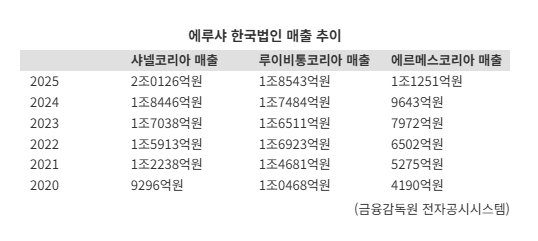
The three leading luxury brands collectively known as Her-Lou-Cha (a collective term for Hermès, Louis Vuitton and Chanel) are posting soaring results in the Korean market. Even among luxury labels, these are at the very top end of the price range, yet they achieved record performance in South Korea last year and continued to grow solidly despite the economic downturn. Analysts point above all to robust demand from wealthy consumers who can still afford ultra-expensive items costing tens of millions of won, which have become difficult for the middle class to buy after steep price hikes. A rebound in the marriage rate and increased spending by foreign tourists, helped by the weaker won, are also driving luxury sales in Korea.
Experts say that not only the wealthy but also middle-class consumers’ appetite for high-priced luxury goods is contributing to Her-Lou-Cha’s rising sales. As the economic slump drags on, people turn to value-for-money retailers in everyday life, yet they still want to splurge on expensive items on special occasions. With mid-priced consumption shrinking, this has produced a polarized landscape in which Daiso Industries, Olive Young, Musinsa and ultra-high-end luxury brands all report record results at the same time. Lee Eun-hee, a professor of consumer studies at Inha University, noted, "Korean consumers tend to want to join the ranks of luxury buyers, even if it is only for small accessories," adding, "The desire to show that they are the kind of people who can afford luxury goods remains very strong, and that is what sets Korea apart from other countries."
Globally, however, Louis Vuitton and Chanel are struggling, with Hermès the notable exception. Last year, revenue at LVMH Moët Hennessy Louis Vuitton (LVMH) fell 5% to 80.87 billion euros, marking a second consecutive year of decline. As Chinese spending slows and middle-class demand weakens, LVMH’s share price has dropped by nearly 30% so far this year. Global consulting firm Bain & Company estimates that 50 million consumers worldwide have exited the luxury market over the two years starting in 2024. The classic "Veblen effect"—the idea that higher prices boost sales—is fading, and more consumers are evaluating the intrinsic value of products rather than just the brand name. In contrast, Korean consumers continue to open their wallets even as luxury prices rise.
Weaker won and rising marriages also play a role
Some analysts argue that luxury price hikes themselves are fueling this kind of spending behavior. The price of a medium Chanel Classic Flap Bag surpassed 10 million won in 2021 and has climbed to 17.9 million won this year, an increase of nearly 80% in five years. Chanel raised prices four times last year alone, cementing its status as the leading brand for repeated price hikes. As a result, more consumers who are considering a luxury purchase choose not to delay, anticipating further increases. The so-called "Chanel investment" or Chanel-flipping strategy—buying now in expectation of future price hikes—also appears to remain in play. Showing a Classic Flap Bag, a Chanel sales associate said, "We don’t know when the next price increase will be." The associate then added, "Given that prices have kept going up, it probably won’t be long before it reaches 18 million won." Lee Jong-woo, a professor of business administration at Ajou University, explained, "While the premium segment is wobbling overseas as consumers polarize, in Korea strategies that maximize scarcity through price increases are still working."
The depreciation of the won has also clearly boosted luxury spending in Korea by foreigners, including Chinese tourists. In the first quarter of this year, sales in the luxury category at Lotte Department Store rose 30%, while luxury purchases by foreign customers jumped 125%. A Chinese shopper in her 20s from Hangzhou, identified only as Ms. A, said, "I bought a pair of Louis Vuitton sneakers for 1.99 million won, and they are 600,000 won more expensive in China," adding, "It’s much cheaper in Korea, so I came here to shop, and everyone is buying luxury goods in Korea." As marriage rates rise among people in their late 30s and early 40s with solid purchasing power, demand for wedding gifts, especially jewelry, is also increasing. In the first quarter, luxury jewelry sales at Shinsegae Department Store grew 55%, outpacing the overall luxury growth rate of 30%. With Korean sales climbing, luxury executives are visiting the country more frequently; late last month, Axel Dumas, Executive Chairman of Hermès and its Chief Executive Officer (CEO), toured local stores, exemplifying this trend.
unsaid@fnnews.com Kang Myung-yeon Reporter