Kang Hoon-sik tours four Middle Eastern countries: "We secured 273 million barrels of crude oil and 2.1 million tons of naphtha"
- Input
- 2026-04-15 14:36:32
- Updated
- 2026-04-15 14:36:32
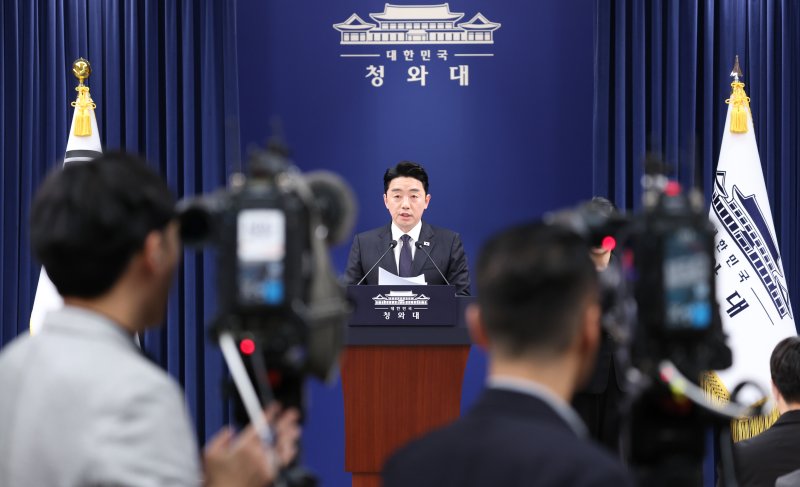
[The Financial News] Acting as Special Envoy for Strategic Economic Cooperation for President Lee Jae Myung, Chief of Staff to the President Kang Hoon-sik visited four countries — Kingdom of Saudi Arabia (KSA), Oman, Kazakhstan and Qatar — and finalized additional imports of crude oil and naphtha. The crude volume corresponds to about three months of imports, and the naphtha volume is equivalent to roughly one month of imports.
In a briefing held at Chunchugwan on the 15th, Kang stated, "We have finalized the import of 273 million barrels of crude oil by the end of this year and secured up to an additional 2.1 million tons of naphtha by year-end." Kang departed on the 7th, delivered President Lee’s personal letters during visits to the four countries, and returned to Korea via Incheon International Airport the previous day.
Kang explained, "As of last year, our economy depended heavily on supplies through the Strait of Hormuz — 61% of crude oil and 54% of naphtha — so we could not simply sit back and hope the Middle East situation would resolve itself." He went on, "From the 7th until yesterday, I visited four countries — Kazakhstan, a major resource producer in Central Asia, and Oman, Kingdom of Saudi Arabia (KSA) and Qatar, key energy suppliers in the Middle East — to discuss ways to secure crude oil and naphtha."
The crude oil and naphtha to be imported under these new arrangements are understood to come from alternative supply routes that are not linked to the Strait of Hormuz.
Kang noted, "The 273 million barrels of crude oil is a volume that, based on last year’s figures, would cover more than three months of consumption under normal economic conditions without any emergency measures. The 2.1 million tons of naphtha corresponds to about one month of imports last year." He stressed, "Because the crude oil and naphtha we have secured this time will be imported from alternative supply lines unrelated to any blockade of the Strait of Hormuz, we believe they will make a direct and tangible contribution to stabilizing domestic supply and demand."
In Kazakhstan, Kang paid a courtesy call on President Kassym-Jomart Tokayev and delivered President Lee’s personal letter. Kang said, "Senior Kazakh government officials noted that many countries have been sending envoys since the outbreak of the Middle East war, but Korea is so far the only country whose envoy the president has personally agreed to receive." He added, "Through government-to-government consultations with Kazakhstan, we secured 18 million barrels of crude oil and also established a new high-level direct communication channel between the two countries."
In Oman, Kang met with the Deputy Prime Minister for Economic Affairs and asked the Omani government to pay special attention and provide support so that 26 Korean-flagged vessels currently anchored inside the Strait of Hormuz can pass through the strait safely. He also met with the Minister of Energy and Mineral Resources and the head of the investment promotion agency, obtaining a commitment to supply about 5 million barrels of crude oil and up to 1.6 million tons of naphtha by the end of the year. Kang explained, "The Omani side said that since the Middle East war began, companies from around the world have been reaching out, but this is the first time they have seen a government take such direct action as Korea’s. They highly valued our government’s proactive efforts and said they would give Korea the utmost consideration."
In KSA, Kang met first with the foreign minister and then with the energy minister, where he highlighted the importance of bilateral economic cooperation not only in energy but also in automobiles, shipbuilding and petrochemicals. He also held talks with the chair of Saudi Aramco, who also heads the Public Investment Fund (PIF), Saudi Arabia's sovereign wealth fund. "The Saudi side promised to give Korea top priority in supplying crude oil and naphtha so that the Republic of Korea does not suffer difficulties due to shortages," Kang said. "More specifically, they firmly pledged to load, without delay, about 50 million barrels of crude oil that had been allocated to our companies but whose selection had been uncertain, using alternative ports near the Red Sea between April and May."
Qatar was not included in the original itinerary, but after hearing news of a ceasefire early on the morning of the 8th, Kang urgently arranged a visit there. He emphasized, "Through this visit to Qatar, following my trip to the United Arab Emirates (UAE) in March, we have taken a step toward completing a high-level consultation framework with major countries in the Persian Gulf region, including KSA, Oman and Qatar."
[email protected] Choi Jong-geun and Sung Seok-woo Reporter