President Lee: "Shift advanced industries to a negative regulatory system... large-scale regulatory free zones"
- Input
- 2026-04-15 10:57:24
- Updated
- 2026-04-15 10:57:24
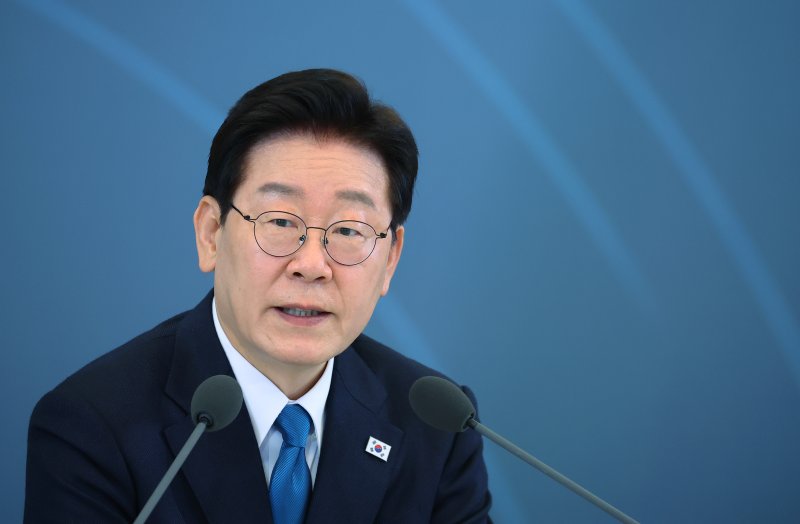
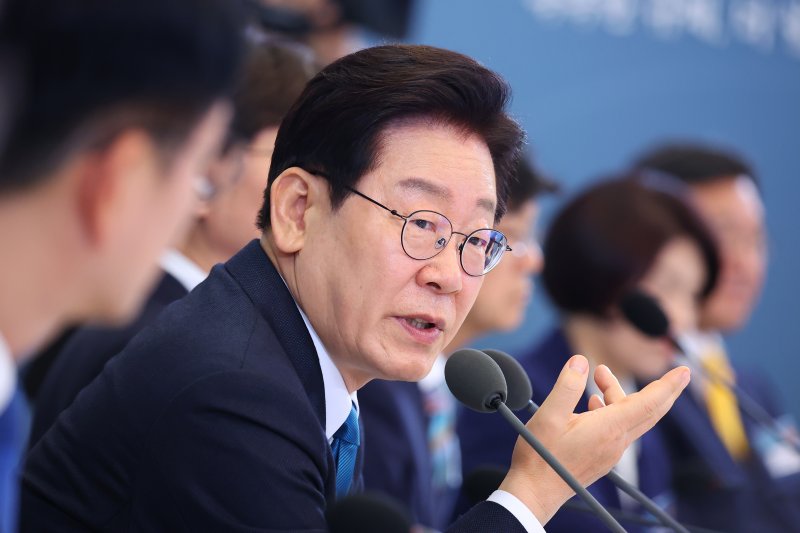
[The Financial News] President Lee Jae Myung stated on the 15th, "In the field of advanced industries, I have come to believe that we need to shift to a negative regulatory system." A negative regulatory system allows all activities except those explicitly prohibited. He was stressing that, in cutting-edge sectors, reasonable deregulation is needed to strengthen global competitiveness.
Presiding over the first plenary meeting of the Regulatory Rationalization Committee at Cheong Wa Dae that day, President Lee said, "I believe international competitiveness lies in strengthening the capabilities of individuals, companies, and industries," adding, "To that end, among the measures we can take, we need to sort out unnecessary or inefficient regulations and align our regulatory framework with global standards."
He went on, "Normally, the government decides everything. It says, 'Only do these things,' listing in a positive way what is allowed, and everything else is strictly prohibited. That is how it has been so far," and continued, "There is a reason for that. When the level of industrial development is low, the smartest group in society is, in fact, the bureaucracy. Bureaucrats can decide for everyone. But as industry and technology advance and the level of social development rises, the public sector can no longer keep up with the private sector."
He added, "The Republic of Korea (ROK) has reached that point. When public officials say, 'Only do these things,' people on the ground find they actually need to do something else. Then the rules must be changed and new approvals obtained, and in that process we lose competitiveness," arguing, "We should shift to a negative regulatory system that says, 'This is not allowed; everything else is.'"
At the same time, President Lee stressed the importance of oversight. "To be honest, even as I say this, I feel very anxious. What if an accident happens? But we have to trust," he said, adding, "In return, we need to move faster. If a problem arises, we must immediately impose a ban or bring it under control. I hope you will discuss in detail how to design regulation in that direction."
President Lee views regulatory rationalization as one of the most important ways to restore the growth potential needed to revive the ROK economy. However, he suggested differentiating regulations by region, rather than easing them uniformly nationwide.
He said, "One of the tools we have is the concept of regulatory free zones. In certain regions or sectors, we are trying to ease regulations or remove them altogether. I think it would be good to try this on a larger scale, at the regional level." Based on this, his idea is to ease the concentration in the Seoul metropolitan area and link it to balanced regional development.
President Lee continued, "The biggest problem facing the ROK right now is the concentration in the Seoul metropolitan area. Because of this concentration, the efficiency of resource allocation is falling and undermining the overall competitiveness of the country. Land prices are also far too high," adding, "Balanced regional development has now become an unavoidable survival strategy for the state to achieve long-term sustainable growth. That is why I think we should create large-scale regulatory free zones at the regional level. I ask you to consider carefully what kinds of activities could be allowed within such zones."
Meanwhile, the Regulatory Rationalization Committee was originally the Regulatory Reform Committee under the Prime Minister's Office. Emphasizing the urgency of regulatory rationalization, President Lee upgraded it in February so that the president chairs the committee. This was the first plenary meeting since the Regulatory Reform Committee was reorganized into the Regulatory Rationalization Committee after 28 years.
[email protected] Choi Jong-geun, Sung Seok-woo Reporter