President-led regulatory reform launched, full overhaul of system after 28 years
- Input
- 2026-04-15 13:43:59
- Updated
- 2026-04-15 13:43:59
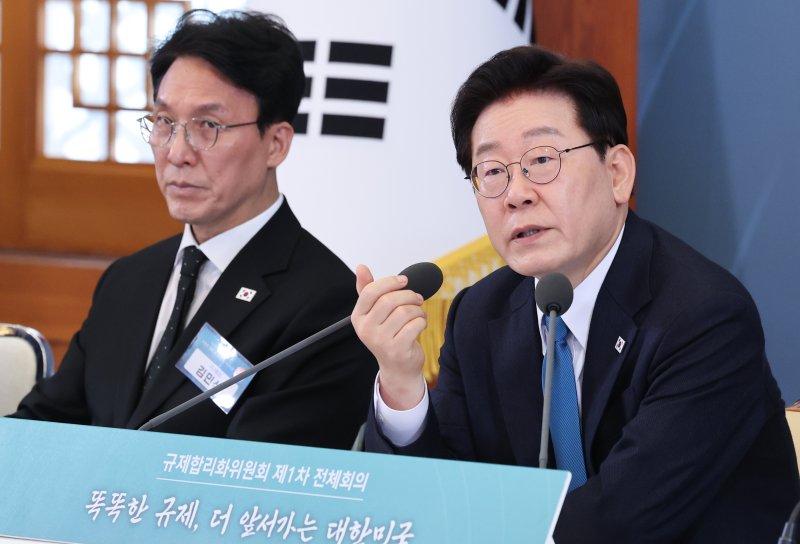
The government has launched a president-led regulatory reform drive and fully revamped its regulatory reform framework for the first time in 28 years. It plans to move away from a system focused on ex post clean-up and shift to proactive, performance-oriented regulatory management.
The Office for Government Policy Coordination announced that it held the first plenary meeting of the Regulatory Rationalization Committee at the Chungmu Room of Cheong Wa Dae on the 15th, chaired by the president. About 60 participants from the government and the private sector attended the meeting.
The core of this overhaul is the significant elevation of the status of the regulatory reform control tower. The existing Regulatory Reform Committee has been reorganized into the Regulatory Rationalization Committee, and its chair has been upgraded from the Prime Minister of South Korea to the president. A new private-sector vice chair has been created, and the committee can now include up to 50 members to expand private participation. Through this, the government intends to pursue national regulatory policy more strategically and enhance the impact felt on the ground.
The main agenda item at the meeting was the "Regulatory and Structural Reform Plan of the People’s Sovereignty Government." The government decided to promote regulatory reform around five key directions: proactive regulatory maintenance, responsiveness to changing environments, performance-based management, improving public perception, and strengthening communication with the field.
An AI-based regulatory information analysis system will be established to integrate and manage regulatory information. For emerging industries, the government plans to use future regulatory roadmaps to identify and address regulatory issues in advance.
The government will also move away from uniform, prescriptive regulation and further expand the use of negative regulation. For key industries, it will reassess regulatory levels against global standards and redesign the framework so that activities are generally permitted, with only necessary aspects managed ex post.
Performance evaluation will be revamped as well. Instead of focusing on the number of regulations abolished or eased, assessments will center on actual impact, such as industrial revitalization and regional change. The government also plans to review the appropriateness of existing regulations through ex post regulatory impact assessments.
Measures to enhance how much the public feels the effects of reform will proceed in parallel. Administrative paperwork for early-stage start-ups will be cut by more than 50%, and on-site burdens such as administrative inspections and rules will be streamlined.
At the same time, the government discussed plans to promote Mega Special Zones, a key element of the Five Poles, Three Special Zones National Balanced Growth Strategy. A Mega Special Zone is a growth hub at the metropolitan or super-regional level, designed directly by local governments and companies, with the central government concentrating regulatory exemptions and policy support there.
Within a Mega Special Zone, regulations will be applied flexibly through three mechanisms: a menu-style set of regulatory exemptions, demand-responsive regulatory deferrals, and an expanded Regulatory Sandbox. In addition, a comprehensive policy support package covering finance, taxation, talent, infrastructure, technology, and institutions will provide both investment incentives and a foundation for corporate activity.
By sector, the government presented Mega Special Zone models focused on new industries such as robotics, renewable energy, biotechnology, and AI self-driving cars.
Through Mega Special Zones, the government aims to attract anchor companies and talent, cluster specialized industries in each region, and thereby drive both regional economic growth and the development of national strategic industries.
Going forward, the committee will conduct regulatory reviews and identify new tasks mainly through its subcommittees, while key policies will continue to be discussed at plenary meetings chaired by the president. The government plans to monitor the implementation of agenda items every month to ensure they translate into tangible results on the ground.
[email protected] Jang In-seo Reporter