"K-ants Were Right"...Foreign Investors Go All-In With 5 Trillion Won on Samsung Electronics and SK Hynix, KOSPI 7,500 in Sight
- Input
- 2026-04-15 08:03:04
- Updated
- 2026-04-15 08:03:04
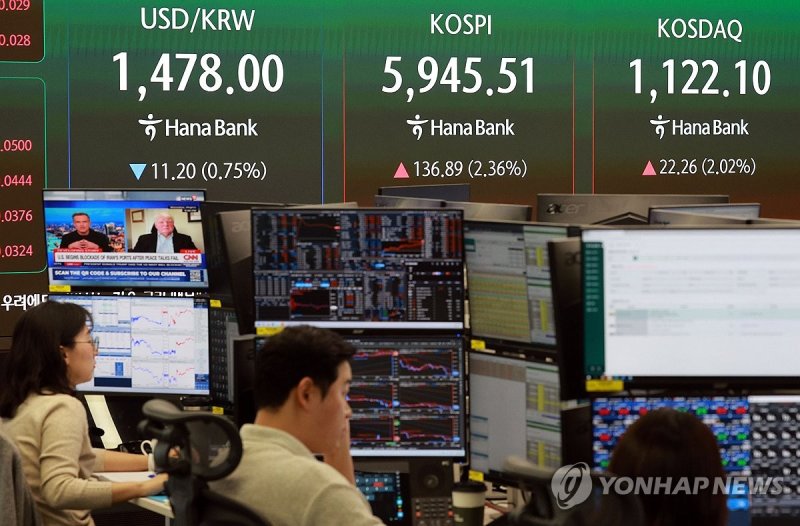
[Financial News] Foreign investors have turned into net buyers in the KOSPI Composite Index market this month. After offloading about 56 trillion won worth of shares in February and March, they have switched back to buying mode in just three months, fueling expectations of a full-fledged return.
According to the Korea Exchange (KRX) on the 14th, foreign investors recorded net purchases of 5.373 trillion won in the KOSPI Composite Index market between April 1 and 14. Previously, they had been heavy net sellers, unloading 21.073 trillion won in February and 35.881 trillion won in March, marking two straight months of large-scale selling dominance.
The shift is also clear on a weekly basis. Net selling of around 13 trillion won in the fourth week of March (March 23–27) shrank to the 6 trillion won range the following week (March 30–April 3), less than half the previous level. Then last week (April 6–10), foreign investors completely reversed course, posting net purchases of about 5 trillion won.
Foreign investors also pile into Samsung Electronics and SK Hynix...90% of net buying concentrated in two semiconductor stocks
The stocks foreign investors bought the most this month were SK hynix, at 2.873 trillion won, and Samsung Electronics, at 1.961 trillion won. Combined net purchases of these two names reached 4.834 trillion won, accounting for 90% of total net buying in the KOSPI Composite Index over the same period.
Samsung Electronics, in particular, had been a net-sold stock for three consecutive months from January through March, but buying interest returned after four months. Net purchases also flowed into Hanwha Aerospace (388 billion won), Samsung Electronics preferred shares (313 billion won), Samsung SDI (267 billion won), and Hyundai Rotem (248 billion won), in that order.
Brokerages point to strengthening earnings momentum at domestic companies as the main driver behind the foreign comeback. Han Ji-young, a researcher at Kiwoom Securities, explained, "The weakening trend in foreign net selling stems from stronger earnings momentum in the KOSPI Composite Index," adding, "Since April, the consensus forecast for this year’s KOSPI operating profit has been revised up to 772 trillion won, a 20% increase from the end of March."
Expectations for the semiconductor sector are even more concrete. Kim Dong-won, head of research at KB Securities, stated, "The memory industry is highly likely to evolve into a pre-order and post-production structure similar to Taiwan Semiconductor Manufacturing Company (TSMC)," and on that basis projected that Samsung Electronics will overtake Nvidia Corporation next year to rank first globally in operating profit. He also forecast that SK hynix’s operating profit ranking will climb from fourth this year to third next year.
Analysts also say that a two-week ceasefire agreement between the United States of America (U.S.) and Iran has eased concerns that tensions originating in the Middle East were peaking, which in turn has spurred foreign buying. Against this backdrop, Kim Dong-won predicted, "With the KOSPI entering an earnings upcycle led by semiconductors, it is poised to emerge as an attractive destination for global investors," and added, "We believe our target level for this year, 7,500 points, has now come into view."
Exchange rate and earnings sustainability remain key variables
Not everyone is optimistic. Junyeong Kim, a researcher at iM Securities, pointed out, "As long as the won–U.S. dollar exchange rate stays above 1,400 won, foreign investors’ incentives to initiate new buying will inevitably be structurally constrained." He cited overlapping factors such as inflation uncertainty driven by higher energy prices, war-related risks, and continued weakness in the Korean won.
Questions are also being raised about the sustainability of the current earnings momentum. Junyeong Kim noted, "Amid intensifying competition in High Bandwidth Memory (HBM) and concerns over a slowdown in the growth rate of artificial intelligence (AI) Capital Expenditures (CapEx), it is difficult to be confident that today’s earnings momentum can be maintained into next year."
[email protected] Kim Hee-sun Reporter