More Women in Professional and Office Jobs, While Young Men Pull Back from the Labor Market
- Input
- 2026-04-14 18:44:38
- Updated
- 2026-04-14 18:44:38
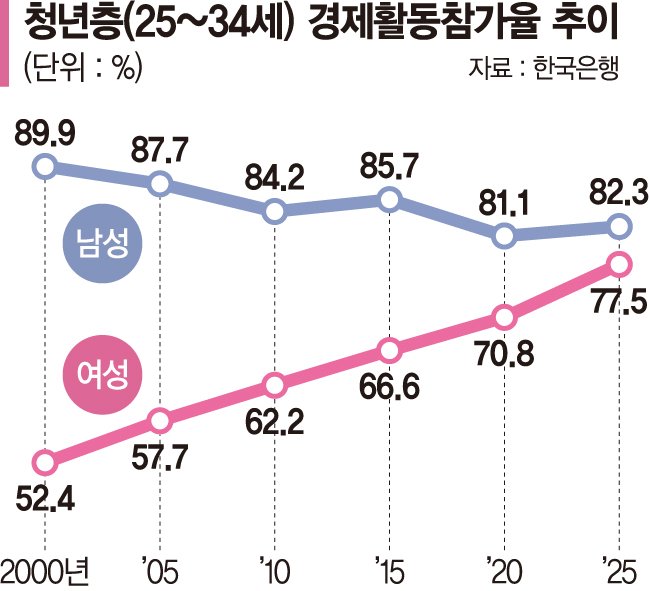
According to a report released on the 14th by the Bank of Korea (BOK) titled "Assessment of the Downward Trend in Labor Force Participation among Young Men," the labor force participation rate of men aged 25–34 stood at 82.3% at the end of last year. This is down 7.6 percentage points from 89.9% at the end of 2000. Over the same period, the participation rate for women in the same age group surged from 52.4% to 77.5%, a jump of 25.1 percentage points, shrinking the gender gap from 37.5 percentage points to 4.8 percentage points.
The BOK identified increases in the number of young men "taking time off" and "preparing for employment" as the main drivers of this trend. For men aged 25–29 between 2003 and 2025, these two categories accounted for most of the decline in labor force participation, contributing 4.8 percentage points and 4.0 percentage points, respectively. A similar pattern was observed among men aged 30–34, with contributions of 3.7 percentage points and 2.0 percentage points.
A major factor behind the shift has been the increased labor supply from highly educated women. Cohort estimates by the BOK show that the probability of labor force participation among men with a four-year college degree or higher born between 1991 and 1995 fell by 15.7 percentage points compared with those born between 1961 and 1970, while the probability for women rose by 10.1 percentage points.
Yoon Jin-young, a manager in the Employment Research Team of the Economic Research Department at the BOK, stated, "As labor supply from highly educated women has increased significantly, young men are now facing much more intense competition than before." He added, "This change in the competitive landscape has led to a rise in female employment in professional and office jobs, and these positions show a high degree of substitutability with highly educated male workers."
Changes in the industrial structure have also played a role. Medium- and low-skilled jobs in manufacturing and construction have declined. Compared with 2000, the probability of labor supply among men with an education level of junior college or below had fallen by 2.6 percentage points as of last year. In contrast, thanks to a shift in employment toward the service sector, the corresponding figure for less-educated women has actually increased.
Population aging and the spread of AI have likewise been cited as factors constraining young people’s entry into the labor market. The growing number of older workers is crowding out new hiring of younger workers, creating a displacement effect.
[email protected] Kim Tae-il Reporter