K-power equipment enjoys record boom... eyeing a 37 trillion won Middle East opportunity
- Input
- 2026-04-14 18:44:32
- Updated
- 2026-04-14 18:44:32
■ Will the 37 trillion won Middle East reconstruction market become an opportunity?
According to energy consulting firm Rystad Energy on the 14th, the cost of restoring and rebuilding energy infrastructure damaged by the Iran war is estimated at a minimum of 25 billion dollars (about 37 trillion won).
Industry officials believe that, given the significant damage to oil facilities in the Middle East, demand for power infrastructure will inevitably emerge during the reconstruction process. This is because every stage of crude oil production, refining and transportation depends heavily on large-scale electrical installations.
A power equipment industry official said, "Oil facilities require large-scale power equipment such as switchgear and transformers," adding, "If the situation in the Middle East stabilizes, demand related to damage recovery and infrastructure investment for large projects in the region, including Neom, could gain momentum."
In particular, as major Korean power equipment makers have worked for years to build their presence in the Middle East, some observers expect they could benefit from a reconstruction-driven boom.
HD Hyundai Electric is a prime example, with about 20% of its revenue coming from the Middle East. Its business report shows that last year it generated 421.2 billion won in sales from the Saudi Energy Company alone, equivalent to 10.3% of total revenue. This was the highest share among its major customers.
Hyosung Heavy Industries has also been actively expanding its Middle East energy business, including establishing a branch in the State of Kuwait following the Kingdom of Saudi Arabia. The Middle East is estimated to account for around 15% of its sales. LS ELECTRIC currently has only a small revenue share from the Middle East, but as it differentiates itself with a portfolio centered on switchgear, it is expected to gain visibility once full-scale infrastructure rebuilding begins.
An industry official explained, "If you look at Iran alone, it was already under economic sanctions even before the war, so it has not been a major market for power equipment companies," but added, "There is still some room to expect replacement demand for power grids in neighboring Gulf countries."
■ From "cost normalization" to AI-driven demand
As instability in the Middle East eases, expectations are emerging that logistics cost relief will bring "cost normalization" even before reconstruction projects begin. When the Iran war escalated in February, power equipment makers were forced to shoulder higher oil prices and additional costs from rerouted shipping lanes.
Because the sector’s product mix is heavily weighted toward bulky and heavy items such as large transformers and circuit breakers, it is particularly sensitive to logistics costs. Since higher freight rates translate directly into higher production costs, the recent easing of geopolitical risks is seen as more than just a simple demand recovery.
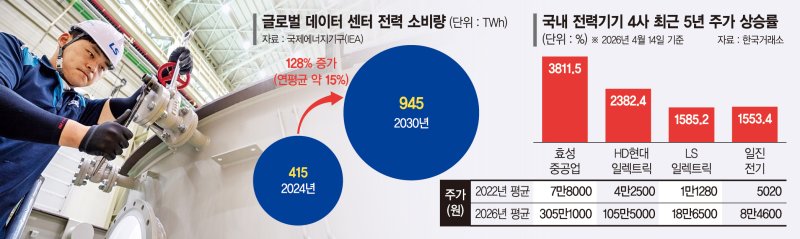
Beyond the Middle East, the global outlook is also brightening. As AI infrastructure build-out continues, analysts say the power equipment industry has entered a structural supercycle. Unlike in the past, the full-scale takeoff of the AI market is making large-scale power demand a constant feature.
In the United States of America, data center power consumption rose from 58 TWh in 2014 to 176 TWh in 2023, a threefold increase, and is projected to reach as much as 580 TWh by 2028. The European Union (EU) is also aggressively expanding infrastructure, pushing plans to increase the budget for the power segment of the Connecting Europe Facility (CEF) and other energy programs to 29.9 billion euros between 2028 and 2034, five times the current level.
These expectations are being fully reflected in the market. HD Hyundai Electric’s share price this year has surged 2,382.4% compared with 2022. Over the same period, Hyosung Heavy Industries jumped 3,811.5%, LS ELECTRIC climbed 1,553.4%, and ILJIN Electric soared 1,585.2%.
[email protected] Jung Won-il, Lee Dong-hyuk Reporter