Samsung Electronics and SK hynix dispel volatility fears as retail investors’ leveraged KOSPI bets hit record high
- Input
- 2026-04-14 18:44:15
- Updated
- 2026-04-14 18:44:15
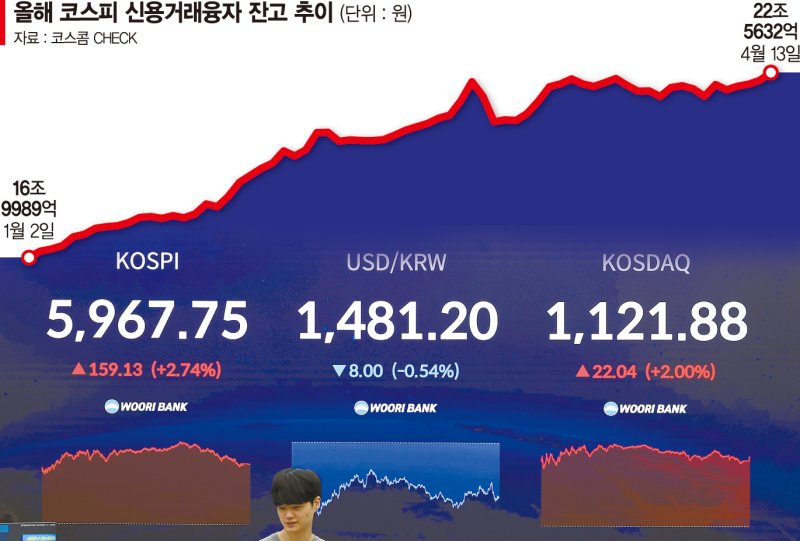
According to Koscom Corporation on the 14th, outstanding margin loans on the KOSPI Composite Index stood at 22.5632 trillion won as of the previous day, up 447.1 billion won so far this month and marking a new record high. Margin trading refers to the amount investors borrow from securities firms to buy stocks and have yet to repay.
Outstanding KOSPI Composite Index margin loans first surpassed 20 trillion won in early February and then broke through 22 trillion won last month. However, the surge lost steam as volatility spiked due to the war in the Middle East. This month, as the domestic stock market has shown resilience and continued to rebound, retail investors’ leveraged investing has swung back to a steep upward trend.
The shift toward the KOSPI Composite Index is particularly striking. Margin debt on the KOSDAQ market stands at 10.2298 trillion won, down 132.7 billion won so far this month. As a result, the KOSPI Composite Index now accounts for 68.80% of total margin trading, up 6.27 percentage points from 62.53% at the start of the year. The KOSPI Composite Index is in fact recovering faster than the KOSDAQ market. On the day, the KOSPI Composite Index closed at 5,967.75, up 159.13 points (2.74%) from the previous session. During trading it jumped to 6,026.52, reclaiming the 6,000 mark for the first time in 30 sessions. From the start of this month through the day, the KOSPI Composite Index has risen 18.12%, recouping most of last month’s 19.08% decline. By contrast, the KOSDAQ market fell 11.77% last month and has rebounded 6.60% so far this month, showing a relatively slower recovery.
Margin trading on the KOSPI Composite Index has grown sharply, centered on Samsung Electronics and SK hynix. As of the previous day, margin debt in Samsung Electronics stood at 3.4213 trillion won, roughly doubling from 1.6468 trillion won at the end of last year. Over the same period, SK hynix margin debt swelled from 882.1 billion won to 2.2793 trillion won, a 2.6-fold increase. Hyundai Motor (860.3 billion won), Doosan Enerbility (821.8 billion won), Naver (597.7 billion won) and Hanwha Ocean (401 billion won) followed.
With expectations for a market rebound building, cash waiting on the sidelines is also increasing, suggesting retail inflows are likely to become even more active. Investor deposits reached 116.1075 trillion won as of the previous day, rising by more than 5 trillion won so far this month.
Han Ji-young, a researcher at Kiwoom Securities Co., Ltd., said, "As the first-quarter earnings season has begun, there is room for further upward revisions to profit consensus. With war-related uncertainty passing its peak, there is also limited scope for the exchange rate to climb much further," adding, "Unless the worst-case scenario of a complete breakdown in negotiations between the United States and Iran materializes, a repeat of last month’s sharp market plunges is unlikely."
Foreign capital inflows are also expected to expand. Kim Dong-won, Head of Research at KB Securities Co., Ltd., noted, "As tensions in the Middle East ease, foreign investors are likely to focus on earnings and fundamentals," and added, "Interest in the KOSPI Composite Index, which currently trades at the lowest valuation relative to profitability among major global markets, is set to grow." He went on, "The KOSPI Composite Index is poised to emerge as an attractive destination for global investors, supported by government measures to revitalize capital markets, including corporate governance improvements following amendments to commercial law, and by an earnings upcycle led by semiconductors," adding, "Our KOSPI Composite Index target of 7,500 for this year now appears within reach."
[email protected] Seo Min-ji Reporter