[Editorial] With the global economy at a standstill, deregulation must revive vitality
- Input
- 2026-04-14 18:12:22
- Updated
- 2026-04-14 18:12:22
Global and Korean economic growth rates are falling in tandem. In fact, the Organisation for Economic Co-operation and Development (OECD) was the first major international organization to cut its forecast for Korea’s growth this year, from 2.1% to 1.7%. The semiconductor supercycle is propping up the current account, but structural vulnerabilities are being exposed.
Many analysts still believe that stagflation—a combination of inflation and recession—is not very likely. Yet that view rests on the assumption that the Middle East crisis will be resolved quickly and disruptions to energy supplies will remain limited. If the situation in the Middle East drags on, stagflation could easily become a reality.
The most powerful way to strengthen crisis response and economic resilience is to boost corporate competitiveness and dynamism. This was true during both the foreign exchange crisis and the global financial crisis. Although the economy fell into turmoil, it was able to recover quickly because globally competitive companies held on without losing their vitality and ultimately managed to rebound.
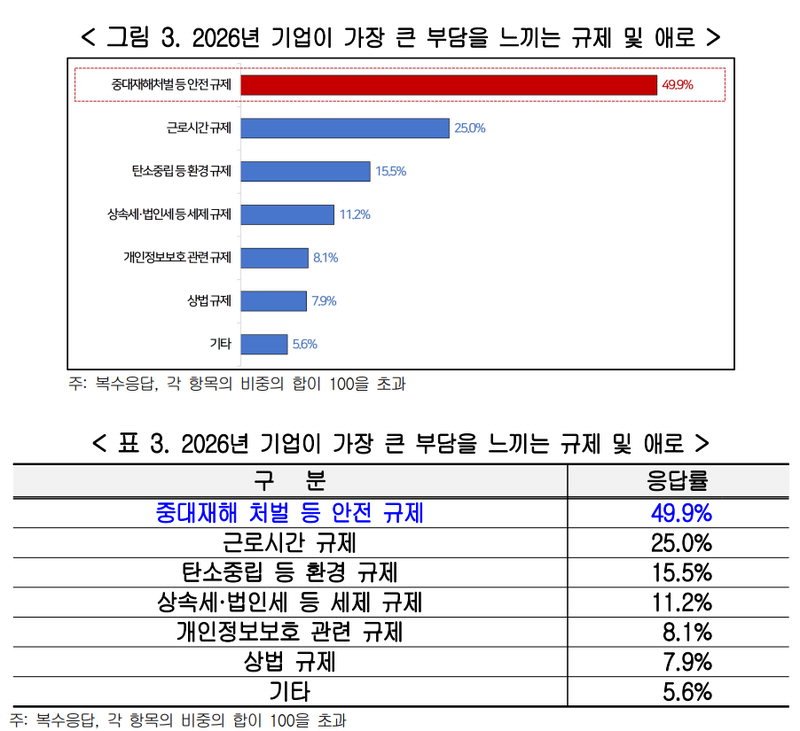
Today, Korean companies possess even greater competitiveness and energy. However, internal and external conditions are applying double pressure, pushing them into a situation where they can hardly exert themselves. Externally, they face higher tariffs and energy costs; internally, they are constrained by regulation. According to a survey by KEF, the regulation that domestic firms found most burdensome this year was the Serious Accidents Punishment Act. With the Yellow Envelope Law now in force as well, the business outlook has become even more opaque. If these two laws tighten around companies at the same time, the regulatory burden felt on the ground will grow far heavier.
No one can predict where the global economy is headed, even in the near term. In such a time of crisis, only companies can play the role of savior. Yet instead of easing regulations that shackle businesses and injecting new vitality, the state is tightening the rules even further. Under these conditions, how can companies possibly demonstrate their competitiveness? From now on, the government must pursue policies that create an environment in which businesses can operate freely. It should slow the pace of unnecessary regulation and provide generous support so that companies can expand their markets and grow without restraint.
In times of crisis, companies tend to shift from aggressive investment to defensive management. They seek survival by restructuring their operations and cutting jobs. This, in turn, triggers a vicious cycle in which economic growth slows even further. When regulation and pressure sap corporate vitality, it becomes increasingly difficult for the national economy to escape from crisis.
The government’s role is all the more crucial in fostering corporate dynamism. What is urgently needed is a proactive policy framework that combines deregulation with support measures. For the Korean economy to avoid falling into crisis and instead move forward amid global uncertainty, the first step must be to loosen the noose of regulations that bind companies. Crises always become opportunities for those who are prepared, and those who are prepared are precisely the companies brimming with vitality. The government must put an end to the current contradiction in which it claims to revive the economy while rolling out policies that actually sap corporate energy.