Export and import prices see biggest jump in 28 years: How much did oil prices rise?
- Input
- 2026-04-15 06:00:00
- Updated
- 2026-04-15 06:00:00

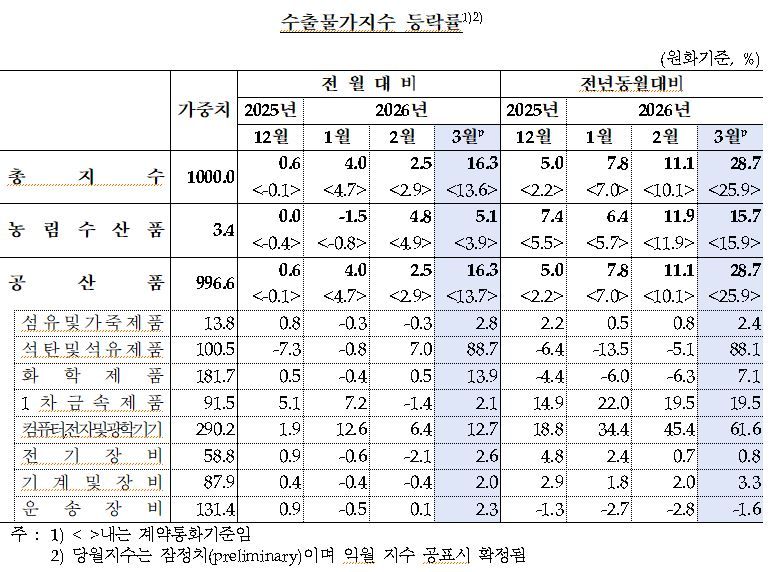
According to the "Export and Import Price Index and Trade Index for March 2026" released by the Bank of Korea (BOK) on the 15th, the export price index in won terms rose 16.3% in March from a month earlier. This index has been climbing for nine straight months since it began rising in July last year (0.8%). In particular, the latest increase is the largest in 28 years and two months, since January 1998, when it jumped 23.2%.
On a year-on-year basis, the export price index rose even more sharply, up 28.7%. It has been increasing for seven consecutive months since last September.
Manufactured goods, which climbed 16.3% from the previous month, had a major impact on the overall rise. Among them, coal and petroleum products soared 88.7%.
Computer, electronic and optical equipment, which includes semiconductors, also posted a high increase of 12.7%. Looking at semiconductors separately, DRAM prices jumped 21.8% from the previous month, while flash memory rose 28.2%. Compared with a year earlier, these figures surge to 167.4% and 189.0%, respectively.
Agricultural, forestry and fishery products rose 5.1% from the previous month.
Excluding exchange rate effects, export prices in March based on contract currencies increased 13.6% from a month earlier. They were up 25.9% compared with the same month a year ago.
The rise reflected simultaneous increases in the won–dollar exchange rate and global oil prices. The average monthly exchange rate climbed from 1,449.32 won in February to 1,486.64 won in March, while Dubai crude oil prices jumped from 68.40 dollars per barrel to 128.452 dollars.
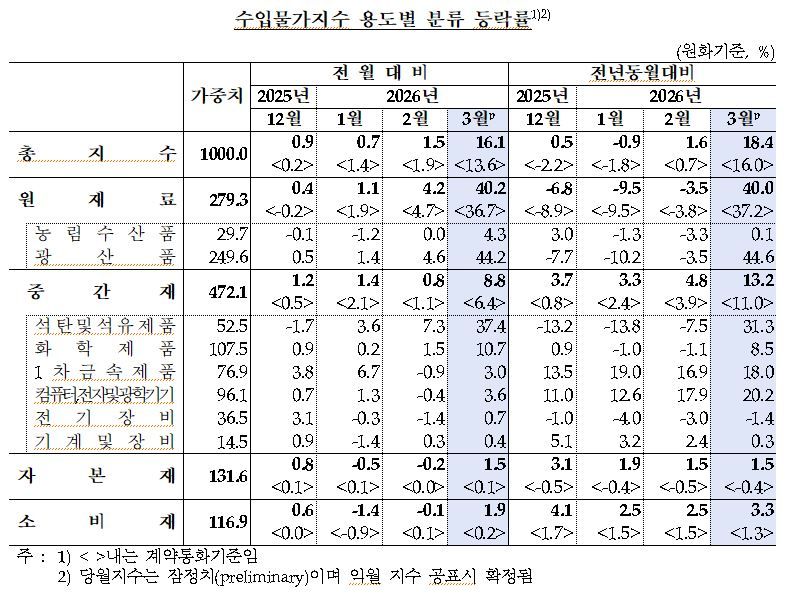
As a result, prices of raw materials rose 40.2%, driven by a 44.2% increase in mining products such as crude oil. Within mining products, crude oil prices surged 88.5%, the highest rate since related statistics began in 1985, roughly 41 years ago. On a contract-currency basis, this is the largest jump in 52 years and two months, since January 1974 during the First Oil Shock, when prices rose 98.3%.
Intermediate goods also increased 8.8%, led by coal and petroleum products (37.4%) and chemical products (10.7%). Capital goods and consumer goods rose 1.5% and 1.9%, respectively.
On a contract-currency basis, import prices were up 13.6% from the previous month and 16.0% from a year earlier.
Lee went on to say, "If the war is prolonged, the impact of high oil prices and disruptions in raw material supplies could spread across the broader economy, increasing upward pressure on consumer prices."
In March, the export volume index jumped 23.0% year-on-year, driven by a 39.5% increase in computer, electronic and optical equipment. Over the same period, the export value index rose 51.7%.
The import volume index also climbed 12.3% from a year earlier, boosted by a 24.6% increase in computer, electronic and optical equipment and other items. The import value index rose 12.9%.
The net barter terms of trade index, which measures the quantity of goods that can be imported per unit of exports, increased 22.8% year-on-year. This was because export prices, up 23.4%, rose much more than import prices, which gained only 0.5%. Compared with the previous month, the index was up 9.0%.
The income terms of trade index jumped 50.9% from a year earlier, as both the net barter terms of trade index (22.8%) and the export volume index (23.60%) rose over the same period. The income terms of trade index measures an economy's ability to increase imports based on its export earnings. When this index rises, it indicates that the quantity of imports that can be purchased with total export revenues has improved.
[email protected] Kim Tae-il Reporter