U.S. boasts of reduced trade deficit with Korea, praises Seoul as a "strategic partner"
- Input
- 2026-04-14 15:49:22
- Updated
- 2026-04-14 15:49:22
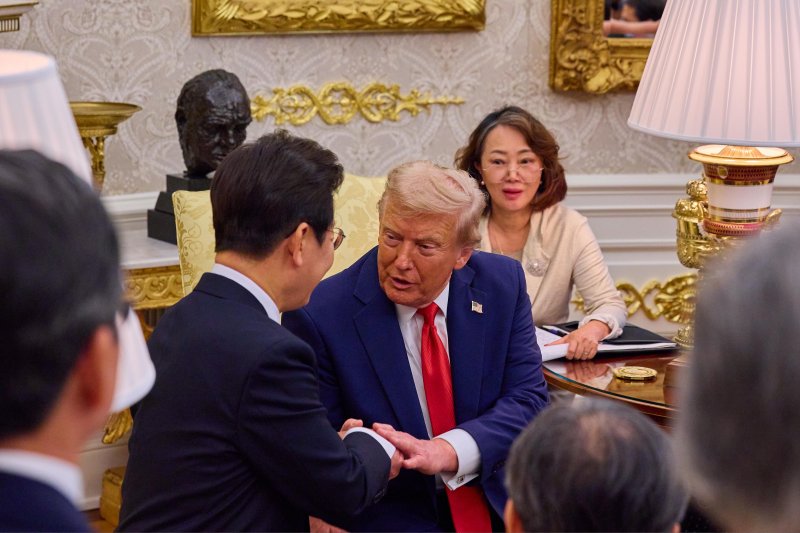
According to The Financial News, the Donald John Trump administration, about six months before this year’s midterm elections, has released a report promoting its economic achievements since taking office last year. In the report, the Trump administration refers to the Republic of Korea (ROK) as a "core partner," while also boasting that the U.S. trade deficit with ROK has narrowed.
The White House Council of Economic Advisers (CEA) on the 13th (local time) posted the "2026 Economic Report of the President" on the White House website. In the report, the Council of Economic Advisers (CEA) stresses that the Trump administration’s key growth strategies are tax cuts, deregulation, protectionist trade policies, and expanded energy production. At the same time, it claims that during the Trump administration’s tenure, the U.S. significantly reduced its trade deficit with foreign countries.
According to the report, the U.S. average monthly goods trade deficit was 101 billion dollars in 2024, but had fallen to 87 billion dollars (about 128 trillion won) by November 2025. In particular, the total value of goods imported from China between January and October last year decreased by 97.1 billion dollars from a year earlier, a drop of 26.7%. The share of Chinese imports in total U.S. imports also declined from 13.4% to 9.3% over the same period. The CEA emphasizes that imports from countries other than China also fell sharply, citing Canada (down 20 billion dollars, -5.8%), Germany (down 6.4 billion dollars, -4.8%), ROK (down 5.7 billion dollars, -5.2%), and the Republic of Singapore (down 4.7 billion dollars, -12.9%).
By contrast, exports to the U.S. increased for Taiwan (up 59.6 billion dollars, 61.5%), Switzerland (up 54.4 billion dollars, 125.3%), Vietnam (up 45.5 billion dollars, 40.4%), Ireland (up 39.8 billion dollars, 46.8%), and Mexico (up 23.9 billion dollars, 5.6%).
While asserting that its trade balance with ROK has improved, the CEA also underscores that the U.S. and ROK are cooperating in trade and investment, artificial intelligence (AI), and energy. In the report, it describes the relationship with ROK as a "strengthened economic partnership" and a "core strategic partner." Chapter 3 of the 14-chapter report, titled "Rebuilding America’s International Trade Policy," contains subsections explaining U.S. trade relations with the European Union (EU), Japan, the United Kingdom, Taiwan, ROK, and the Indo-Pacific. In the subsection "Deepening the U.S.–ROK Partnership," the CEA claims the two countries concluded a strengthened Economic Partnership Agreement (EPA) in November last year. This refers to ROK’s investment commitments in the U.S. that the two leaders agreed to in October. The CEA states that ROK will invest 200 billion dollars in sectors essential to U.S. economic security and 150 billion dollars in the U.S. shipbuilding industry.
In addition, in Chapter 4, "energy hegemony," the CEA notes that the ROK government pledged on July 31 last year to invest more than 100 billion dollars to purchase U.S. energy products. In Chapter 8, "defense industry," it lists ROK alongside Australia, the State of Israel, and Japan as one of the U.S. four core allies. Chapter 5, "AI revolution," points out that when comparing Research and Development (R&D) spending as a share of gross domestic product (GDP), ROK ranks second in the world at 5.2%, behind only the State of Israel at 6%. The CEA also notes that in the race for cutting-edge AI models, the U.S., China, France, ROK, the United Kingdom, Canada, and the State of Israel stand out.
The Associated Press (AP) focuses on housing issues in its coverage of the report. The CEA argues that easing various regulations to lower housing construction costs could spur the building of up to 13.2 million homes. AP assesses that the Trump administration had sought to focus on housing and the cost of living ahead of the November midterm elections, but lost that focus due to international crises such as the war with Iran. The Wall Street Journal (WSJ) points out that although the Trump administration has opposed Diversity, Equity, and Inclusion (DEI) policies, the report nevertheless analyzes DEI and industrial productivity.
[email protected] Park Jong-won Reporter