Electricity to Be Cheaper During the Day and More Expensive in the Evening from the 16th
- Input
- 2026-04-14 12:00:00
- Updated
- 2026-04-14 12:00:00
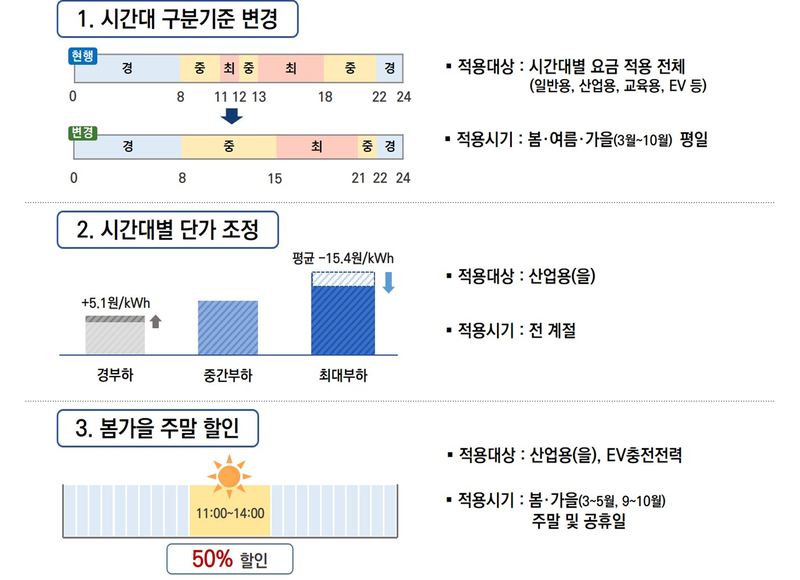
The government will overhaul the electricity pricing system to encourage power use during the daytime and reduce the evening peak load burden. The strategy is to lower rates when solar power generation is abundant during the day and raise them in the evening, when demand is concentrated, in order to change consumption patterns themselves.
On the 13th, the Ministry of Climate, Energy and Environment announced that the "seasonal and time-of-use electricity tariff reform plan" will take effect from the 16th.
The core of this reform is a readjustment of the time-of-use rate brackets. The peak rate (maximum load period), which had applied on weekdays from 11 a.m. to 3 p.m., will be lowered to a mid-level rate, while the 6 p.m. to 9 p.m. period will instead be raised to the peak rate.
In addition, on weekends and public holidays in spring and autumn, the electricity usage charge between 11 a.m. and 2 p.m. will be discounted by 50%. The government expects this to maximize the use of power generated by solar power generation and reduce reliance on liquefied natural gas (LNG) power generation in the evening.
The government also expects this measure to help address energy supply instability stemming from the prolonged war in the Middle East. By using surplus electricity during the day, it can cut back on LNG power generation, which is relatively more expensive.
The reform plan will first apply to the industrial electricity tariff and to electric vehicle charging rates. The industrial electricity tariff is the rate system for large-scale facilities, which account for about 46% of total power consumption.
The government expects that, with this reform, industrial power demand will gradually shift toward daytime hours. For the industrial electricity tariff as a whole, the average rate reduction is projected to be about 1.7 won per kWh.
During the process of drafting the reform plan, industry representatives said they needed additional preparation time. Reflecting this, applications for a grace period were accepted from March 23 to April 10. As a result, 514 facilities, or about 1.3% of the total, applied for deferral. Some sectors such as food products, primary metals, and non-metallic minerals were included, but the government assesses that decisions were made based on each company’s power usage structure rather than being concentrated in specific industries. Companies that applied for a grace period will have until September 30 to prepare, and the new rates will apply to them from October 1.
Electric vehicle charging rates will also change. From April 18, charging fees will be discounted by 50% during daytime hours on spring and autumn weekends. The discount will be applied immediately at about 94,000 private chargers and around 13,000 public fast chargers, resulting in savings of up to 40–48 won per kWh.
For general and educational users, the reform plan will take effect from June 1. The scope of seasonal and time-of-use rates will also be expanded for residential customers. Regarding regionally differentiated tariffs, the government is comprehensively reviewing evaluation factors and plans to present a concrete direction in the second half of the year.
[email protected] Park Ji-young Reporter