"KOSPI 6,000 today"... Retail investors who bet 1 trillion won despite failed talks, semiconductor stocks surge in pre-market session
- Input
- 2026-04-14 08:42:14
- Updated
- 2026-04-14 08:42:14
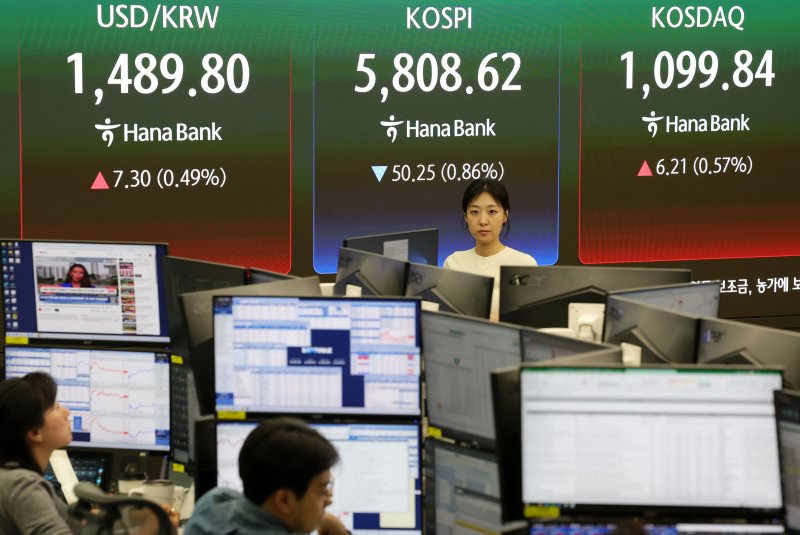
[The Financial News] With the possibility of renewed talks between the United States of America (USA) and the Islamic Republic of Iran back in focus, the domestic stock market was up more than 2% in the pre-market session on the 14th.
Pre-market jumps 2.4%... Samsung and SK hynix rally
According to alternative trading system (ATS) NextTrade, the pre-market session was up 2.40% as of 8:07 a.m. on the 14th. Samsung Electronics and SK hynix were leading the gains, rising in the 2% and 3% ranges, respectively, and pushing the index higher.
On the previous day, when the first cease-fire talks between the USA and the Islamic Republic of Iran broke down, retail investors bought more than 1 trillion won in the domestic stock market, helping to support the lower end of the index.
Buoyed by this buying, the KOSPI Composite Index, which had been down more than 2% during the session, recovered to close at 5,808.62, up 50.25 points (0.86%) from the day before. Although the cease-fire negotiations, which had served as a driver of the market rebound since the truce on the 7th, ultimately ended in failure, the index’s smaller-than-feared decline is seen as having mitigated the shock.
Earlier, on the 12th (local time), the USA and the Islamic Republic of Iran held a 21-hour marathon round of talks in Islamabad, Pakistan, but failed to narrow their differences over nuclear abandonment and reopening of the Strait of Hormuz, leading to a breakdown. On the news, the index plunged more than 2% early in the session, but within about 30 minutes of the open, it had pared losses to within 1% and managed to hold the 5,800 level.
Retail investors were the main force cushioning the blow. The previous day, individuals recorded net purchases of 750 billion won on the main board and 264 billion won on the KOSDAQ market, for a combined 1.014 trillion won. The KOSDAQ market also opened down more than 1% but reversed into positive territory during the session, moving close to the 1,100 level.
Notably, they poured about 350 billion won into Samsung Electronics alone, roughly half of all individual net buying on the KOSPI Composite Index. This heavy concentration in Samsung Electronics is seen as a sign that bargain-hunting picked up after earnings were confirmed. Even though the company reported record-high preliminary first-quarter results, the share price did not respond accordingly, which retail investors appear to have interpreted as a justification to buy the stock as undervalued.
Judgment that failed talks do not alter the cease-fire trajectory
This wave of individual buying is interpreted as reflecting the view that, despite the breakdown in talks, the overall direction toward a cease-fire remains intact. After the talks collapsed, U.S. Vice President J. D. Vance said at a press conference, "We are leaving behind our best offer," leaving room for further negotiations, while Iranian state media also reported that "talks will continue." The fact that neither side declared a complete breakdown has helped to limit market anxiety.
Experts likewise view the failure as a temporary setback in the negotiation process rather than a signal of a prolonged war. Lee Kyung-min, a researcher at Daishin Securities, noted, "We have confirmed sharp confrontation between the USA and the Islamic Republic of Iran over nuclear-related talks, the resumption of traffic through the Strait of Hormuz, and the extent of sanctions relief," but added, "This should be seen as part of the negotiation process toward a cease-fire. The goal of a cease-fire agreement remains valid, so volatility in the stock market during the talks should be viewed as an opportunity to increase exposure."
"Entering a protracted war phase... volatility may have already peaked"
Lee Sang-yeon, a researcher at Shinyoung Securities, also stated, "Given that we are entering a phase of prolonged conflict, it is highly likely that overall asset-market volatility has already passed its peak." He argued that using index declines driven by geopolitical risk as a medium- to long-term buying opportunity remains a valid strategy.
Alongside geopolitical risk, fundamentals such as earnings and economic momentum are drawing close attention. South Korea’s exports in March jumped 48.3% year-on-year to a record monthly high of 86.1 billion dollars. Semiconductor exports reached 32.8 billion dollars, surging 151.4% from a year earlier and, for the first time ever, breaking through the 30 billion dollar mark in a single month.
Kim Doo-eon, a researcher at Hana Securities, said, "This suggests not just a simple price rebound, but an improvement in both volume and price." He stressed, "The higher the uncertainty, the more capital moves from narratives to numbers. Right now, the clearest numbers are in semiconductors."
[email protected] Kim Hee-sun Reporter