Samsung Hikes HBM ‘Brain Chip’ Prices by 50%... Is Its Non-Memory Business Finally Escaping the Red?
- Input
- 2026-04-13 18:32:23
- Updated
- 2026-04-13 18:32:23
In particular, the logic die price hikes, combined with growing demand for advanced process nodes, are fueling expectations that the business could swing to profit in the second half of this year.
■ Foundry chip prices are rising
According to industry sources on the 13th, the price of logic dies produced on Samsung Electronics’ 4-nanometer (nm, one nanometer is one-billionth of a meter) foundry process for HBM4 high-bandwidth memory (HBM4) has been raised by roughly 40–50% compared with previous levels since the start of this year.
The logic die is the key chip that acts as the “brain” of HBM4. As Samsung Electronics ramps up shipments of HBM4, demand for these logic dies is rising in tandem, which in turn has strengthened the company’s hand in price negotiations.
An industry insider said, "The unit prices that had been kept low for some time have recently been brought back to normal levels."
Samsung’s foundry business has been winning major orders from big tech companies since last year, steadily broadening its customer base. In 2023 it signed a contract worth about 23 trillion won with Tesla to manufacture the US company’s latest AI chips, and it plans to start producing those chips on a 2-nanometer advanced process at its Taylor, Texas, plant at the end of this year. As some orders that had been concentrated at Taiwan Semiconductor Manufacturing Company (TSMC) are now seen as potentially shifting to Samsung, many in the industry expect new foundry orders to increase this year.
“The customer orders secured last year will start to be reflected sequentially from this year,” another industry source noted, adding, “Key lines such as 4-nanometer are running at full capacity, and profitability is gradually improving.”
■ Rising expectations for Exynos 2700 performance
Following the foundry business, the System LSI Business Division is also showing signs of a rebound. This year’s earnings are expected to benefit from the performance of the Exynos 2600, which has been adopted in flagship models such as the Samsung Galaxy S26 and S26+. The Exynos 2600 is a mobile application processor (AP) designed by the System LSI Business Division and manufactured on the foundry’s 2-nanometer process.
Last year, the Exynos 2500 failed to make it into the Galaxy S25 lineup, dealing a blow to System LSI and related units. This year, however, analysts say that broader use of Samsung’s in-house chips will help cushion results. Expectations are also rising as early assessments suggest that the next-generation AP under development, Exynos 2700 (code-named Ulysses), offers significantly improved power efficiency—performance per watt—compared with rival products. That said, with the smartphone market slowing and costs rising, overall demand for mobile APs has weakened, making the acquisition of external customers the key variable for a full-fledged rebound.
With foundry price hikes and expanding orders, along with successful chip designs at the System LSI Business Division, Samsung’s profit structure is improving at a rapid pace.
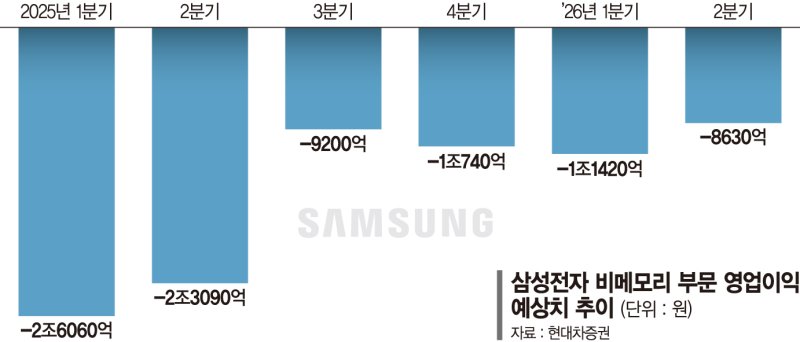
According to securities firms, operating losses in Samsung Electronics’ non-memory semiconductor segment shrank from 2.606 trillion won in the first quarter of last year to about 920 billion won in the third quarter. Losses that temporarily widened afterward have since returned to a downward trend. This year, the loss is estimated at around 1.142 trillion won in the first quarter and is projected to narrow further to the 800 billion won range in the second quarter.
[email protected] Reporter Lim Su-bin Reporter