Dormant Treasury Shares Unlocked as EB Exercises Reach 860 Billion Won [EB Exercises Instead of Share Cancellations]
- Input
- 2026-04-13 18:29:55
- Updated
- 2026-04-13 18:29:55
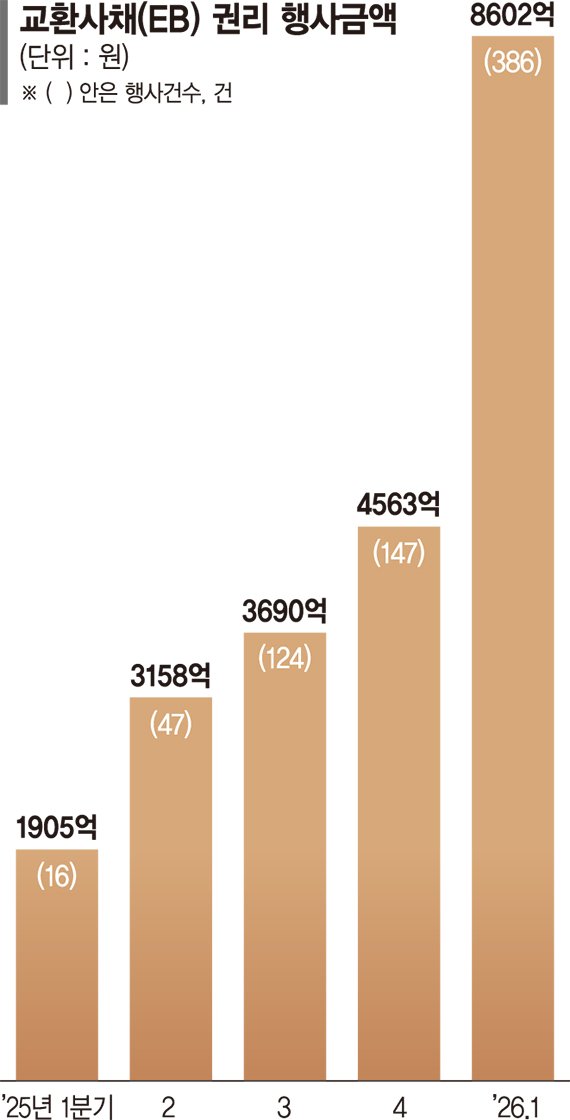
According to the securities industry on the 13th, the value of EB exchange rights exercised in the first quarter of this year reached 860.2 billion won. This is four times the 190.5 billion won recorded in the same period last year and marks the largest quarterly figure on record. An exchangeable bond is a corporate bond that can be exchanged for treasury shares held by the issuer or shares of a third party. After the KOSPI Composite Index settled above the 5,000 level, more stocks traded above their exchange prices, prompting investors to convert EBs into shares to lock in capital gains.
Changes to the rules on treasury shares have also played a significant role. Last month, the National Assembly of the Republic of Korea passed the Third Amendment Bill to the Commercial Act, which requires companies to cancel treasury shares within one year. As a result, firms now face greater constraints on holding treasury shares for long periods or using them strategically, leading to more EB issuances backed by treasury shares for investors, including friendly shareholders, and to more exchange rights being exercised as share prices rise. In practice, EB exercises have been concentrated among companies that issued EBs with treasury shares as the underlying. Dormant treasury shares are starting to return to the market, with SK Innovation, Harim Holdings and EcoPro among the most notable examples.
Market participants believe that the large volume of EB exchanges concentrated in the first quarter has increased short-term supply-demand pressure and contributed to greater share price volatility. Due to such concerns, a number of companies have already scrapped planned EB issuances. Taekwang Industrial, for example, planned to issue 320 billion won in EBs in November last year but withdrew the plan amid a falling share price and criticism that it would hurt shareholder value. Kwangdong Pharmaceutical likewise canceled a 25 billion won EB issuance plan announced in October last year. In effect, both companies stepped back from moves to dispose of treasury shares.
More than 200 listed companies canceled treasury shares in the first quarter of this year alone. Analysts say this reflects a structural shift in treasury share policies, driven by the amendment to the Commercial Act of the Republic of Korea and the South Korean government’s Corporate Value-up Policy. According to Sustinvest, only 64 listed companies canceled shares in 2021, but that number jumped to 102 in 2023, 165 in 2024 and 240 in 2025. With the pace of cancellations accelerating this year, the total is expected to reach a new all-time high.
A representative at Sustinvest stated, "Institutional compulsion lies at the heart of these changes," adding, "The recently implemented Third Amendment Bill to the Commercial Act mandates that newly acquired treasury shares be canceled within one year, and existing treasury shares within one year and six months." The representative went on to say, "Even within this grace period, around 50 listed companies announced treasury share cancellations in the two weeks immediately after the bill passed, proactively making decisions in line with the policy direction."
[email protected] Kim Hyun-jung Reporter