Kazakh Crude Gains Traction with Lower Costs and No Strait of Hormuz Route [Oil Prices Surge Again]
- Input
- 2026-04-13 18:21:18
- Updated
- 2026-04-13 18:21:18
■ Government accelerates ‘move away from the Middle East’
According to industry sources on the 13th, the government has begun in earnest to expand imports of non-Middle East crude, including from Kazakhstan. Kim Jeong-kwan, Minister of Trade, Industry and Energy of South Korea, appeared on the KBS current affairs program Sunday Diagnosis Live the previous day and stated, "Talks on importing Kazakhstan crude have made significant progress," adding, "We expect to announce specific volumes and details early next week."
Kim recently visited Kazakhstan from the 7th as part of a government delegation that included Kang Hoon-sik, Chief of Staff to the President of the Republic of Korea, and returned on the 10th. He noted, "Kazakhstan may feel geographically distant, but the shipping time for crude is similar to that from the United States, at around 50 to 60 days," and emphasized, "We are now in an era where securing the resources themselves is more important than price."
The government has mobilized commercial officers at overseas missions, the Korea Trade-Investment Promotion Agency (KOTRA) trade offices, and foreign branches to secure alternative supplies of crude oil, natural gas, and naphtha. As diversifying the supply chain away from a Middle East–centric structure becomes a core task, efforts are under way in parallel to expand sourcing from the United States, Kazakhstan, Greece, Algeria, and other countries.
Actual imports have already begun. GS Caltex recently brought in about 1 million barrels of Kazakhstan crude via the Caspian Pipeline Consortium (CPC). This volume is enough to fill the fuel tanks of roughly 1 million mid-size cars. The crude was shipped from a tanker departing the Port of Novorossiysk on Russia’s Black Sea coast and arrived on April 8 at the crude oil pier in Yeosu, South Jeolla Province.
■ Kazakh crude: strengths in supply routes and pricing
Kazakhstan is a resource-rich Central Asian country with proven crude oil reserves of about 4 billion tons, ranking 12th in the world, and 3.8 trillion cubic meters of natural gas, placing it 15th. Its annual crude production is expected to expand to around 100 million tons in the coming years.
Its supply routes are considered a particular strength. Roughly 70–80% of Kazakhstan crude is transported through the Caspian Pipeline Consortium (CPC) pipeline, which runs from oil fields near the Caspian Sea to the Port of Novorossiysk on Russia’s Black Sea coast, and is then exported. Because this route does not pass through the Strait of Hormuz, it is relatively insulated from geopolitical risks such as military clashes or maritime blockades originating in the Middle East.
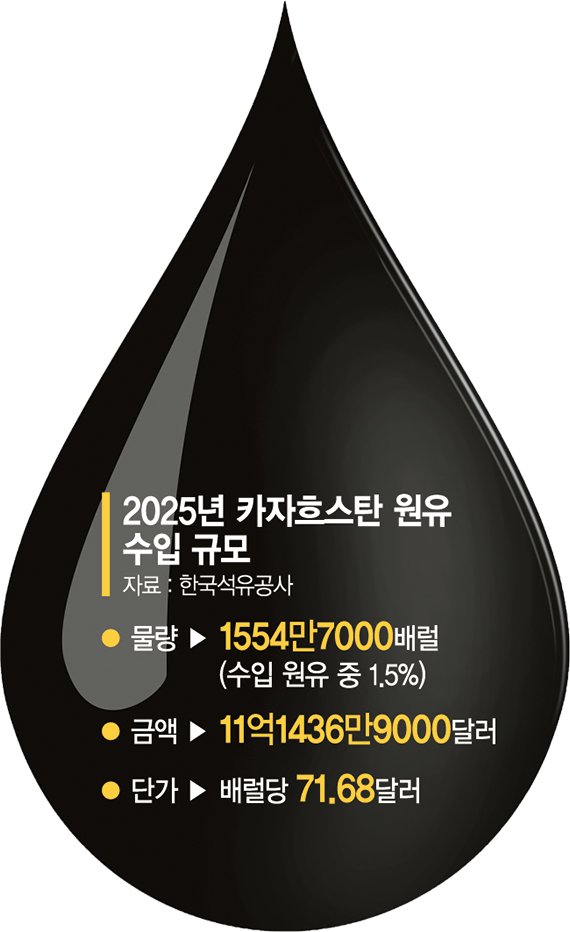
Its price competitiveness is also clear. The average price of Kazakhstan crude stands at $71.68 per barrel, lower than the Kingdom of Saudi Arabia (KSA) at $73.80, the United Arab Emirates (UAE) at $75.11, and the United States at $73.64. While transportation and refining costs must be considered, analysts say the basic import price is attractive.
Korea’s crude import structure is already shifting. The share of Middle East crude fell from 86% in 2016 to 69.6% last year, while the portion from the United States jumped from 0.21% to 16.3%. Kazakhstan crude still accounts for only about 1.5%, but many expect this share to grow.
There are, however, limitations on the refining side. Kazakhstan crude is predominantly light crude, which yields higher volumes of gasoline and naphtha but relatively less diesel and kerosene. Experts point out that domestic refineries, which are optimized to process heavy crude from the Middle East, may see somewhat lower efficiency when running Kazakhstan crude.
Even so, the industry is placing greater weight on the need to diversify supply sources. An industry official said, "We already have some experience importing Kazakhstan crude, and it is significant that the route does not pass through the Strait of Hormuz," adding, "At this stage, securing stable volumes is more important than maximizing refining efficiency."
solidkjy@fnnews.com Gu Ja-yoon Reporter