"Rearm During the Truce": Middle East States Urgently Ask South Korea and Others for Weapons Supplies [U.S.: "Strait of Hormuz Blockade"]
- Input
- 2026-04-13 18:20:42
- Updated
- 2026-04-13 18:20:42
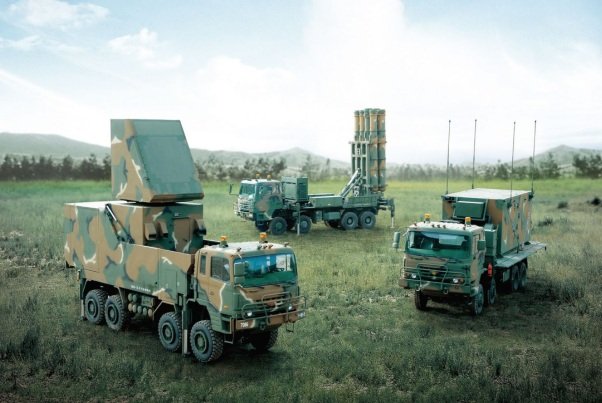
On the 13th (local time), The Wall Street Journal (WSJ) reported that, amid a fragile cease-fire between the United States and the Islamic Republic of Iran (Iran), Gulf states in the Middle East such as the Kingdom of Saudi Arabia (KSA) and the United Arab Emirates (UAE) are turning to Republic of Korea (South Korea)-made missile defense systems and Ukraine-style counter-drone technology.
Saudi Arabia has recently asked South Korea’s Hanwha Group and LIG Nex1 whether deliveries of the Cheongung medium-range surface-to-air missile system (M-SAM), a medium-range surface-to-air missile system, can be brought forward, according to reports. The M-SAM medium-range surface-to-air missile system can intercept drones, missiles, and aircraft, and the UAE has already proven its performance in combat by using it to shoot down weapons launched from Iran. Saudi Arabia is also in contact with Japan, a producer of the MIM-104 Patriot interceptor missile, as it pushes hard to diversify its sources of supply.
Middle East countries have become so anxious because the regional situation is too unstable for them to simply wait and rely on U.S.-made systems. The Donald Trump administration approved arms sales worth 23 billion dollars (about 34 trillion won) to the UAE, the State of Kuwait, and the Hashemite Kingdom of Jordan, but actual delivery is expected to take years. In particular, the MIM-104 Patriot system has been in extremely short supply worldwide due to the Russo-Ukrainian War, and Switzerland has recently even considered canceling its order over delivery delays.
Beyond traditional missile defense systems, more creative alternatives are being introduced one after another. The relentless waves of low-cost Shahed drone suicide attacks from Iran have created an urgent need for cost-effective defensive measures.
Saudi Arabia and Qatar have recently signed defense cooperation agreements with Ukraine. Qatari officials have visited Ukraine’s drone-interception training grounds and are exploring the purchase of interceptor drones and electronic warfare equipment from local companies.
However, the defense industry’s production capacity is struggling to keep up with the explosive surge in demand. Adrienne Rabié, an analyst at AllianceBernstein, noted, "New facility investments have begun, but they are far from sufficient to meet the current intensity of demand."
As a result, the key variable for security in the Middle East is how quickly countries can secure alternatives that can be deployed in the field, moving away from an exclusively U.S.-centric weapons mix. In this process, the position of South Korean defense companies, which offer proven performance and relatively fast delivery, is expected to strengthen further.
Last week, the government of the United Kingdom of Great Britain and Northern Ireland (UK) announced that domestic start-up Cambridge Aerospace will supply low-cost short-range missiles to Gulf states.
Inquiries are also pouring in for Raytheon’s Phalanx Close-In Weapon System (CIWS), produced by RTX Corporation. Truck-mounted, machine-gun-based weapons of this type have proven to be the cheapest and most effective means of shooting down drones in Ukraine.
WSJ reported that the mood at a meeting last month between Gulf state officials and defense contractors, held at a military base near Buckingham Palace in the UK, was one of urgency.
Luke Pollard, the Parliamentary Under-Secretary of State for Defence, was quoted as asking company representatives, "What can you deliver immediately within 30, 60, or 90 days?"
[email protected] Yoon Jae-joon Reporter