Warning Lights Over EB Exercise Overhang: "Share Price Under Pressure" [EB Exercise Instead of Share Cancellation]
- Input
- 2026-04-13 18:17:44
- Updated
- 2026-04-13 18:17:44
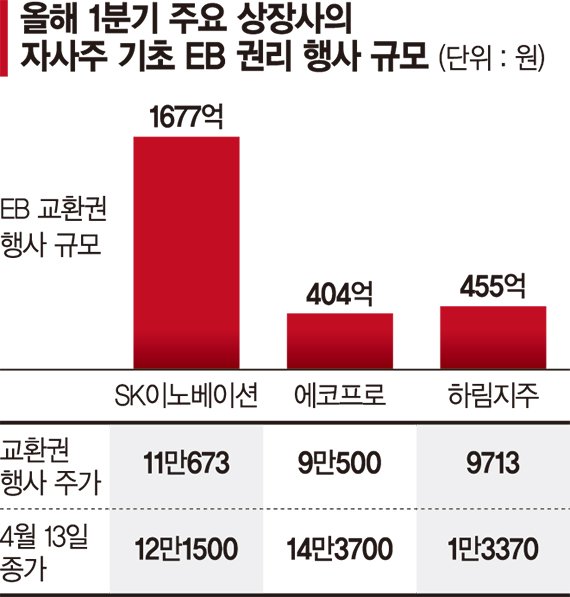
According to the securities industry on the 13th, SK Innovation, EcoPro and Harim Holdings have all exercised exchange rights this year on EBs issued on the basis of their treasury shares. SK Innovation exercised EB exchange rights worth 167.7 billion won between February and March this year. It also moved to exercise an additional 38.1 billion won worth of rights this month. The company had issued 376.7 billion won in EBs backed by treasury shares in July last year. Due in part to the supply overhang, SK Innovation’s share price, which climbed to 138,000 won on February 24, is now trading around the 120,000-won level.
Investors are believed to have locked in capital gains by converting their EBs into shares through the exercise of exchange rights. At the same time, as more shares were released into the market, some analysts say the resulting dilution of corporate value dragged down the share price.
EcoPro has exercised exchange rights on more than half of the perpetual EBs it issued. The company issued 75 billion won in perpetual EBs in October 2024, with its own treasury shares as the underlying exchange asset. As the share price rose this year, EcoPro exercised exchange rights totaling 40.4 billion won between January 23 and March 11. Its share price, which had climbed to 174,200 won in early February, is now hovering around 140,000 won.
The underlying asset for the 143.2 billion won in EBs that Harim Holdings issued in September last year is also its treasury shares. From January 28 to March 10, Harim Holdings exercised exchange rights worth 45.5 billion won. Its share price, which had risen to 19,610 won on a closing-price basis in early February, has since retreated to around 13,000 won. S&T Dynamics issued 110 billion won in EBs backed by treasury shares in July last year, and all of those rights have now been exercised, leaving a current outstanding balance of zero. Market watchers say the company has effectively dumped its treasury shares, exercising 56.1 billion won worth of exchange rights this year alone.
The surge in EB exercises is also linked to changes in the rules governing treasury shares. With the passage of the Third Amendment Bill to the Commercial Act, which requires companies to cancel treasury shares within one year, firms now face limits on holding treasury stock for long periods or using it strategically. Experts explain that, in this environment, companies increased issuance of EBs backed by treasury shares to friendly parties, and as share prices rose, the exercise of exchange rights spiked. If the stock market’s upward trend continues, most observers expect EB exercises to expand further.
A market participant said, "Structurally, EBs often lead to selling after the exchange is completed," adding, "In a rising market, they can actually become a factor that weighs on share prices."
Meanwhile, the financial authorities will expand disclosure requirements on the holding and disposal of treasury shares to cover all listed companies, in line with the Third Amendment Bill to the Commercial Act. They will also ban the disposal of treasury shares by trustees and the issuance of EBs backed by treasury shares. Under the amendment, issuing EBs backed by treasury shares will be prohibited, and market sales targeting unspecified investors will also be restricted. However, after-hours block trades in which the counterparty is specifically identified will remain permitted. The revised rules are scheduled to take effect after a legislative notice and regulatory notice period through May 11, followed by approval at the State Council of South Korea.
[email protected] Kim Hyun-jung Reporter