[Editorial] Government must mediate to resolve confusion over the Yellow Envelope Law
- Input
- 2026-04-13 18:13:28
- Updated
- 2026-04-13 18:13:28
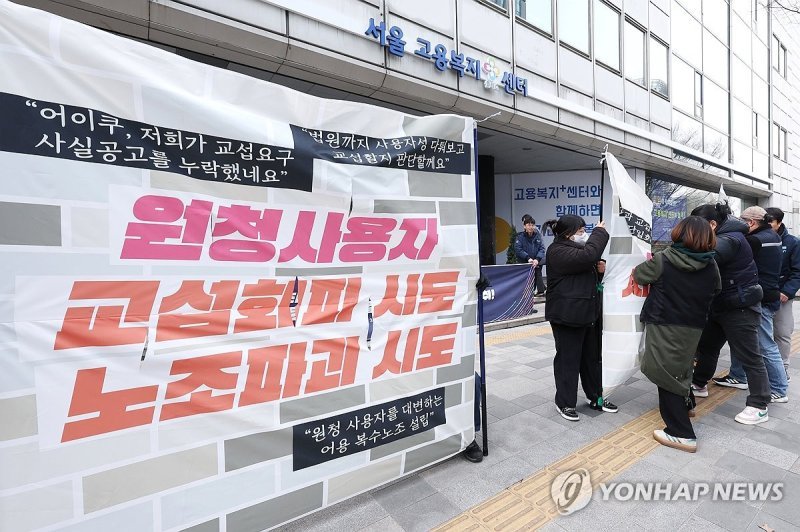
Kim Young-hoon, minister of the Ministry of Employment and Labor (MOEL), also commented on the Yellow Envelope Law at the 3rd Emergency Employment and Labor Situation Review Meeting held the same day. He argued, "At this point, it is not reasonable to talk about confusion," and said that a stable bargaining order is taking shape in the field within the framework set by law. In other words, both the head of the Central Labor Commission, a quasi-judicial independent body that mediates labor disputes, and the minister in charge share the view that the law is being implemented without major problems.
However, in contrast to this perception within the government, concern about confusion is growing in workplaces. In the month since the Yellow Envelope Law came into force, 1,012 subcontractor unions, branches, and chapters have demanded bargaining with 372 principal contractors, involving some 147,000 workers. On top of this, labor commission decisions on employer status are increasingly leaning in favor of subcontractor unions, further adding to the burden on companies. As recognition of separate bargaining units becomes more common, firms with many partner companies fear they may have to engage in negotiations virtually all year round.
Recently, the labor commission has shown a tendency to recognize principal contractors as employers exercising substantial control, based on evidence that they have faithfully implemented safety measures for subcontracted workers. Companies point out that this creates a contradictory situation: if they strengthen safety measures, they risk falling under the scope of the Yellow Envelope Law, but if they neglect them, they face possible violations of the Serious Accidents Punishment Act.
There is also considerable concern that bargaining, which begins with safety as the agenda, may expand to demands for direct employment or wage increases. The chair of the Central Labor Commission denied the possibility of such agenda expansion, yet he also acknowledged that indirect improvements could emerge in the course of negotiations. It is therefore difficult to dismiss industry concerns as mere overreaction.
Amid this uncertainty, there is a high risk that conflicts between principal contractors and subcontractors will intensify. Interpretations diverge on key issues such as whether it is permissible to start a strike under the banner of industrial safety and then expand its goals to wages, and whether replacement workers can be deployed during a strike. If issue-specific bargaining is allowed without clear standards, a wave of lawsuits is likely, imposing heavy costs on both labor and management.
To narrow the gap between the intent of the Yellow Envelope Law and realities on the ground, the government must swiftly prepare clear guidelines on how to determine employer status, define the scope of bargaining, and set limits on industrial action. It is urgent to prevent unnecessary disputes and enhance predictability in the law’s application through detailed rules that reflect the unique structure of relationships between principal contractors and subcontractors. The government should quickly present supplementary measures that carefully reflect voices from the field, so that trust in policy is not shaken amid power struggles between labor and management.