"Middle East war has changed the stock market trend... Inflection point expected if earnings roll over"
- Input
- 2026-04-14 06:00:00
- Updated
- 2026-04-14 06:00:00
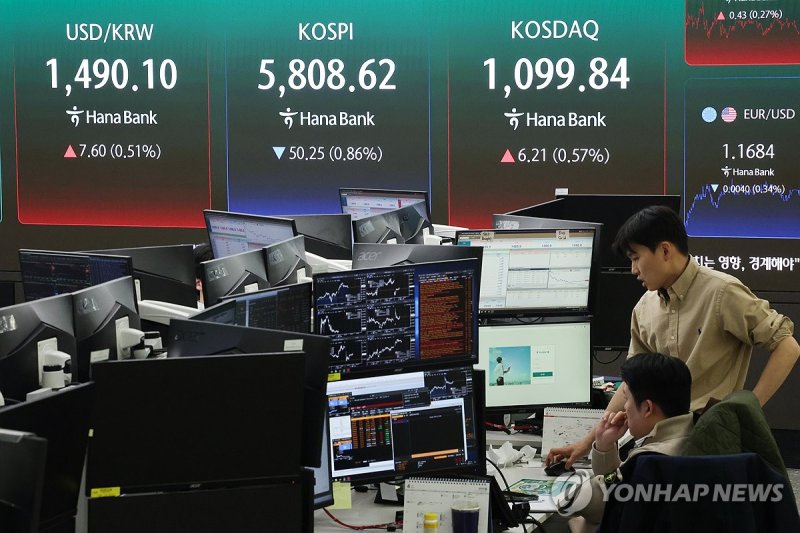
[The Financial News] At the beginning of this year, the domestic stock market extended its gains on expectations for artificial intelligence (AI) and an improvement in the semiconductor cycle. However, analysts say the market has entered a turning phase as changes in macroeconomic variables triggered by geopolitical risks from the Middle East are now being fully reflected. Over the medium to long term, they warn that lower corporate earnings forecasts, combined with a shift toward tighter policy by major central banks, could weaken the drivers of the market’s advance.
Lee Sang-heon, a researcher at iM Securities, said on the 14th, "Up until the beginning of this year, expectations for semiconductor earnings driven by rising prices of Dynamic Random Access Memory (DRAM) and NAND flash memory were the key factors pushing stock prices higher," adding, "As earnings estimates for Samsung Electronics and SK hynix were revised upward, the index continued to climb."
However, the trend changed around the end of February, when the Middle East war broke out. Following the war, international oil prices surged, driving up inflation and creating a structure in which the exchange rate and interest rates jumped at the same time. Lee noted, "In particular, Korea imports most of its crude oil, so the rise in the exchange rate has further amplified inflationary pressure."
He went on, "When risk increases, the dollar stands out as a safe asset, and the won inevitably weakens in relative terms," adding, "An environment where the exchange rate, interest rates, and prices are all rising at once is structurally burdensome for the stock market."
The concern is that the macro shifts sparked by the Middle East war may go beyond simple market volatility and start to weigh on corporate earnings. Lee pointed out that as oil prices climb, not only energy costs but also transportation and infrastructure expenses are bound to rise, pushing up overall production costs. As the cost burden on companies increases, he explained, their earnings estimates will inevitably be revised downward.
The possibility of weaker consumption is another variable. He said, "When prices rise, real income falls and households have little choice but to cut spending," adding, "If demand contracts, it leads to lower corporate sales, which in turn exerts further downward pressure on earnings."
He also argued that it is difficult to remain purely optimistic about the earnings outlook for major electronics companies. "If prices of DRAM and NAND flash memory keep rising, it will feed through into higher prices for electronic products, and ultimately consumer replacement demand will inevitably decline," he said. "In that case, there is a real possibility that corporate earnings estimates will be revised down."
Lee further cautioned that investors should be wary of how they view current valuations. "The current price-earnings ratio (PER) is around 8 times, and the prevailing view in the market is that this looks relatively cheap compared with other countries," he said.
He continued, "As we move into the latter part of the second quarter, when the prolonged impact of the war is fully reflected, the market may enter a phase in which corporate earnings start to shrink due to macro variables," adding, "When earnings fall, the PER actually rises, so this may be an illusionary phase that does not yet reflect the coming earnings decline."
Central bank policy is also cited as a headwind. Lee explained, "In an environment of rising inflation, interest rates ultimately have to go up, and that leads to a contraction in liquidity," adding, "When rates rise, discount rates increase, and stock market valuations are bound to come down."
He added, "So far, only part of the valuation adjustment has been reflected, but going forward, additional pressure may emerge as earnings downgrades are also priced in."
In the end, he projected that the market is likely to shift from an uptrend into a range-bound phase. "When downward revisions to earnings estimates driven by macroeconomic variables and central bank tightening act together, the market cannot help but feel the strain," he said. "Since the peak already appears to be in, there is a high likelihood that a lower, range-bound trading pattern will persist for the time being."

[email protected] Park Ji-yeon Reporter