Lee: "Weapons of the Republic of Korea are protecting Poland"... Tusk: "South Korea is our most important ally after the U.S."
- Input
- 2026-04-13 15:52:51
- Updated
- 2026-04-13 15:52:51
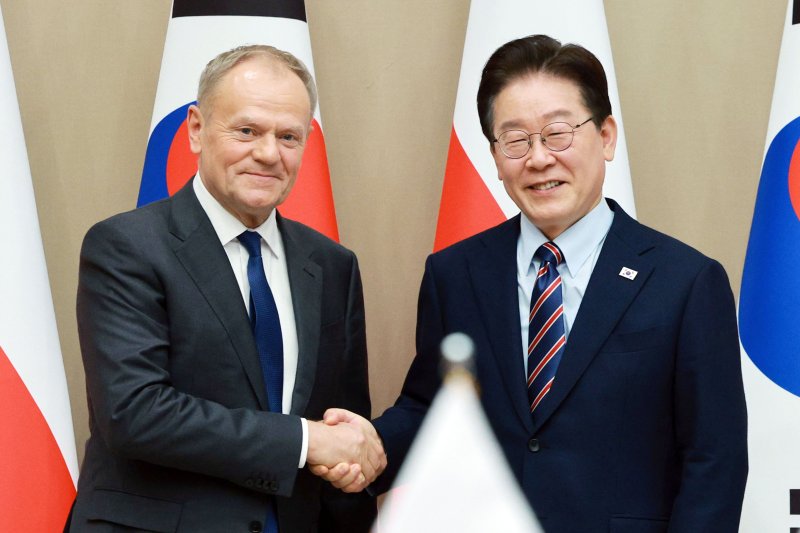
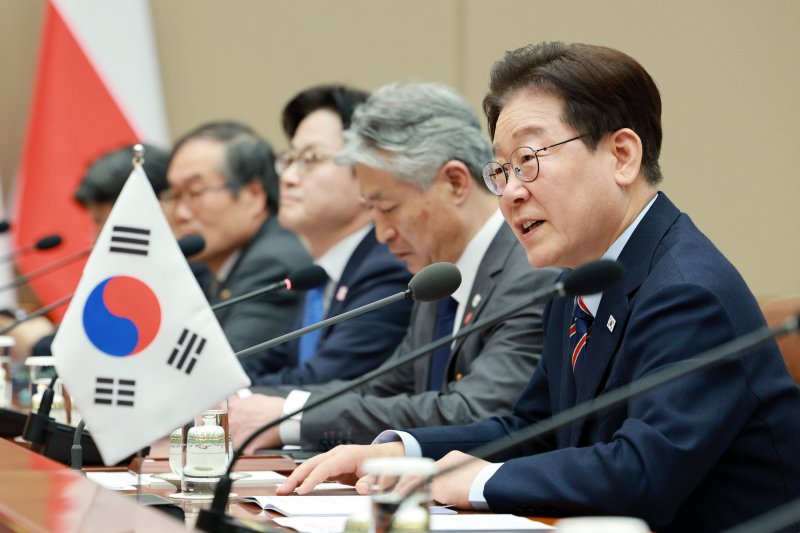
The Financial News reported that President Lee Jae Myung held a summit with Polish Prime Minister Donald Tusk at Cheong Wa Dae (the Blue House) on the 13th, where they agreed to elevate bilateral relations to a "comprehensive strategic partnership." In particular, President Lee and Prime Minister Tusk concurred on the need to further expand reciprocal cooperation in the defense industry. Referring to exports to Poland of the K2 Black Panther main battle tank, the K9 Thunder self-propelled howitzer, the FA-50 light attack aircraft and the K239 Chunmoo multiple rocket launcher system, President Lee stressed, "Our defense industry cooperation is growing ever stronger." He also proposed expanding cooperation in future-oriented fields such as battery infrastructure, science and technology, space and culture. Prime Minister Tusk responded, saying, "For Poland, South Korea is the most important ally after the United States of America (U.S.), and the defense industry in particular is playing that role."
■ President Lee: "Korea–Poland defense cooperation will expand further"
After concluding the summit with Prime Minister Tusk at Cheong Wa Dae on the same day, President Lee said in a joint press statement, "Poland has become the fifth-largest trading partner for the Republic of Korea (South Korea) among European Union (EU) member states, and South Korea is the largest investor in Poland among non-European countries." He continued, "With the signing in 2022 of a framework contract worth about 44.2 billion dollars, our bilateral defense industry cooperation is also leaping toward the future. Our mutually beneficial defense industry cooperation will continue to expand."He went on to say, "Building on the deep trust our two countries have accumulated, we decided to upgrade our relationship to a comprehensive strategic partnership." He added, "The joint statement reflects our firm and clear determination to strengthen cooperation in a wide range of areas, including politics, the economy, culture and people-to-people exchanges, and to broaden the horizon of cooperation into comprehensive and future-oriented fields such as advanced industries, science and technology, space, energy and infrastructure."
Previously, in 2022, South Korea and Poland signed a comprehensive defense contract worth about 44.2 billion dollars covering the K2 Black Panther main battle tank, the K9 Thunder self-propelled howitzer and the FA-50 light attack aircraft. They have since been implementing follow-up contracts in stages. In December last year, Poland and Hanwha Aerospace concluded a third export contract worth 5.6 trillion won for the K239 Chunmoo multiple rocket launcher system. With this summit, attention is now turning to whether additional defense cooperation will follow, including potential exports of the KAI KF-21 Boramae, the first mass-production unit of which was recently rolled out.
President Lee emphasized, "Our defense industry cooperation is developing in a much deeper way. The K2 Black Panther main battle tank, the K9 Thunder, the FA-50 light attack aircraft and the K239 Chunmoo multiple rocket launcher system—these weapons, which embody the technology and pride of the Republic of Korea (ROK), are proudly deployed across Poland’s green plains, defending Poland’s territory and its people." He added, "I also stressed that stable implementation of the framework contracts we have already signed is essential for our bilateral defense industry cooperation to deepen and advance."
President Lee noted, "Our defense industry cooperation is not simply about selling weapons." He stressed, "Through mutually beneficial cooperation in joint production, technology transfer and training within Poland, we are contributing to the development of Poland’s own defense industry ecosystem, which makes this cooperation all the more meaningful."
President Lee also asked for support regarding South Korean companies’ expansion into Poland. In detail, he said, "South Korean electric vehicle battery investors in Poland are beginning to make a full-fledged entry into the energy storage system market and are diversifying their portfolios." He continued, "I asked for the Polish government’s interest and active support for our companies. I also requested special attention so that our companies can take part in major infrastructure projects in Poland, such as the new airport rail link project and the Warsaw tram replacement project."
■ Lee–Tusk luncheon brings together South Korean defense companies
After the summit, the two leaders discussed cooperation measures over an official luncheon. The luncheon drew particular attention as key figures from South Korea’s defense industry attended, including Lee Yong-bae, CEO of Hyundai Rotem, Son Jae-il, CEO of Hanwha Aerospace and Hanwha Systems, Kim Jong-chul, CEO of Korea Aerospace Industries (KAI), Han Man-hee, head of the International Contractors Association of Korea (ICAK), and Lyu Jae-cheol, president of the home appliance division at LG Electronics.At the luncheon, President Lee said, "The Republic of Korea’s advanced weapons systems are evolving into Poland’s own weapons and are reaching out to the vast stage of the European market." He added, "As Europe moves to strengthen its defense capabilities, I hope that our bilateral defense industry cooperation will accompany Poland on the path to reinforcing its national defense and the competitiveness of its defense industry, and that South Korean companies will contribute to Poland’s economic development."
Prime Minister Tusk also stated, "The core driving force of our bilateral relationship remains cooperation in the defense industry. We intend to continue this cooperation and to accelerate it further through technology transfer, localization in Poland and the relocation of production bases to Poland." He went on, "We agreed on the need to strengthen our strategic cooperation across many areas. This includes not only cutting-edge technologies such as digitalization, artificial intelligence (AI), the semiconductor industry and space exploration, but also energy, infrastructure and transportation."
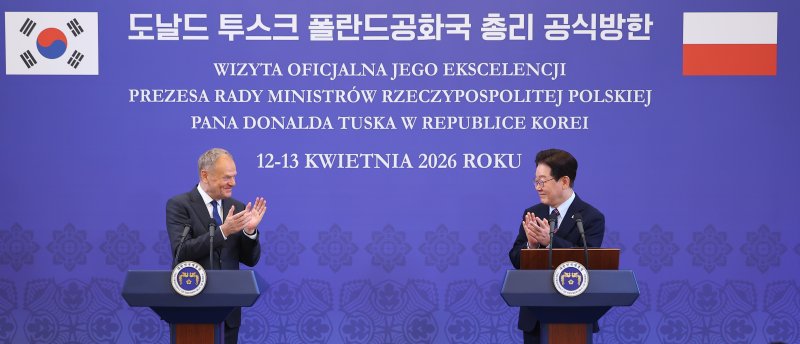
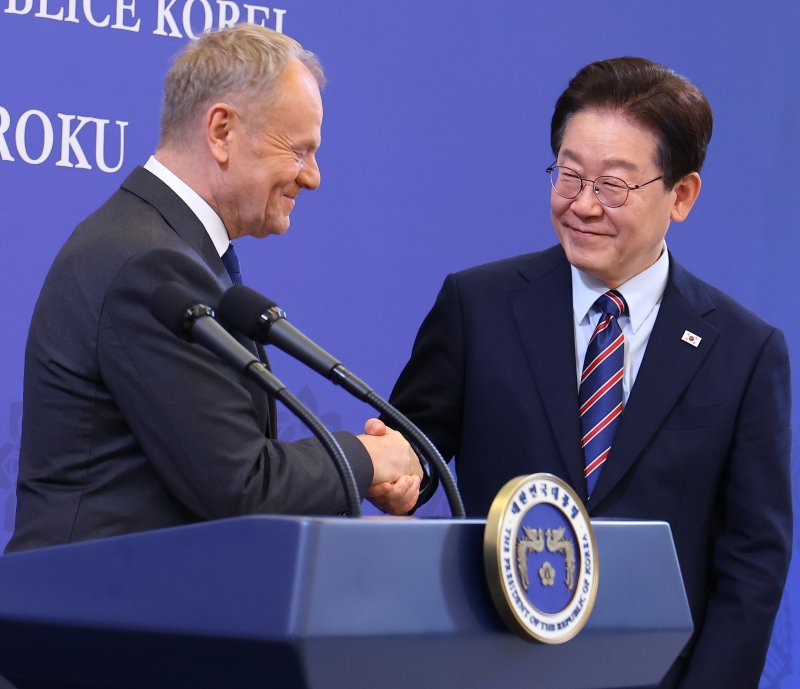
Prime Minister Tusk also raised the issue of imports of Polish beef into South Korea. He said during the expanded summit, "With regard to beef exports, President Lee said he would resolve the matter without delay," and proposed that cooperation be strengthened in the food industry as well. In the joint press statement, Tusk added, "We also decided to enhance cooperation in the food industry. I am very grateful that President Lee fully understands our expectations regarding improved access for Polish products to the South Korean market."
The two leaders also discussed international affairs, including the war in the Middle East. President Lee stressed, "Both our countries agreed that stabilizing global supply chains is crucial to addressing the crisis triggered by the war in the Middle East, and we agreed to continue the necessary cooperation to that end."
This is the first visit in 27 years by a Polish prime minister, who heads the cabinet in Poland’s semi-presidential system. President Lee, wearing a navy tie with white and red diagonal stripes, personally welcomed Prime Minister Tusk at Cheong Wa Dae. The tie’s white and red, the colors of the Polish flag, were chosen to symbolize cooperation and respect as comprehensive strategic partners.
Prime Minister Tusk, himself a former worker, also expressed affinity by pointing out what he shares in common with President Lee. He said, "Like you, Mr. President, I also worked as a laborer when I was young, and we both understand well that one must pay a high price for democracy and freedom." He continued, "From South Korea’s perspective, I would like to say how grateful we are that you have personally set an exemplary standard in difficult times. Not only in Poland but across Europe and around the world, people are expressing admiration for your efforts." His remarks were seen as an assessment of the shared history of democratization struggles in South Korea and Poland, and of how South Korea peacefully overcame the 2024 South Korean martial law crisis of December 3.
[email protected] Choi Jong-geun and Sung Seok-woo Reporter