"KOSPI Won’t Return to the Old Days"... Why a Comeback to the 3,000-Point Boxed Range Is Seen as Impossible
- Input
- 2026-04-13 10:57:37
- Updated
- 2026-04-13 10:57:37
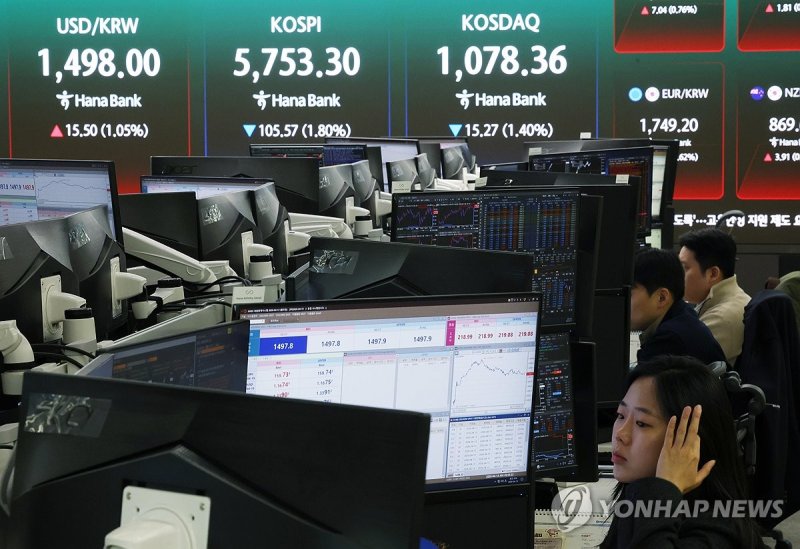
[Financial News] As geopolitical risks in the Middle East rattle markets, some analysts argue that the Korea Composite Stock Price Index (KOSPI Index) is unlikely to fall back into its previous boxed trading range.
Shinhan Future Strategy Research Institute report says "value-up has lifted the KOSPI Index floor itself"
According to the report "Conditions for Structural Transformation of the Korean Stock Market," released on the 12th by Shinhan Future Strategy Research Institute under Shinhan Financial Group, the likelihood of the KOSPI Index returning to its past trading range is assessed as low, even amid current uncertainty. The report noted that government and corporate efforts toward value-up (corporate value enhancement) have pushed the market up to a higher level, making a reversion to previous levels unlikely.
The report estimates that the Corporate Value-up Program alone has lifted the KOSPI Index by about 1,000 points (p). Compared with the upper bound of the trading range around 3,000 points where the Korean stock market had been stuck for years, the logic is that the value-up initiative has structurally raised the index’s floor itself. The institute stated, "Given the impact of the value-up policy, we believe the probability that the KOSPI Index will revert to its previous 1,500–3,000 trading range is low."
However, the report cautioned against unbridled optimism. Not falling back into a boxed KOSPI market and achieving further re-rating are two different issues. The institute argued that, for the KOSPI Index to maintain a medium- to long-term upward trend, it is essential to reduce earnings volatility, foster a culture of long-term investment, and secure next-generation growth engines.
The institute also pointed out, "The average holding period of domestic individual investors’ portfolios is only nine days, and they show a particularly strong preference for high-risk investments," adding, "This short-term trading–oriented flow structure is entrenching the KOSPI Index’s structural undervaluation."
KOSPI Index falls on breakdown of ceasefire talks, then pares losses
On the 13th, the KOSPI Index opened more than 2% lower on news that ceasefire talks between the United States of America (US) and the Islamic Republic of Iran had broken down, but has since been trimming its losses.
As of 9:22 a.m. that day, the KOSPI Index was trading at 5,784.01, down 74.86 points (1.28%) from the previous session. The index had started at 5,737.28, a drop of 121.59 points (2.08%) from the previous close, but steadily narrowed its decline and, as of 10:18 a.m., had recovered to 5,810.88 (-0.82%).
The move is seen as a reaction to the collapse of the first ceasefire talks amid disagreements over reopening the Strait of Hormuz and the Islamic Republic of Iran’s nuclear program. As a result, most leading stocks in the domestic market are weakening, with the exception of a few sectors enjoying secondary benefits, such as major semiconductor names and defense stocks.
[email protected] Kim Hee-sun Reporter