Koo Yun-cheol: "We will respond strategically to Section 301 probe to prevent harm to Korean companies"
- Input
- 2026-04-13 09:30:00
- Updated
- 2026-04-13 09:30:00
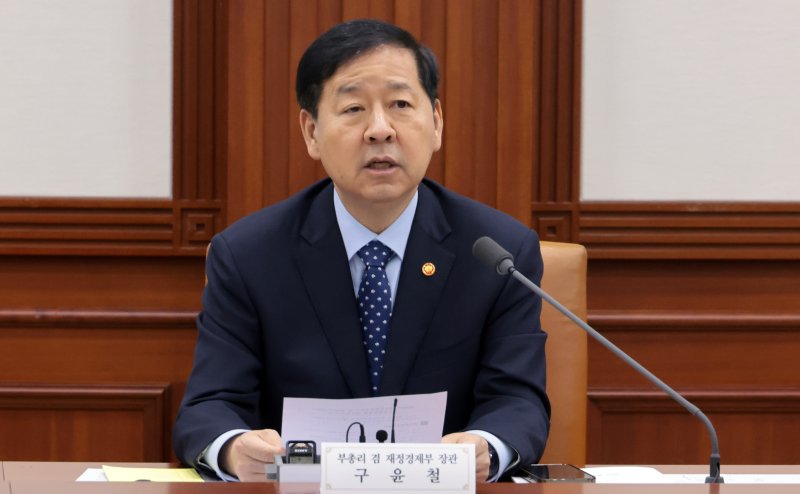
According to The Financial News, Deputy Prime Minister for Economic Affairs and Minister of Finance and Economy Koo Yun-cheol said on the 13th, in connection with the federal government of the United States announcing the launch of an investigation under Section 301 of the U.S. Trade Act of 1974, "We will respond strategically so that the interests of our companies are not undermined."
Presiding over the 266th Ministerial Meeting on External Economic Affairs at Government Complex Seoul, Koo stated, "This is an issue that could affect our companies and industries, and the government will continue close communication and consultations with the federal government of the United States."
He added, "Contrary to the U.S. side’s claims, there is no overcapacity, as capacity utilization in our manufacturing sector is at an appropriate level," and went on, "We will actively explain that our exports of capital goods contribute to the revival of the U.S. manufacturing sector."
At the meeting, ministers and vice ministers from relevant ministries discussed the progress and future response plans regarding the Section 301 of the Trade Act of 1974 investigation, as well as plans to promote K-style development finance, strategies for pursuing new trade agreements amid shifts in the global trade order, and case studies and implications from key countries’ responses to the Middle East wars.
Regarding the launch of the Section 301 of the Trade Act of 1974 investigation by the U.S. government, the Korean government has been preparing response arguments that reflect Korea’s position through a public–private joint Section 301 response task force, gathering input from industry and relevant ministries.
On the U.S. claim of overcapacity in Korea, the government plans to actively explain the appropriateness of Korea’s facility utilization, the mutual benefits created through Korea–U.S. supply chain linkages, and Korea’s technology-based export structure.
On the allegation of forced labor, Korea intends to clearly convey its position, based on strict compliance with International Labour Organization (ILO) conventions and implementation of the United States–Korea Free Trade Agreement (KORUS FTA).
In addition, to support Korean companies’ entry into new markets in the Global South, the government will promote K-style development finance. This is a development finance model that uses private capital and diverse financial instruments to support development in developing countries. Korea plans to use it, as major advanced economies do, as a strategic tool for cooperation with the Global South.
Koo said, "We will introduce a new form of development finance that supports development in developing countries through a variety of financial instruments," explaining that, "As in other advanced economies, we will mobilize private capital through market borrowing and investment funds, and provide loans, guarantees and insurance, and equity investments."
The government also drew up plans for pursuing trade agreements during the transition in the global trade order.
It plans to expand cooperation with promising regions such as New Southern Policy partner countries, Latin America, and Africa, and to pursue flexible negotiation strategies—such as modular and phased agreements—focused on new trade areas including digital trade and supply chains.
[email protected] Jung Sang-geun Reporter