"Even with a job, I can't repay" Student loan delinquencies hit record high... 1.41 million won per person
- Input
- 2026-04-13 08:55:08
- Updated
- 2026-04-13 08:55:08
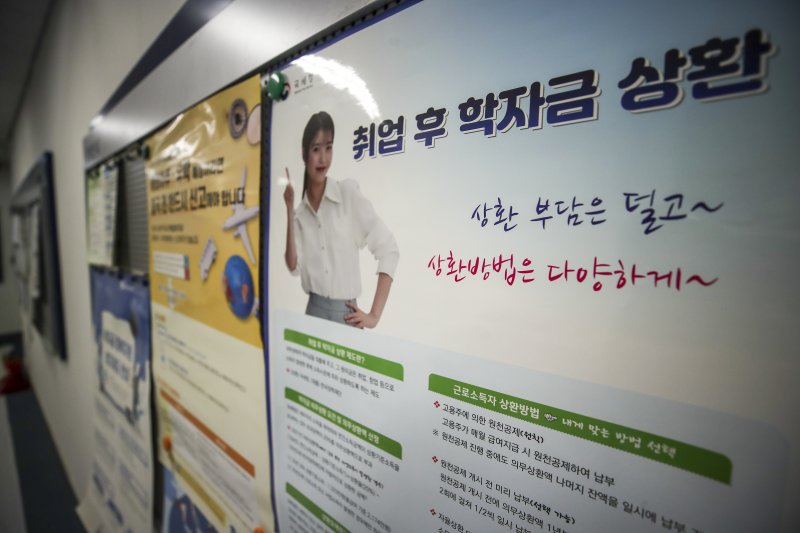
[Financial News] The share of graduates who have reached a certain income level but still fail to repay their student loans neared 20% last year, the highest on record.
Annual income above 17.52 million won... 1 in 5 borrowers in arrears
According to the National Tax Service (NTS) National Tax Statistics Portal on the 13th, the non‐repayment rate for 2025 Income-Contingent Loan (ICL) obligations, on an accumulated basis, reached 19.4% by amount and 18.0% by number of borrowers, the highest level since statistics began in 2012.
This means roughly one out of every five young people who are supposed to repay is not meeting their obligations. Borrowers subject to repayment under the Income Contingent Loan scheme are those whose annual income exceeds the threshold income level (17.52 million won for 2024 income), and they must repay 20–25% of the portion above that threshold.
Last year, 319,648 people were required to make repayments, but only 262,068 actually did so, while 57,580 fell into arrears. In monetary terms, of the 419.8 billion won that was due, only 338.5 billion won was repaid, leaving 81.3 billion won unpaid. It is the first time since records began that arrears have exceeded 80 billion won.
The non‐repayment rate by number of borrowers has risen steadily from 7.4% in 2016, surpassing 10% in 2019 (12.1%) and reaching 18.0% last year. The rate by amount also climbed from 7.3% in 2016 to 19.4% last year. The average arrears per person hit a record 1.41 million won in 2024.
Graduating on debt, still struggling with debt
An increasing share of young people are graduating from university with debt, securing jobs that put them above the income threshold, yet still struggling to repay what they owe. On top of this, the number of young people who cannot find work at all, or who lose their jobs and therefore defer repayment, is rising rapidly, fueling concern.
Data obtained by the office of Democratic Party of Korea (DPK) lawmaker Jeong Il-young from the National Tax Service show that the amount of repayment deferred reached 24.2 billion won in 2024, about 2.2 times the 11.0 billion won recorded in 2020. The number of people deferring repayment nearly doubled from 7,962 to 14,527 over the same period.
What stands out is the sharp increase in deferrals due to "unemployment, business closure, parental leave, and similar reasons." These grounds are largely tied to delayed employment or job insecurity. The number of borrowers deferring for such reasons rose from 6,871 in 2020 to 12,158 in 2024, while the deferred amount jumped from 9.7 billion won to 20.0 billion won, an increase of 10.3 billion won. As of 2024, combining those in arrears and those with deferred repayments, 68,768 people owed about 98.2 billion won.
Using the deferment system prevents late‐payment penalties
The NTS is actively encouraging borrowers to apply for repayment deferment so that those eligible do not unknowingly incur late‐payment penalties. However, youth employment indicators have continued to deteriorate this year. According to February employment data from the Ministry of Data and Statistics, the number of employed young people aged 15–29 fell by 146,000 from a year earlier. The youth unemployment rate reached 7.7%, the highest since February 2021, when it was 10.1%.
The National Assembly Budget Office (NABO) also noted last year, "As employment instability among young people worsens and living costs rise, repayment conditions have deteriorated, and the non‐repayment rate among those obligated to repay has shown a persistent upward trend," adding, "The increase in the number of borrowers deferring repayment suggests that the repayment capacity of young people may be weakening."
NABO went on to warn, "The continued rise in the number of borrowers in arrears and the accumulation of unpaid balances could prolong the youth debt problem, making repayment even harder due to mounting late‐payment penalties and placing young people at greater credit risk," and recommended, "The government should consider measures such as raising the income threshold for repayment and lowering repayment rates to ease the burden on low‐income young borrowers."
[email protected] Kim Hee-sun Reporter