Retail investors bought 11.6 trillion won in a month... All-in on blue chips Samsung Electronics and Hyundai Motor
- Input
- 2026-04-13 06:00:00
- Updated
- 2026-04-13 06:00:00
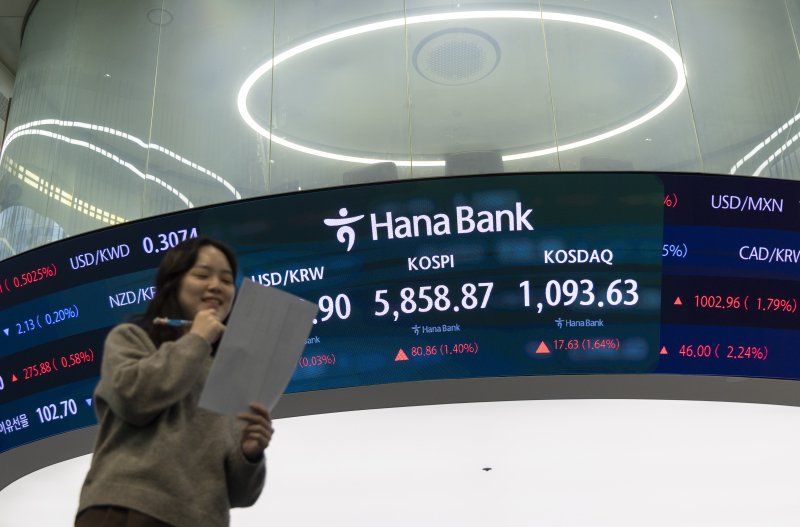
[The Financial News] As retail investors have recently re-emerged as the driving force in the domestic stock market, funds are clearly flowing into top-cap blue chips such as semiconductor and automobile stocks. Analysts say the focus is shifting away from short-term trading in theme stocks toward core names whose earnings and industry outlook are more solid.
According to the Korea Exchange on the 13th, retail investors posted net purchases totaling 11.5902 trillion won in the Korea Exchange Securities Market over the one-month period from March 12 to April 10. Over the same period, institutions recorded net purchases of 6.5546 trillion won, while foreign investors logged net sales of 24.8615 trillion won. Pension funds also booked net sales of 745.2 billion won, apparently taking profits.
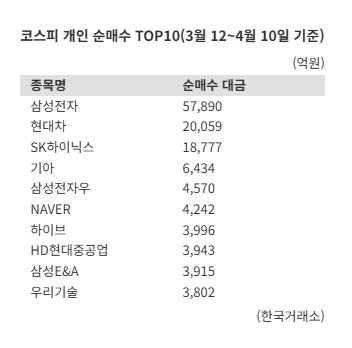
With the balance of power in order flows clearly shifting to retail investors, their buying has been concentrated in a handful of large-cap stocks. The stock most heavily bought by individuals was Samsung Electronics, with net purchases reaching 5.789 trillion won. It was followed by Hyundai Motor Company (2.0059 trillion won), SK hynix (1.8777 trillion won), and Kia (643.4 billion won).
These companies are all top-cap names that represent the semiconductor and automobile sectors. As retail money concentrates in these core index components, a structure is emerging in which they effectively determine the direction of the KOSPI Index. This stands in sharp contrast to the past, when funds were heavily skewed toward specific theme stocks such as biotech and secondary batteries.
In particular, the large-scale net buying of Samsung Electronics reflects expectations for a recovery in the semiconductor cycle. Seo Seung-yeon, a researcher at DB Securities, analyzed, "In memory, tight supply and strong server demand have driven a sharp increase in selling prices, which in turn led to an earnings surprise." Seo went on to predict, "The DRAM market is likely to remain in a boom phase as limited supply coincides with solid demand."
In fact, Samsung Electronics is estimated to have far exceeded market expectations in its preliminary first-quarter results, posting sales of 133 trillion won and operating profit of 57.2 trillion won. Rising memory prices and growing server demand are seen as the main drivers of this earnings improvement.
The inflow of retail funds has also been notable in the automobile sector. Hyundai Motor Company is being re-rated from a simple automaker to a future mobility platform company that combines autonomous driving and robotics. Min-ki Yoo, a researcher at Sangsangin Investment & Securities, stated, "By building a data integration structure and internalizing autonomous driving technology, mass production of Software-Defined Vehicles (SDV) is expected to begin in earnest after 2027." Yoo added, "Its autonomous driving roadmap is becoming more concrete through the adoption of NVIDIA DRIVE Hyperion and collaborations in robotics."
This trend of retail investors concentrating their funds in earnings-driven large caps such as semiconductors and automobiles is being interpreted as a shift in investment style. Rather than chasing short-term momentum, they are allocating capital to core stocks where industry recovery and earnings improvement are anticipated.
The change is also significant from a market-structure perspective. While foreign investors continue large-scale net selling, retail investors are absorbing this supply and effectively putting a floor under the market. Even as institutions and pension funds take profits, retail money has established itself as a key pillar supporting the market.
A securities-industry official commented, "If you look at the recent top names by net retail buying, they are concentrated in earnings-driven sectors such as semiconductors and automobiles," adding, "Investment strategies are shifting to focus on stocks with a strong impact on the index."
However, some warn that if the concentration in a few large-cap stocks deepens, volatility could increase.
Another industry official emphasized, "Because stock prices can be heavily influenced by the semiconductor cycle and global economic trends, the importance of investment strategy is expected to grow even further."
[email protected] Choi Doo-seon Reporter