Exclusive: Korea-Japan business low birthrate committee launched, led on Korean side by Chey Tae-won
- Input
- 2026-04-12 18:35:19
- Updated
- 2026-04-12 18:35:19
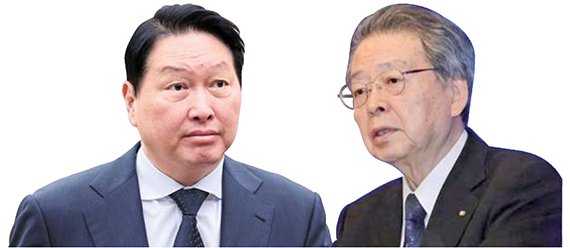
According to Korean and Japanese industry officials on the 12th, the two countries' business sectors are launching the "Korea-Japan Low Birthrate Countermeasures Exchange Committee" and plan to hold the "1st Korea-Japan Low Birthrate Countermeasures Symposium" (tentative title) on August 31 in Sendai City, Miyagi Prefecture, Japan.
The committee will be a private-sector consultative body made up of leaders from major companies and economic organizations in Korea and Japan. Its secretariat will be housed within the Japan Productivity Center's "Conference for Choosing the Future."
On the Korean side, the committee will be chaired by Chey Tae-won, head of the Korea Chamber of Commerce and Industry (KCCI), while on the Japanese side it will be led by Ken Kobayashi, head of the Japan Chamber of Commerce and Industry (JCCI). The vice chair will be Hiroya Masuda, co-representative of the Conference for Choosing the Future.
From Korea, Jin Ok-dong, chairman of Shinhan Financial Group, and Choi Soo-yeon, CEO of Naver, will participate as committee members.
The two sides held a preparatory meeting in Tokyo on the 30th of last month, where they formally confirmed the launch of the committee.
The committee plans to share policy cases and research findings on low birthrates and to promote joint studies. In particular, it will focus discussions on structural solutions related to the labor market, childcare environment, and corporate culture. Korea and Japan also intend to hold regular annual symposia, alternating between venues in Japan and Korea.
This cooperation is drawing attention as a private-sector initiative to address the population decline that both Korea and Japan are facing.
The two countries share a sense of crisis that falling birthrates could lead to a shrinking workforce and slower economic growth.
Through sharing policy examples and conducting joint research, the committee aims to identify effective response measures, while also discussing institutional reforms such as labor market structures and corporate culture.
Previously, at the Korea-Japan Summit in September last year, the two governments agreed to activate the "Japan–Republic of Korea Consultative Body on Common Social Issues" to jointly discuss and seek solutions to shared social challenges such as low birthrates, aging populations, and balanced regional development. In line with this, the chambers of commerce of both countries also decided to join forces to address the low birthrate issue.
In December last year, the chambers of commerce of the two countries issued the "Joint Statement by the Presidents of the Korea-Japan Chambers of Commerce on the 60th Anniversary of the Normalization of Diplomatic Relations between Korea and Japan" at the 14th Korea-Japan Chamber Leaders Meeting held on Jeju Island. The statement set out three pillars: investment and joint supply chain building in three key future industries—artificial intelligence (AI), semiconductors, and energy; joint responses to low birthrates and aging populations; and expanded cultural exchanges.
Notably, the leaders' meeting for the first time designated responses to low birthrates and aging populations as a major area of cooperation, recognizing the need for joint action and drawing considerable attention.
[email protected] Seo Hye-jin Reporter