Vance Says U.S.–Iran Nuclear Talks Ended Without Agreement
- Input
- 2026-04-12 11:58:57
- Updated
- 2026-04-12 11:58:57
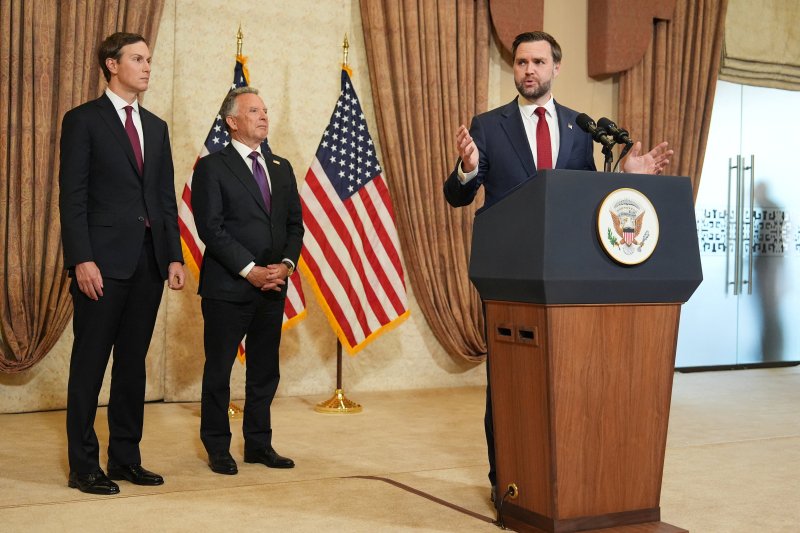
The Financial News reported that high-level nuclear talks between the United States and the Islamic Republic of Iran, held in the Pakistani capital of Islamabad, ended without any agreement.
On the 12th local time, foreign media including The Associated Press (AP) reported that James David Vance, Vice President of the United States, officially announced, "The talks between our two countries concluded without an agreement because the Iranian side rejected the U.S. condition that it would not develop nuclear weapons."
The negotiations were conducted intensively for about 21 hours. On the U.S. side, Vice President Vance led the delegation, while on the Iranian side, Mohammad Bagher Ghalibaf, the parliament speaker, served as chief negotiator.
Right after the talks, Vice President Vance told reporters, "The simple fact is that we need a firm commitment from Iran that it will not pursue nuclear weapons and that it will not possess the tools that would allow it to acquire such weapons quickly. That is President Donald Trump's core objective, and it is what we sought to achieve through these negotiations."
He added that the biggest obstacle in the talks was Iran's nuclear program itself.
Vance said he spoke with President Trump more than ten times during the negotiations, maintaining close contact. He also shared real-time updates with key national security and economic advisers, including Secretary of State Marco Rubio, Treasury Secretary Scott Bessent, and Admiral Brad Cooper, Commander, United States Central Command.
The United States has left what amounts to a final ultimatum on the table for Iran. "We are leaving behind a very simple proposal, our 'final and best offer,'" Vance said, adding, "It remains to be seen whether Iran will accept it."
On the 7th, the United States had announced that, in order to facilitate the talks, it would temporarily suspend attacks on Iran for two weeks in coordination with Israel, a move seen as giving Tehran time to deliberate.
Regarding the negotiations, Iran's state-run Tasnim News Agency criticized that "the United States' excessive demands prevented the formation of a common framework and agreement." Iran has consistently claimed that its nuclear program is for peaceful purposes and has denied suspicions that it is seeking to build an atomic bomb.
Despite the cease-fire, tensions remain high. The United States and Israel not only carried out strikes on key sensitive facilities inside Iran last year, but also conducted such attacks during the war that broke out on February 28.
Vice President Vance, in closing, pressed Iran on its sincerity.
He said, "The fundamental question is whether Iran has the genuine will not to develop nuclear weapons. I am talking about a long-term commitment, not just for now or two years from now. We have not yet seen that. We can only hope to see it."
With the collapse of these talks, tensions in the Middle East are unlikely to ease anytime soon, and global attention is now focused on how Iran will respond to the United States' 'final offer.'
After the press conference, Vice President Vance and the rest of the U.S. negotiating team departed Pakistan.
[email protected] Yoon Jae-joon Reporter