Overseas Orders in the Middle East Virtually Zero in March as War Slams Foreign Construction
- Input
- 2026-04-12 12:37:22
- Updated
- 2026-04-12 12:37:22
[Financial News] Overseas construction orders in the Middle East, long the "largest market" for Korean builders, have effectively come to a halt due to the fallout from the war between the United States of America (U.S.) and the Islamic Republic of Iran. In the first quarter of this year, order volume from the Middle East plunged about 94% year-on-year, becoming the decisive factor behind the overall slump in overseas contracts.
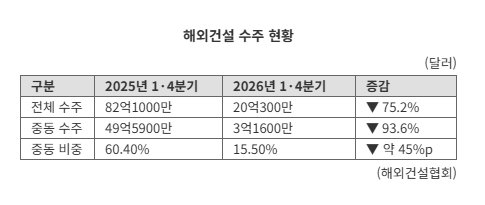
According to the International Contractors Association of Korea (ICAK) on the 12th, overseas orders from the Middle East in the first quarter totaled 316.22 million dollars. This is only about one-tenth of the 4.95893 billion dollars recorded in the same period last year. The region's share of total overseas orders also tumbled from more than 60% to 15.5%. Since 1965, the Middle East has been Korea's largest export market for construction, accounting for 48% of all orders, but in this quarter its share of 15.5% fell below Asia at 33.9% and North America and the Pacific at 27.5%.
In particular, orders from the Middle East in March amounted to only 29.97 million dollars, and even that figure mainly reflects increased design costs for previously awarded water and sewage projects. Taking this into account, new orders are effectively close to zero. As of April, there have been no reports of additional tenders being issued.
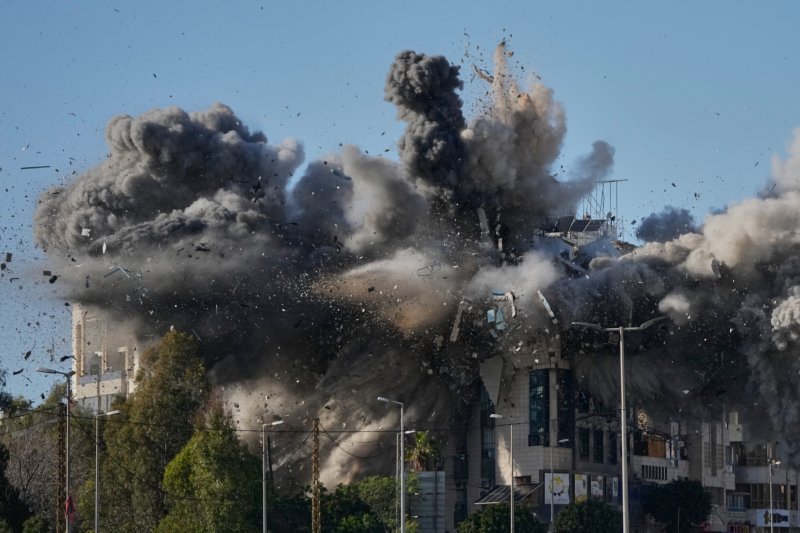
The Middle East market has long been the main source of orders for Korean construction companies, centered on infrastructure such as plants, roads, and power facilities. However, as the war led by the U.S. and the Islamic Republic of Iran escalated in late February, major project tenders have been repeatedly delayed. Follow-up work at Al Faw Port in the Republic of Iraq is cited as a representative example.
This gap in Middle East orders has dealt a direct blow to overall overseas performance. Overseas construction orders in the first quarter came to only 2.03739 billion dollars, far below the recent five-year average of 6.89 billion dollars. Compared with the same period last year, when orders reached 8.21 billion dollars, the figure represents a decline of about 75.2%.
A construction industry official noted, "The poor order performance in the Middle East is largely due to large projects that had been scheduled being postponed or carried over." The official added, "The war is having a major impact, and even if a ceasefire is reached, it is hard to say with confidence that conditions will improve immediately." The person went on to say, "There is still a possibility that large projects will be tendered after the first quarter, so we need to keep a close eye on developments."
Another official at a construction company commented, "Quarterly results can be concentrated in specific periods, so it is difficult to judge the situation based only on short-term indicators." Even so, the official acknowledged, "In the Middle East, virtually no new tenders are being issued at the moment." The official further predicted, "Given that Middle Eastern countries are likely to prioritize their fiscal resources for war damage recovery and reconstruction, it will be difficult to see new large-scale project tenders for some time."
Meanwhile, ICAK has set this year's overseas order target at 200 billion dollars. Orders secured so far amount to 2.03739 billion dollars, or about 0.10% of the target.
[email protected] Choi Ga-young Reporter