Neukgu Coin Becomes a Case Study in the Attention Economy... ‘Neukgu’s Escape’ Reflects How the World Looks at Us [Useful Issues]
- Input
- 2026-04-12 07:00:00
- Updated
- 2026-04-12 07:00:00

[Financial News] Interest in the wolf known as “Neukgu,” whose whereabouts have remained unknown for four days after escaping from Daejeon O-World, is now expanding into a broader social “phenomenon.”
As the capture was delayed, public sympathy initially formed around the idea that Neukgu “should not be killed.” Then, using social media, generative artificial intelligence (generative AI), and other tools, people began creating memes that anthropomorphized Neukgu and built narratives around the animal. Before long, a cryptocurrency appeared, followed by AI-manipulated photos.
Why has Neukgu’s escape drawn such an intense reaction from Korean society?
Neukgu Coin and the Attention Economy
Professor Koo Jung-woo of the Department of Sociology at Sungkyunkwan University (SKKU) noted, “The ways we respond to social issues have become far more diverse than in the past, and the perspectives from which we view those issues have also diversified.” He explained, “Through tools like generative AI and social media, people are expressing their own viewpoints in their own ways, and Neukgu has become a clear example of that.”
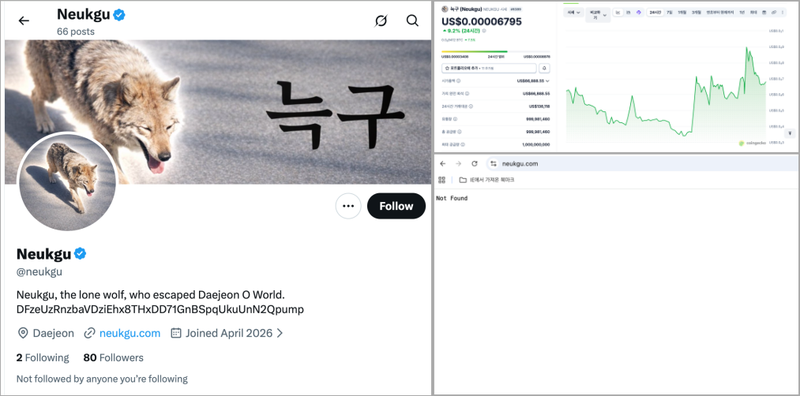
The most prominent example is the coin named after Neukgu.
On the 10th, Yonhap News Agency reported that “on overseas decentralized exchanges (DEX) such as PumpSwap, a coin named ‘Neukgu’ after the wolf is being traded.”
Created on the 8th, this is a typical meme coin— a hype-driven cryptocurrency. The total supply is 160 million tokens, with total liquidity of around 20,000 dollars.
Experts see this as an example of the attention economy at work. In a platform-driven environment, it is not physical goods but public attention—what people focus on—that is converted into economic value. Dogecoin and Shiba Inu are classic cases.
Tim Wu, in his book on the attention economy, The Attention Merchants, wrote, “This is different from traditional capitalism,” adding, “In the past, companies manufactured something like cars and made money by selling them. Today, companies offer something for free, then use the attention that generates to sell something else. It is a more advanced form of capitalism.”
In Neukgu’s case as well, the narrative of a “lonely wolf” was layered onto the story, driving clicks and shares and ultimately giving rise to the Neukgu meme coin.
Professor Koo Jung-woo observed, “Some people are trying to use the attention around Neukgu to seek economic gain, while others are focusing on animal protection.” He added, “People are projecting their own worldviews and moral values onto a topic that has captured public attention.”
A Narrative of Neukgu Shaped by the Times
As Professor Koo Jung-woo suggested, Neukgu has become a focal point of the attention economy because a range of factors have pushed social interest to a high level.
Using generative AI, people created fake images of Neukgu eating instant cup noodles at a convenience store or enjoying freedom against a backdrop of city nightscapes. These manipulated scenes spread rapidly across social media.
In the process, the public seems to have largely forgotten the physical threat posed by a real wolf. Instead, many appear to have felt a sense of vicarious liberation through an underdog—an animal that escaped a cramped enclosure. Public opinion also began to anthropomorphize Neukgu as both a victim of poor management and a subject yearning for freedom.
Online communities and social media were flooded with posts personifying Neukgu and cheering it on, with captions such as “a wolf version of ‘The Shawshank Redemption’” and “I hope it can live freely.”
Shifting perceptions of animal rights also played a role.
Korean society has already grown weary and resentful of the modern zoo as a form of exhibition. On top of that, people recalled the 2018 incident in which a puma named Bbo-rong escaped from the same zoo and was shot dead, which fueled public sentiment that “this time, it must not be killed.”
On the evening of the 9th at 9:18 p.m., President Lee Jae-myung of South Korea also posted a message on X, formerly known as Twitter, expressing support for Neukgu’s safe return.
Soon after, social media users created an account for Neukgu itself.
The “Neukgu” account on X, described as “Neukgu, the lonely wolf that escaped from Daejeon O-World,” posts real-time news about the animal and repeatedly calls for it not to be killed. The account currently has around 500 followers.
On this page, supporters post messages such as “Neukgu is lonely but independent,” “I’m walking off into the sunset. You’ll never find me,” “I’m spinning around, living my best life,” and “Find me if you can,” cheering Neukgu on.
A website called Neukgu.com has also appeared, although it contains no content.
Even Sightings of Neukgu Are Being Faked
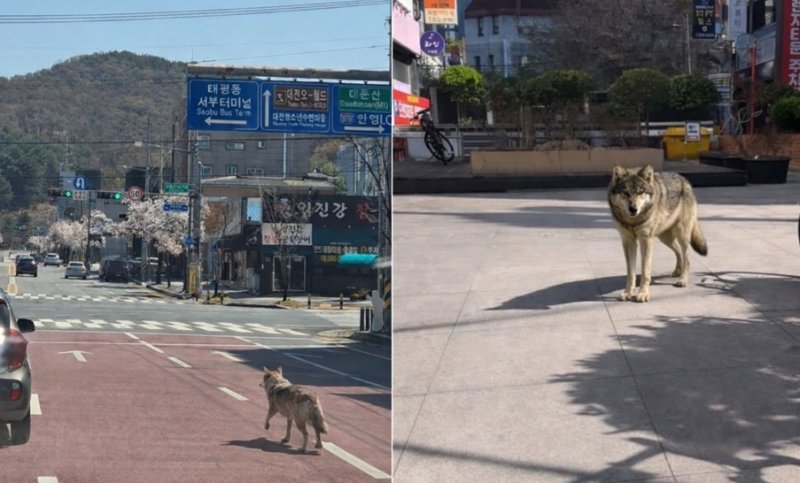
Excessive attention has also produced side effects. People submitted AI-generated composite photos claiming to show Neukgu, which caused confusion and hampered the search efforts of the authorities.
Police and fire authorities, together with Daejeon O-World and other related agencies, formed a search team of about 250 people on the morning of the 8th, the first day of the escape, and began combing the area. Later, after receiving photo tips and reports that “a wolf has appeared at the Daejeon O-World intersection,” they rushed personnel to the scene and expanded the search area.
A large number of personnel were also deployed to a nearby elementary school, where an on-site situation room was set up, and the Daejeon Metropolitan City Government sent out safety alert text messages to residents.
However, it was later found that the authenticity of the tip-off photos, which played a decisive role in shaping those responses, was unclear. According to reports, the wolf did not appear on Closed-Circuit Television (CCTV) cameras covering the location in question.
From the morning of the 8th, when news of Neukgu’s escape first broke, images believed to have been created with generative AI—such as CCTV footage showing a wolf jumping over the zoo enclosure fence—spread rapidly online.
Police, fire authorities, and the city received well over a hundred related reports, but most turned out to be false alarms or were based on composite images circulating on the internet.
[email protected] Seo Yoon-kyung Reporter