High Oil Price Relief Payments of up to 600,000 Won per Person from the 27th..."Convenience Stores Allowed, Delivery Apps Excluded"
- Input
- 2026-04-11 14:02:13
- Updated
- 2026-04-11 14:02:13
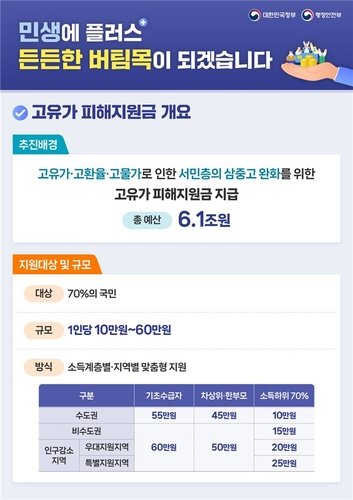
[The Financial News] To ease the burden on the public from the prolonged war in the Middle East, the government will provide "high oil price relief payments" of 100,000 to 600,000 won per person to 70% of the population.
Vulnerable groups such as basic livelihood security recipients, those just above the poverty line, and single-parent families will receive the payments first, starting on the 27th of this month. The remaining 70% of the population will receive the money between May 18 and July 3, based on income criteria. The payments must be used by August 31.
Minister of the Interior and Safety Yun Ho-jung held a joint briefing with related ministries at Government Complex Seoul on the 11th and announced the payment plan.
First payments on April 27, second payments from May 18...Applications accepted until July 3
Eligibility for the relief payments was determined based on March 30, the day before the Cabinet approved the supplementary budget proposal. About 32.56 million people, representing the bottom 70% by income, will receive the payments.
In the first round, from the 27th to May 8, basic livelihood security recipients will receive 550,000 won, and those just above the poverty line and single-parent families will receive 450,000 won each. Residents in non-capital regions and population-declining areas will receive an additional 50,000 won, bringing the total to between 450,000 and 600,000 won.
In the second round, from May 18 to July 3, payments will be made to the general public after screening based on income. By region, residents in the capital area will receive 100,000 won, those in non-capital regions 150,000 won, those in priority population-declining areas 200,000 won, and those in special support areas 250,000 won. The government will select 70% of the population based on health insurance contributions, and is also reviewing additional criteria to exclude high-asset households. The final eligibility criteria will be announced in May.
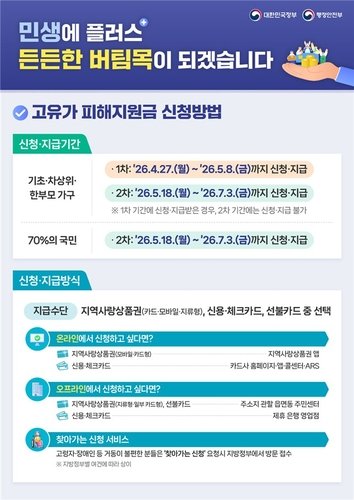
Applications for the relief payments can be made both online and offline. Online applications for the first round will be accepted from 9 a.m. on April 27 until 6 p.m. on May 8, including weekends and public holidays. To reduce congestion in the first week, a day-of-week system will apply. People whose birth year ends in 1 or 6 can apply on Monday, 2 or 7 on Tuesday, 3 or 8 on Wednesday, and 4, 9, 5, or 0 on Thursday. From Friday onward, the day-of-week restriction will be lifted. However, because May 1, a Friday, is designated as Labor Day and a public holiday, those whose birth year ends in 4 or 9 as well as 5 or 0 will be able to apply on Thursday, April 30, for the first-round payments starting on the 27th.
Relief payments used first...Unused funds expire at the end of August
Recipients can choose to receive the payments via credit card, debit card, prepaid card, or local love gift certificates.
Mobile and card-type local love gift certificates can be requested through the local government’s gift certificate app for the applicant’s registered address. Credit and debit card payments can be requested through the card company’s website or app.
Payments will be made the day after the application. If received as local love gift certificates, the amount will be credited to the recipient’s account the next day. The relief funds will be managed separately from any existing local currency balance, and the relief amount will be deducted first when making payments. The system is designed so that the time-limited relief funds are used up before other balances. For example, even if there is an existing local currency balance, when paying at a restaurant or supermarket, the relief funds will be used first, and the previous balance can be used later. For credit and debit cards, the funds will also be credited to the card in the recipient’s name the next day, and the relief amount will be used first when the card is used.
Use restricted at gas stations with annual sales over 3 billion won
The use of high oil price relief payments will be limited to small business stores with annual sales of 3 billion won or less. The government applied the same principle used for last year’s consumption coupons in order to maintain the policy goal of revitalizing local economies and supporting small businesses.
The payments can be used at most small business outlets in the community, including traditional markets, neighborhood supermarkets, restaurants, cafes, franchise convenience stores, fried chicken shops, hair salons, hospitals, pharmacies, opticians, florists, and independently operated grocery stores.
In contrast, use will be restricted at large discount stores, department stores, corporate supermarkets (SSMs), duty-free shops, online shopping malls, delivery apps, and entertainment or gambling-related businesses. Among franchise outlets, company-owned stores operated directly by headquarters are excluded, but franchise stores run by individual owners are eligible.
The government applied the same criteria to gas stations, allowing use only at stations with annual sales of 3 billion won or less.
According to the Korea Oil Distribution Association, gas stations with annual sales of 3 billion won or less are estimated to account for less than 30% of all stations. This has prompted criticism in the National Assembly that "the payments are meant to ease the burden of high oil prices, yet they cannot be used at most gas stations."
The government decided to maintain the existing principle, judging that the core purpose of the payments is to revitalize local commercial districts and similar goals.
Song Kyung-joo, Deputy Minister for Local Fiscal and Economic Affairs of the Ministry of the Interior and Safety, said at the briefing, "Convenience for the public is important, but given that the purpose of the payments is to support small businesses and revitalize local economies, it is necessary to limit usage to businesses with annual sales of 3 billion won or less."
There are exceptions for rural areas and towns. In recognition of the limited consumer infrastructure in these regions, stores such as Nonghyup Hanaro Mart will be eligible regardless of their sales size.
In addition, even if a store is located inside a department store or large discount store, independently leased outlets run by small businesses, such as florists and opticians, will be allowed to accept the payments.
Taxis will also be eligible if certain conditions are met. Payments can be used if the taxi operator’s annual sales are 3 billion won or less and the garage or corporate address meets the local address requirement. However, some transactions processed through payment gateway (PG) systems may be restricted, so users will need to check in advance.
Use of the payments will be limited to the local government jurisdiction corresponding to the recipient’s registered address. Residents of metropolitan cities and special cities, including Sejong Special Self-Governing City and Jeju Special Self-Governing Province, can use the funds anywhere within that city or province. Residents of provincial areas can only use them within the city or county of their registered address. For example, a resident of Jung District, Seoul can use the payments anywhere in Seoul, while a resident of Cheongju, North Chungcheong Province can use them only within Cheongju.
Overseas residents can apply after returning by July 17
In principle, foreign nationals are excluded from the payments. However, permanent residents (F-5), marriage migrants (F-6), and recognized refugees (F-2-4) who are enrolled in the national health insurance system as subscribers or dependents, or who receive medical aid, may exceptionally receive the payments. Foreign nationals listed on the same resident registration record as at least one Korean national will also be eligible if they meet the same conditions.
Korean nationals staying overseas can also receive the payments. Those who return to Korea between March 30 and July 17 can receive the money if they file an objection by July 17, the deadline for appeals. Even if a person was not a basic livelihood security recipient on the reference date but later qualifies, the amount will be corrected and paid if an objection is filed within the same period.
The payments must be used by August 31. Any remaining balance after that date will automatically expire.
[email protected] Reporter Lee Bomi Reporter