Galaxy S26 delay hits hard: Samsung cedes first-quarter top spot to Apple for the first time
- Input
- 2026-04-11 10:52:10
- Updated
- 2026-04-11 10:52:10
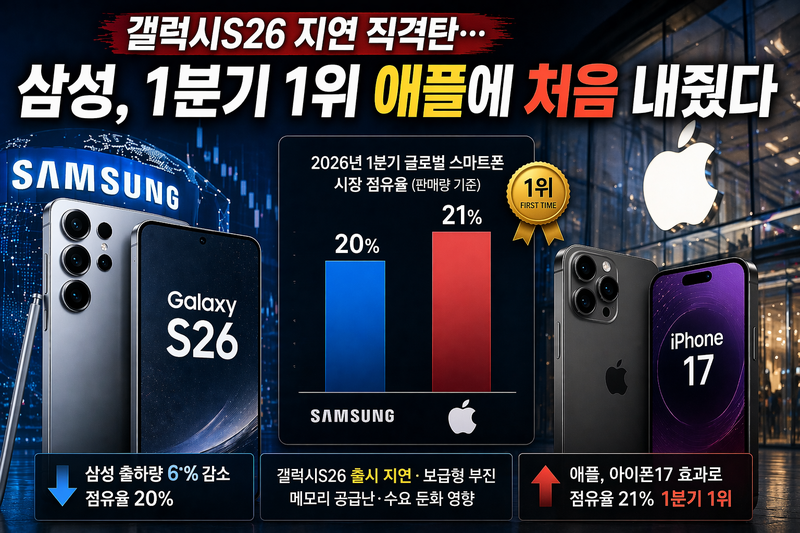
Samsung Electronics has lost its long-held lead in the global smartphone market in the first quarter, handing the top spot to Apple for the first time. The delay in launching the Samsung Galaxy S26 and weak performance in the budget segment hit the company hard.
According to Counterpoint Research on the 11th, Samsung Electronics’ smartphone shipments in the first quarter of this year fell 6% year-on-year, giving it a 20% market share. Over the same period, Apple captured a 21% share, becoming the global No. 1 in the first quarter for the first time in its history.
Apple maintained its growth despite a shortage of memory components, supported by strong sales of the iPhone 17 series and solid supply chain management. Its focus on premium products, trade-in programs, and the strength of its ecosystem helped drive demand.
Samsung, by contrast, was unable to benefit from an early shipment boost because the Samsung Galaxy S26 series launch was pushed back. On top of that, a slowdown in demand in the mass-market segment focused on budget models further dragged down its overall shipments.
Even so, analysts say the competitiveness of Samsung’s new models remains intact. The Samsung Galaxy S26 series has received a positive initial response since its release, with particularly strong demand for the Galaxy S26 Ultra. Samsung is cutting back on low-end models and reshaping its lineup around higher-spec devices as it moves to protect profitability.
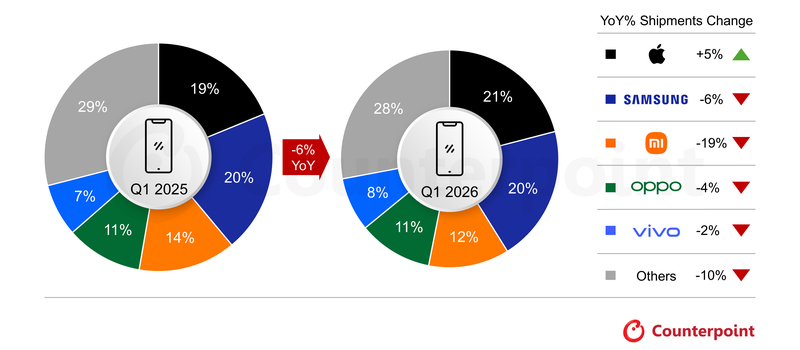
Chinese manufacturers also took a hit. Xiaomi held on to third place with a 12% share, but its shipments dropped 19%, the steepest decline among the top players. Oppo and Vivo saw their shipments fall 4% and 2%, respectively. By contrast, Google and Nothing grew 14% and 25%, successfully tapping into niche segments.
Market conditions remain challenging. A shortage of Dynamic Random Access Memory (DRAM) and NAND flash memory has pushed up production costs for smartphone makers, and part of that burden is being passed on to consumers through higher prices. The mid- to low-end segment, where buyers are highly price-sensitive, has been hit especially hard.
As a result, global smartphone shipments in the first quarter of 2026 fell 6% compared with a year earlier. Weaker consumer sentiment due to heightened tensions in the Middle East and rising logistics costs also contributed to the market slowdown.
Counterpoint Research expects the memory shortage to continue into next year and forecasts that the smartphone market will shift away from pure volume competition toward premium positioning and a stronger focus on profitability.
[email protected] Reporter Koo Ja-yoon Reporter