"Less Bad" Is Not Eco-Friendly: The Blind Spots of Renewable Energy [Lee You-beom's Eco & Energy]
- Input
- 2026-04-11 06:00:00
- Updated
- 2026-04-11 06:00:00
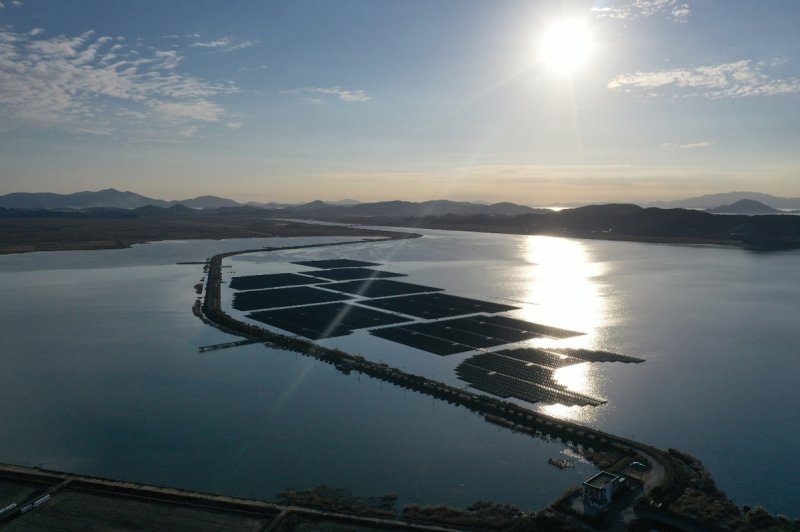
Renewable energy emits less carbon than fossil fuels. This advantage is one of the main reasons why countries around the world, including Korea, are expanding renewables. The Lee Jae-myung administration also recently formalized a plan to expand renewable capacity to 100 GW by 2030 through its "Energy Transition Promotion Plan." However, critics argue that the claim often made in some quarters—that renewable energy is inherently "eco-friendly"—is far from the truth. From the perspective of mineral extraction, land degradation, waste generation, and damage to ecosystems, it is hard to call renewables truly environmentally friendly. There is also growing consensus that Korea needs concrete measures to address the environmental problems that can arise during the installation of renewable facilities.
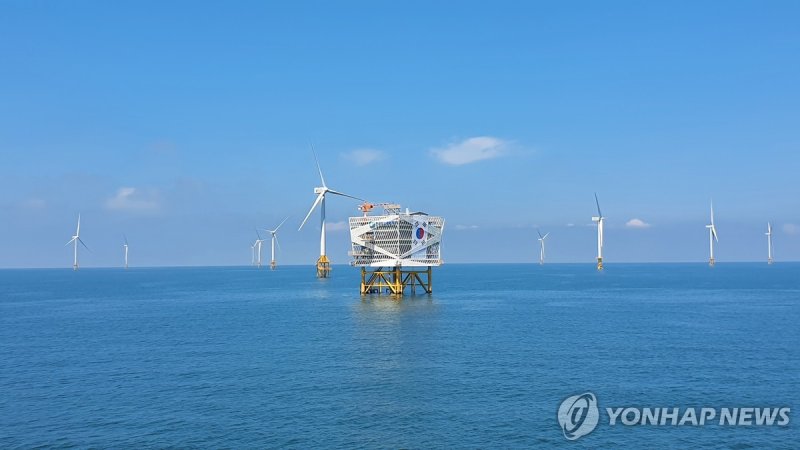
The expansion of renewable installations is still accelerating
According to industry sources on the 11th, the rollout of renewable energy is progressing rapidly worldwide. As of 2024, renewables account for 32% of global power generation, up 12 percentage points from 2010. Combined output from solar and wind has, for the first time, surpassed that of hydropower.The International Energy Agency (IEA) projects that this share will reach 43% by 2030. In Korea, wind and solar together account for only about 6% of power generation, less than half the global average share of roughly 15%. Korea relies on fossil fuels for 80% of its primary energy, and 93% of those fuels are imported. Annual energy import costs amount to about 240 trillion won. When the Strait of Hormuz was effectively blockaded in April 2026 due to war involving the United States of America (US), the State of Israel, and the Islamic Republic of Iran, this structural vulnerability came back into sharp focus. In response, the government officially committed at a Cabinet meeting on the 6th to achieving the 2030 target of 100 GW of renewable capacity ahead of schedule through the Energy Transition Promotion Plan.
To increase capacity from the current 34 GW to 100 GW, Korea must add roughly 11 GW of new installations every year through 2030. Solar power will be the main driver of this expansion, supplemented by offshore wind. The government plans to build large-scale clusters in areas such as Saemangeum and off the coast of South Jeolla Province, and to roll out nationwide a "Sunlight and Wind Pension" model that shares power-generation profits with local residents. Officials justify these targets on three grounds: responding to the climate crisis, achieving energy self-reliance, and revitalizing regional economies. Domestic environmental groups also label renewables as "eco-friendly" energy and are calling for a 100% transition.
The environmental costs left behind by renewables
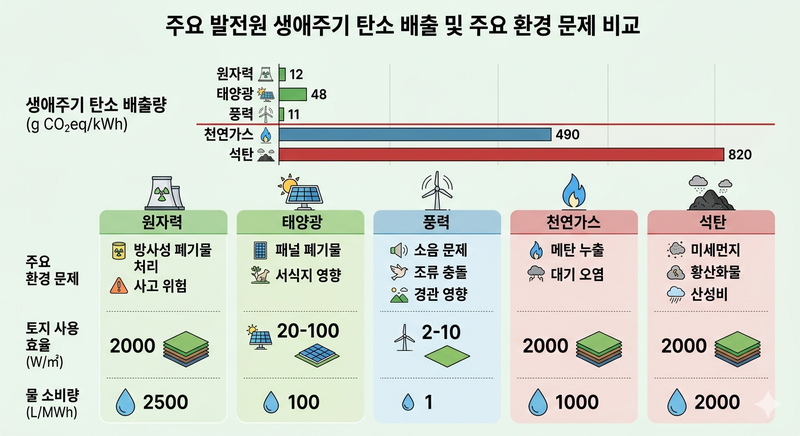
The logic behind calling renewable energy eco-friendly is simple. It does not emit carbon during operation, and its life-cycle carbon emissions are significantly lower. Measured by life-cycle carbon emissions—grams of CO2 equivalent per kilowatt-hour generated (gCO2eq/kWh)—solar power stands at 48, while coal is 820, a 17-fold difference. Yet environmental impact cannot be measured by carbon emissions alone. Ecosystem destruction, land use, water pollution, loss of biodiversity, hazardous substances, mineral extraction, and waste are all part of environmental impact. When carbon is used as the sole benchmark, all these other factors are excluded from the assessment. Critics argue that being better than coal does not erase these other impacts.
Manufacturing solar panels requires critical metals such as indium, tellurium, and silver. The solar industry now consumes more than 10% of global silver production each year. China, which produces over 80% of the world’s panels, relies heavily on coal-fired power, meaning many panels are effectively manufactured using coal-based electricity. Panel lifespans are 25 to 30 years, so large-scale disposal will begin in the late 2030s. The International Renewable Energy Agency (IRENA) estimates that cumulative waste from discarded panels could reach up to 78 million tons by 2050. Panels are composite materials made of glass, lead, and cadmium, and with current technology they are difficult to recycle economically. In Korea, more than 70% of the land consists of slopes or protected areas, so large-scale solar farms inevitably encroach on mountains and farmland. If the Lee Jae-myung administration adds 11 GW of capacity every year, ecological damage from site development will grow at the same pace. Wind turbine blades are made of glass fiber–reinforced plastic (GFRP), which is also not economically recyclable. When they reach the end of their life, blades are landfilled or incinerated, and materials requiring landfill could total several million tons by 2050. Rotating blades also kill birds and bats; in the US, estimated annual bird deaths range from 140,000 to 500,000. Energy storage systems (ESS), which compensate for the intermittency of renewables, require large amounts of cobalt and lithium. About 70% of the world’s cobalt is produced in the Democratic Republic of the Congo (DRC), where child labor and wastewater pollution are repeatedly reported. In the Lithium Triangle in South America, lithium extraction consumes vast quantities of water in already arid regions. ESS units also carry a risk of thermal runaway and fire. In Korea, there were 28 ESS fire incidents between 2018 and 2019.

An Energy Transition Promotion Plan with numerical targets but no environmental policy
The Lee Jae-myung administration’s Energy Transition Promotion Plan includes a target of 100 GW of installed capacity and a schedule to add 11 GW of new facilities each year. However, the plan contains no itemized assessment of the environmental costs that will accompany this expansion. It does not specify the area of mountains and farmland that will be disturbed, rules for handling discarded panels, or human-rights and environmental standards for ESS supply chains. If setting installation targets is an energy policy decision, then determining what kinds of ecological damage will occur, and on what scale, is an environmental policy decision. The current plan includes only the former, not the latter.
When policymakers present only numerical targets and skip cost assessments, the trade-off between installation speed and ecological impact disappears from the policy debate. The label "renewable energy" ends up functioning as a substitute for environmental impact assessment. In this framework, the judgment that renewables are "less bad" is effectively treated as if they are "problem-free." Under such a structure, the 100 GW plan is calculated in terms of how much carbon it will cut, but not in terms of how many hectares of forest will be cleared or how many tons of waste panels will accumulate in the 2050s.
The introduction of a fast-track system for offshore wind, which shortens site-approval procedures, is also drawing criticism. Even now, many projects under the Southwest Offshore Wind Power Project along the southwestern coast of Korea are delayed at the permitting stage due to concerns over damage to fisheries and disputes over marine environmental impact assessments. These delays are a sign that the regulatory system is functioning. The failure to obtain permits also indicates that ecological damage is a real concern. Observers warn that a fast-track system would mute these warning signals and bring forward the onset of environmental harm.
Speeding up site approvals does not reduce ecological damage. If permits are rushed now to meet the 2030 target, the environmental harm will persist long after 2030. Construction may be completed within a few years, but the resulting changes to ecosystems will unfold over decades.
If the Lee Jae-myung administration installs 11 GW of solar capacity every year, those facilities will all reach the end of their life at roughly the same time between 2055 and 2060, 25 to 30 years from now. Korea currently has no standalone law that specifically governs the disposal of waste panels. The faster installations grow, the more quickly future waste burdens accumulate. Today’s installation decisions are effectively booking an environmental problem for 30 years down the line.
Waste batteries pose the same structural problem. The ESS expansion plan sets targets for battery installations, but the document is silent on standards for handling end-of-life batteries or environmental requirements for supply chains. Lithium-ion batteries typically last 10 to 15 years. Batteries being installed now will reach disposal around 2035 to 2040. Without rules in place ahead of that time, critics warn, the costs will inevitably be passed on to the next administration.
"Climate, environment, and energy are like two sides of the same coin. Depending on how we produce energy, we can accelerate global warming, while in the opposite direction, changes in climate and the environment can reshape energy demand and supply."[Lee You-beom's Eco & Energy]will explore climate, environmental, and energy issues that are inseparable from one another, and will be published every Saturday for our readers. Subscribe to the reporter’s page to receive it conveniently. Due to reporting schedules, the column will take a one-week break and return in the April 25 edition.
[email protected] Lee You-beom Reporter