President Lee: "Law Intended to Protect Fixed-Term Workers Has Become a 'Total Ban on Employment Beyond Two Years'"
- Input
- 2026-04-10 13:47:30
- Updated
- 2026-04-10 13:47:30
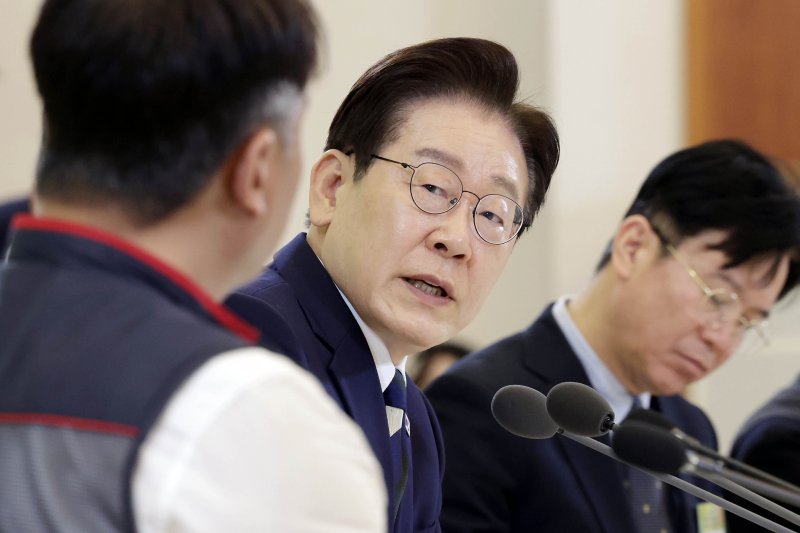
According to The Financial News, on the 10th President Lee Jae Myung criticized the two-year limit on fixed-term employment contracts, saying, "The law that was created to protect workers has in effect become a law that absolutely bans employment beyond two years." He publicly raised the need to revise the system, arguing that a scheme introduced to protect non-regular workers has, in reality, led to repeated 1-year-and-11-month contracts and forced unemployment.
In his opening remarks at the meeting with the Korean Confederation of Trade Unions (KCTU) held at Cheong Wa Dae that day, Lee said, "The provision in the law that says workers must be made permanent after two years of employment looks excellent on paper, but in reality employers simply cut contracts off at exactly 1 year and 11 months and never sign anything beyond two years." He went on, "Even in positions where they could use someone for four or five years, or even five to ten years, they hire for 1 year and 11 months, take a short break, and then sign another 1-year-and-11-month contract," adding, "There are aspects of this that effectively force unemployment."
Lee reiterated, "The Act on the Protection of Fixed-Term and Part-Time Employees was ultimately designed to convert ongoing work that lasts more than two years into regular employment, but in practice it has turned into a de facto law that absolutely prohibits employment beyond two years." He added, "I hope we can seriously consider how to resolve this issue in a practical way."
These remarks came as he addressed discrimination against non-regular workers and polarization in the labor market. Lee said, "It has become almost common sense that people doing the same work are paid far less if they are non-regular workers than if they are regular employees," and, "Simply because they are non-regular, they do the same job but receive less, and the shorter their contract period, the less they are paid." He added, "This also has the effect of forcing polarization within the workforce."
He also criticized the reality in which protections for regular workers have, in effect, led to fewer new hires and more indirect forms of employment. Lee said, "From the employer’s point of view, it has become almost a given that they will never hire regular workers," and, "Whenever possible, they resort to in-house subcontracting and dispatched labor, and on top of that, all sorts of tricks are used so they only employ people for 1 year and 11 months." He assessed, "Efforts intended to improve overall working conditions and strengthen the status of workers ultimately seem to be weakening their treatment and standing."
Lee stressed that social dialogue among the government, labor, and management is needed to break this vicious cycle. He said, "The government must firmly take the lead and assume responsibility, and through genuinely serious dialogue, confirm each side’s situation and ensure that the concessions they make are matched by what they gain," adding, "It would be good to hold discussions so that we can come up with realistic alternatives to the two-year limit on fixed-term contracts." He also called on the KCTU to participate more actively in social dialogue.
He also raised the issue of collective rights for small business owners. Lee said, "Small business owners should be allowed to engage in collective bargaining, and at the very least their right to organize must be guaranteed," and, "Suppliers, franchisees, and individual outlets should be given the opportunity to negotiate collectively." He pointed out, "Right now, such activities are all banned and subject to punishment under the Monopoly Regulation and Fair Trade Act (MRFTA)."
[email protected] Reporter Seong Seok-woo Reporter