"We used to meet whenever we came here, but now everyone is scattered"... Daily lives of seniors vanish with the janggi boards [Chronicler of the Lowly]
- Input
- 2026-04-12 06:00:00
- Updated
- 2026-04-12 06:00:00
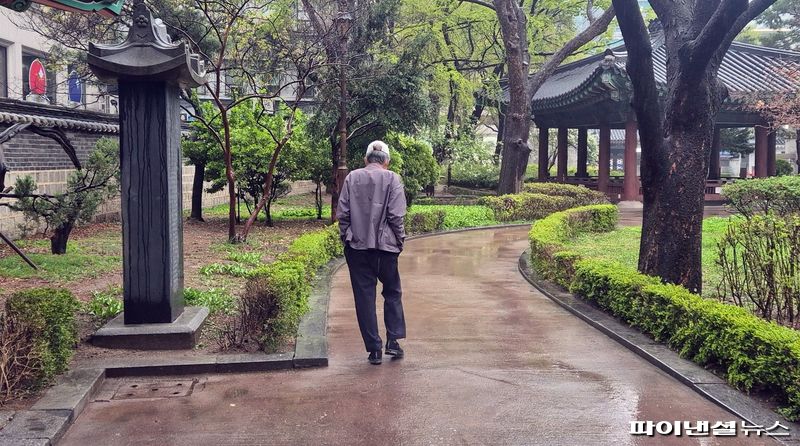
Photo by Han Seung-gon Since the janggi boards were removed from Tapgol Park, older people have stopped coming as they used to. Seniors we met on site said they now have fewer places to stay and fewer spaces to exchange greetings. We looked at where older people spend time and how they maintain relationships in a super-aged urban society, and what the changes in the park reveal about the reality of spaces for older adults.
(Editor’s note) [The Financial News] "In the past, a whole day would pass once I came here. I met people, chatted with them, and that was my day." This is how a 78-year-old man, identified by the surname Kim, described it after looking around Tapgol Park in Jongno District on the afternoon of the 9th. Because it was raining that day, the park was even quieter than usual. Only a few seniors passed by the pavilion and along the paths, and not many stayed for long.
On the park’s wall, there were notices designating it as an alcohol-free zone and a banner reading "Please take care of Tapgol Park. " In November last year, Jongno District designated the inside and outside of Tapgol Park as the first alcohol-free zone in the district. Since April 1 this year, it has been imposing a 100,000 won fine for drinking and similar behavior. The district explained that the measure is meant to restore the park’s historical character as a symbol of the March 1st Independence Movement and to curb indiscriminate drinking, while also improving the preservation environment for the Ten-story Stone Pagoda at Wongaksa Temple Site. The janggi boards that used to line the streets have been moved to facilities managed by the district.
Janggi boards moved to Nakwon Shopping Mall, but the park’s old daily rhythm has not returned The purpose of the park maintenance was clear, but many seniors could not hide their disappointment.An 82-year-old man, identified by the surname Park, said, "In the past, whenever I came here, there were always familiar faces, but now everyone is scattered. " Another man, surnamed Lee, 75, added, "There should be somewhere in the park where we can sit and talk, but now we just take a quick look around and leave. " The spots along the park’s edge where people played janggi and baduk were places where seniors could come and go freely without cost or formalities, pass the time, naturally strike up conversations with others, and spend the day.
That does not mean older people have been left with nowhere to go at all.Jongno District opened a Tapgol Senior Cultural Playground on the first floor of Nakwon Shopping Mall in February, and it has been operating every day except public holidays since March. The facility has 17 tables and boards for janggi and baduk. According to the district, the cumulative number of visitors since opening is 1,124, with an average of about 60 users per day. Kim, the 78-year-old man we met near the park, said, "It’s better in that we can go inside when it rains or is cold." However, a 69-year-old man, identified by the surname Choi, said "You have to make a point of going there, and it doesn’t have the same feel as just blending in with people’s faces in the park like before" and Lee, 75, also said "You could just drop by the park as you were passing, but that place feels different.
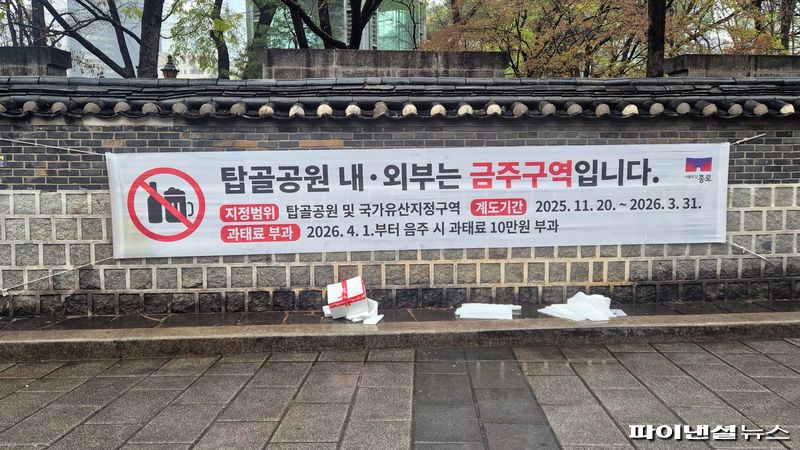
Since April 1, 2026, Jongno District has been imposing a 100,000 won fine for drinking within Tapgol Park and the designated national heritage area. Photo by Han Seung-gon Empty spaces in old age revealed by Tapgol Park in a super-aged society The sense of loss voiced by seniors in Tapgol Park is not just a problem of one park.
In a Korea that has entered a super-aged society, the daily lives of older people themselves are already changing. 2%.
In other words, use of formal, institutional facilities is declining, while relationship-based activities centered on peers are becoming more important. This shift is also evident in analysis by the Korea Institute for Health and Social Affairs (KIHASA). In the November 2024 issue of its Health and Welfare Policy Forum, in an article titled "Older Adults’ Family and Social Relationships," KIHASA reported that analysis of the 2023 National Survey of Older Koreans showed a solidifying trend of older single-person households, shrinking blood-tie-centered networks, and stronger peer-based networks.
It went on to recommend greater policy attention to older adults at high risk of social isolation, more support to help them maintain and strengthen peer relationships, and diversification of mechanisms that can complement informal care. The National Assembly Research Service (NARS) has raised similar concerns. In a November 2023 report titled "Exploring Ways to Improve Laws and Systems for Older Adults in Response to a Super-Aged Society," NARS argued that older people should be seen as a group with diverse needs and social backgrounds, not as a category that can be defined by age alone.The report also noted that the entry of baby boomers into old age, the trend toward healthy aging, and the growth of "active seniors" who actively engage in leisure and cultural activities are already well under way.Ultimately, as society becomes more super-aged, spaces where older adults can routinely stay and maintain relationships are becoming ever more important. The disappointment voiced in Tapgol Park is closely tied to these broader changes.
It raises the question of where older people can spend time, with whom they can sustain relationships, and how policies can be designed to support these changes.
Finding places for older adults to stay within their own neighborhoods Many other countries address aging not simply by increasing the number of facilities, but by building structures that help people maintain relationships within their everyday living areas. The National Health Service (NHS) in the United Kingdom explains that it uses "social prescribing" to connect people with local activities, groups, and services. The Republic of Singapore operates Active Ageing Centres close to residential areas; according to government data, 223 centers are currently in operation, and 8 out of 10 older adults can access a center near their home.
Japan implemented the Act on the Advancement of Measures to Address Loneliness and Isolation in April 2024, establishing a system in which the central and local governments work together on problems of social disconnection. Korea is also working to improve its systems, but many say that measures felt on the ground, within people’s daily living areas, are still far from sufficient. Places where people used to gather have already emptied out, while the spaces and structures meant to replace them are lagging behind. Even after the janggi boards were moved from Tapgol Park to Nakwon Shopping Mall, the seniors’ core message remained the same: having an indoor space is not the same as the park’s role as a place where they could drop by, exchange greetings, and spend half the day.
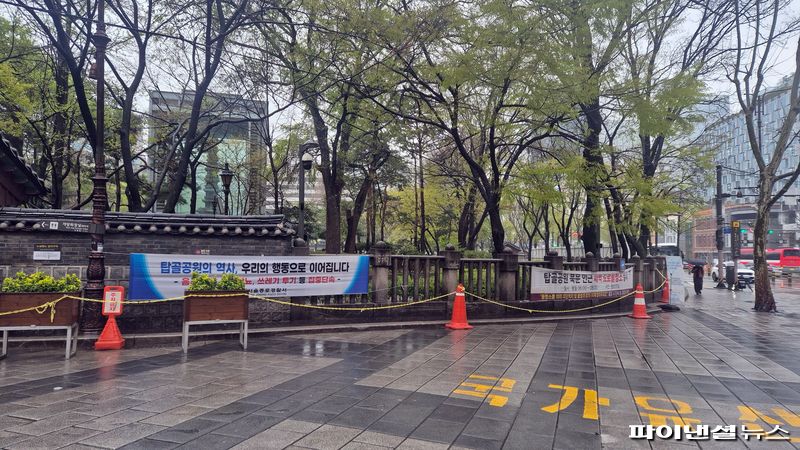
Photo by Han Seung-gon Beyond protection, toward older age embedded in the community Given this situation, some argue that we must move beyond the traditional view of older people solely as objects of protection and support. As life expectancy rises and the trend toward healthy aging becomes clearer, it is increasingly difficult to see older adults simply as a uniform group in need of welfare.
In particular, as family-centered networks weaken and single-person and peer-centered relationships grow, there is a growing call to see older adults again as members of the community who form relationships and continue to play roles within it.Rather than approaching later life only in terms of institutional care or formal care services, we need to design structures that allow older adults to stay, meet, and participate in everyday life at the same time.
This perspective was also raised at a policy forum titled "Seeking New Paths for a Dignified Old Age," jointly hosted in January this year by the Presidential National Unity Committee, the Korean Senior Citizens Association, and The Korean Gerontological Society.Jung Soondul, a professor in the Department of Social Welfare, Ewha Womans University, stressed that policies for older adults in a super-aged society should not remain stuck in viewing them only as objects of protection, but must be redesigned so that they can continue their relationships and roles within the community. Jung said, "At present, Korea’s old-age poverty rate is the highest among OECD countries, and older adults are socially isolated through ageism and discrimination," adding, "We need to build an intergenerationally integrated society for all generations.
" We record dense stories of life in print. We capture, as they are, the rough but vivid words we pick up in the field. From alleys and markets to someone’s workplace, records of ordinary days that we have passed by will find their way to you, our readers.[Chronicler of the Lowly] To receive this series comfortably, please subscribe to the reporter profile page.
[email protected] Han Seung-gon Reporter