NATO: "We can help in the Hormuz situation, but step by step"
- Input
- 2026-04-10 10:05:15
- Updated
- 2026-04-10 10:05:15
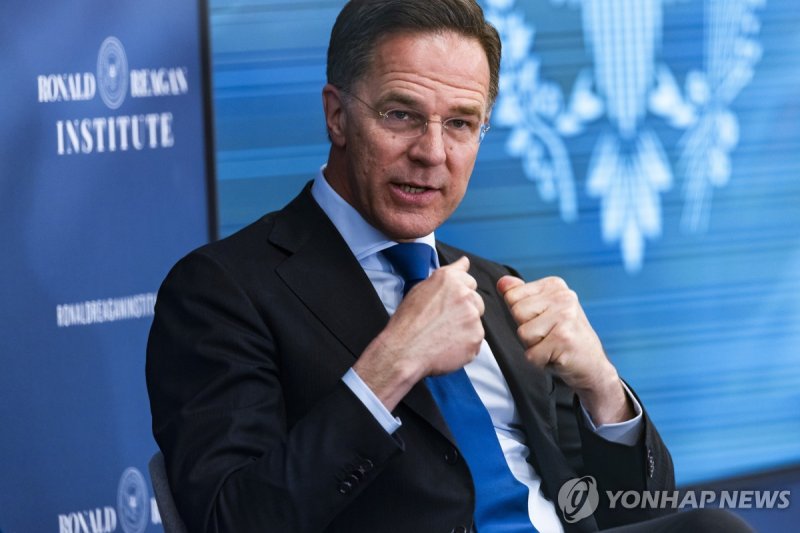
[The Financial News] NATO Secretary-General Mark Rutte has hinted at a possible expansion of the alliance’s role in the issue of the Strait of Hormuz, while at the same time sending a message that the pace must be carefully managed. His stance is seen as a strategy to opt for gradual involvement rather than fully and immediately accepting the United States’ requests.
Speaking at an event in Washington, D.C. on the 9th (local time), Secretary-General Rutte stated, "If NATO can help, there is no reason not to," but added that it "has to be done step by step." Because NATO involvement requires consensus among member states, he effectively drew a line against any immediate military intervention.
His remarks are being interpreted as an attempt to find a middle ground between pressure from United States President Donald Trump and the political and security burdens within Europe. In fact, President Trump has been urging European countries to swiftly present concrete measures to ensure safe passage through the Strait of Hormuz.
Rutte noted that military leaders from around 30 countries recently met to discuss security in the strait, describing this as a "first-stage measure." In other words, he underscored that multinational consultations and preparations are already under way before any full-scale NATO involvement.
Responding to criticism that Europe was slow to react in the early phase of the war, he commented that "some allies were taken by surprise" and suggested that President Trump may not have shared information in advance in order to preserve the element of surprise. At the same time, he stressed that "almost all allies are now responding to U.S. requests," highlighting Europe’s current cooperation.
In practice, the United States is reported to be increasing pressure by considering redeployment of United States Forces in Europe, depending on the level of cooperation from NATO member states. European governments therefore have to weigh both security risks and domestic political costs.
Rutte also made clear that the Strait of Hormuz issue should not be viewed as an internal NATO matter alone. He said that Japan, South Korea, Australia and others should work together on the problem, emphasizing an expanded concept of alliance. His explicit mention of the Republic of Korea (ROK) and Japan reflects the global nature of securing stable energy supply routes.
He further linked the question of the Islamic Republic of Iran to the case of the Democratic People's Republic of Korea (DPRK), underscoring the risks of nuclear proliferation. Citing how the DPRK managed to secure nuclear capabilities during prolonged negotiations, he voiced concern that Iran could follow a similar path.
Until now, Secretary-General Rutte has generally responded in a conciliatory manner to President Trump’s demands for higher defense spending. However, observers view the current issue as a critical turning point that will test both NATO’s role and the burdens it must shoulder. Politico noted that skepticism about Rutte’s strategy is spreading as anti-American sentiment grows in Europe.
[email protected] Reporter Kim Kyung-min Reporter