"A housing market disaster is coming"...chilling warning: "Without this, there will be no new supply"
- Input
- 2026-04-10 15:00:00
- Updated
- 2026-04-10 15:00:00
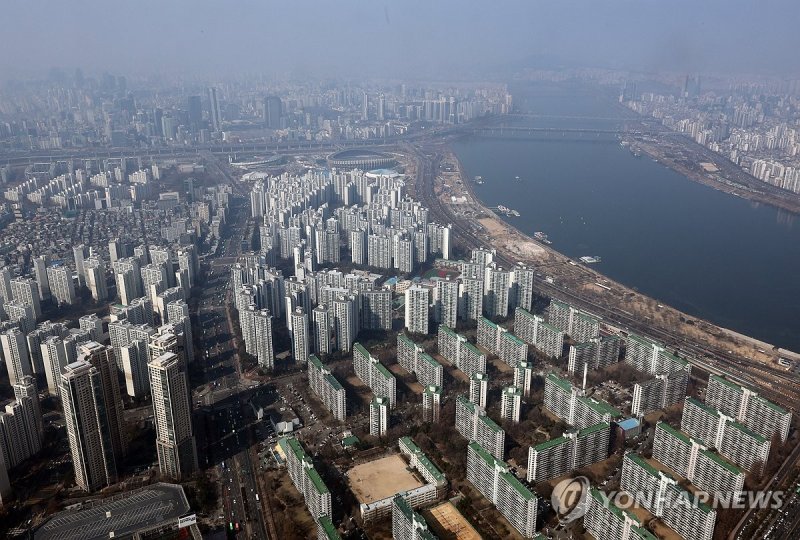
[Financial News] A new analysis shows that redevelopment and reconstruction projects now account for more than 90% of new apartment move-ins in Seoul. This is an unprecedented figure. As available land for new housing sites dries up, it effectively means there is no viable supply channel other than urban renewal projects. According to the Seoul Metropolitan Government, these projects take an average of 18.5 years to complete.
According to an analysis released on the 10th by Real Estate R114, the total number of new apartment move-ins in Seoul last year, excluding rental units, was 32,370. Of these, 29,413 units came from redevelopment and reconstruction projects, representing 91% of the total. A review of annual data back to 2001, commissioned from Real Estate R114, shows that this is the first time the share has exceeded 90%.
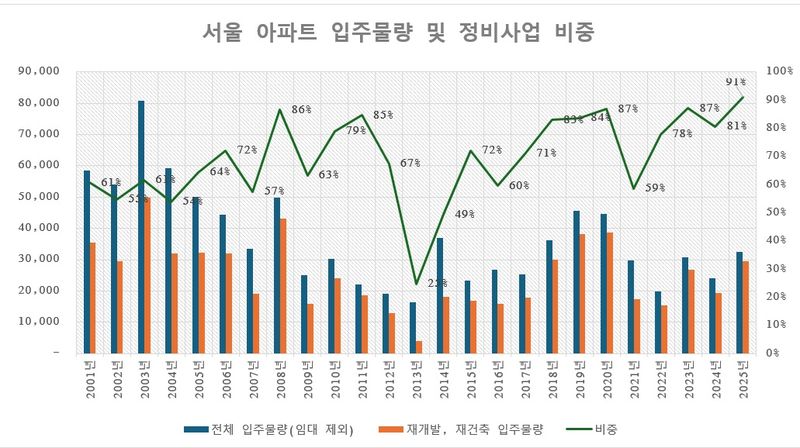
The statistics show that the share of redevelopment and reconstruction in Seoul’s housing supply has recently hovered in the 80% range. It stood at 78% in 2022, 87% in 2023, and 81% in 2024.
Kim Ji-yeon, senior researcher at Real Estate R114, said, "Last year was the first time since 2001 that the share of redevelopment and reconstruction projects exceeded 90%." She added, "It has now become difficult to expect any new housing supply without these projects."
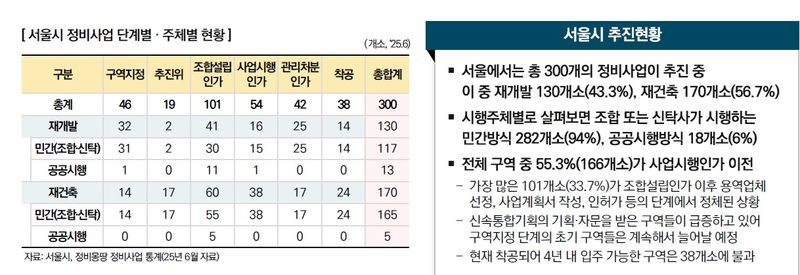
An analysis by the Housing Industry Research Institute shows that, as of June 2024, a total of 300 redevelopment and reconstruction projects were under way in Seoul. By type, there were 130 redevelopment projects and 170 reconstruction projects.
The data also show that 4 out of 10 redevelopment sites are clustered in northern and outer parts of Seoul, such as Seongbuk, Dongjak, and Dongdaemun District. Meanwhile, 67% of reconstruction projects are concentrated in the Gangnam 3 Districts (Gangnam-gu, Seocho-gu, and Songpa-gu), as well as Yongsan and Yeouido. Of all designated project areas, 166 sites, or 55.3%, are still at stages prior to receiving project implementation approval.
Compounding the problem is the long lag before these projects translate into actual housing supply. An analysis by the Seoul Metropolitan Government shows that the average project duration is 18.5 years.
An official at the Housing Industry Research Institute noted, "In Seoul, the average project cost per designated renewal area is about 850 billion won for redevelopment and 930 billion won for reconstruction." The official continued, "Despite the large scale of these projects, many problems are arising due to factors such as a lack of expertise among project associations, delays in permits and approvals, and frequent policy changes."
Many experts argue that institutional support is needed to speed up these projects. Jeongseob Kim, a professor at the Ulsan Institute of Science and Technology Policy, said, "Despite ongoing housing supply efforts, the housing supply rate in Seoul continues to decline." He added, "Project timelines of more than 18 years until completion are directly leading to supply delays."
Kim stressed, "We need to strengthen the division of roles and cooperation between the public and private sectors to expand housing supply in urban areas." He went on, "It is also worth considering the introduction of a tentative 'Housing Supply Promotion Zone' system that would offer incentives in areas suffering from a shortage of new housing."
[email protected] Lee Jong-bae Reporter