Koo Yun-cheol: "We are closely coordinating the passage of our ships through the Strait of Hormuz"
- Input
- 2026-04-10 09:01:15
- Updated
- 2026-04-10 09:01:15
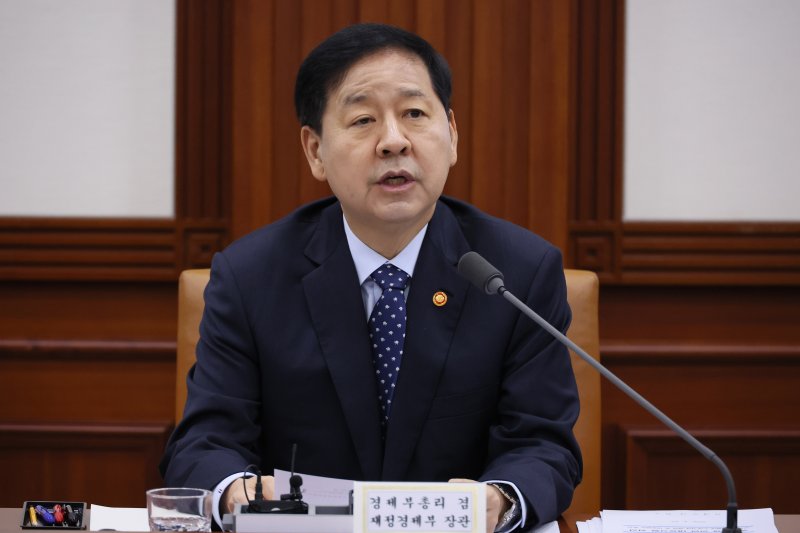
[Financial News] Koo Yun-cheol, Deputy Prime Minister and Minister of Finance and Economy, said on the 10th, "We will maintain close communication with shipping companies and relevant countries so that South Korean vessels can pass through the Strait of Hormuz as quickly as possible."
Presiding over the Emergency Economic Headquarters Meeting and the Council of Economic Ministers at Government Complex Seoul that day, Deputy Prime Minister Koo stated, "The war in the Middle East has reached a major turning point with the ceasefire agreement, but uncertainty remains high, and the shock to supply chains and its impact are still unfolding."
Koo stressed, "While closely monitoring the supply and demand and price trends of key items, as well as their impact by industry, we will swiftly resolve corporate difficulties arising from supply chain instability."
On the 8th, the Government of South Korea designated seven basic petrochemical feedstocks as crisis items under the Framework Act on Supply Chain Stabilization Support for Economic Security.
Naphtha and other raw materials are currently being prioritized for healthcare and essential daily necessities.
At the meeting, officials reviewed the response to the war in the Middle East and discussed measures to support public contracts, improve the system for holding and managing virtual assets in the public sector, and strengthen the effectiveness of the Personal Information Management System (PIMS).
The Government of South Korea will ease regulations and expand support for companies that are struggling to fulfill public contracts due to supply chain disruptions.
Regulations have been relaxed so that contract amounts can be adjusted even within 90 days when raw material prices surge and a price revision is necessary. Previously, adjustments were in principle allowed only after at least 90 days had passed since the contract date.
If contract performance is delayed due to disruptions in the supply of raw materials, delivery deadlines will be extended and no liquidated damages will be imposed.
Starting this month, the price survey cycle for major construction materials such as steel products will be shortened from every six months to every month so that changes can be reflected in costs immediately.
In response to a series of recent thefts and losses of virtual assets in the public sector, the system for holding and managing such assets will also be improved.
The government plans to establish guidelines on compliance requirements for each stage, from the acquisition and storage of virtual assets to incident response, and apply them across the entire public sector. It will also require the installation or designation of dedicated organizations and personnel responsible for managing virtual assets held by the government, public institutions, and local governments.
To protect personal information held by companies from hacking and other threats, oversight and certification of information-holding companies will be strengthened.
Large-scale personal data handlers whose operations have a significant impact on people’s daily lives will be required to obtain Personal Information Protection Certification. For companies that suffer serious data breaches, post-management will also be reinforced, including the possibility of revoking their certification.
[email protected] Jung Sang-geun Reporter