Government: "If transit fees are imposed in the Strait of Hormuz, domestic gasoline prices could rise by 0.5%"
- Input
- 2026-04-09 18:20:33
- Updated
- 2026-04-09 18:20:33
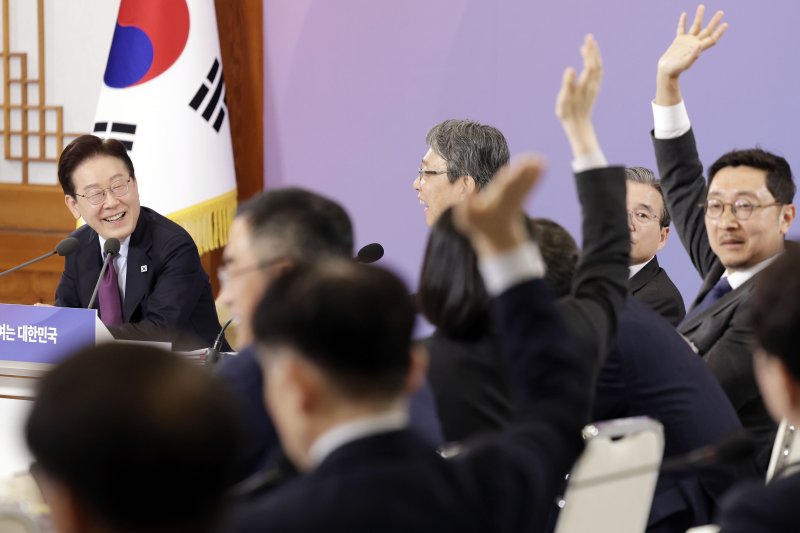
■ President Lee: "Hard to know when the situation will be resolved"
In the morning, President Lee presided over the first plenary session of the National Economic Advisory Council, and in the afternoon he chaired a meeting of his senior secretaries, discussing response measures to the situation in the Middle East.
At the first plenary session of the National Economic Advisory Council, President Lee said of the Middle East situation, "It is very difficult to know when this situation will be brought under control." At the senior secretaries' meeting, he noted that "with the United States and the Islamic Republic of Iran agreeing to a two-week ceasefire, the Middle East conflict, which had been deteriorating rapidly, is entering a new phase," but he also emphasized, "It is still too early to be optimistic about the outcome, and even if negotiations proceed smoothly, there is a high risk that the shock of the war will continue for a considerable period of time."
He went on, "The government must not relax its vigilance for a moment and should push ahead in a more detailed and preemptive manner with well-prepared measures for every possible scenario," adding, "The most urgent task is to ensure the safe return of our seafarers and vessels currently stranded in the Strait of Hormuz." He also called for thorough efforts to ensure stable supplies of crude oil and key raw materials, as well as items that have recently raised supply concerns such as plastics, vinyl products, and medical supplies.
President Lee said, "However and whenever the war in the Middle East comes to an end, the world after the war will be completely different from the world before it," and continued, "We must accelerate diversification of our energy supply sources, the transition to a society centered on renewable energy, and innovation in our industrial structure, while also redoubling efforts to foster future growth engines such as ultra-advanced AI, next-generation Small Modular Reactors (SMR), AI, and Robot technologies."
Policy recommendations in response to the Middle East situation followed. At the plenary session of the National Economic Advisory Council, Park Won-joo, Head of the Strategic Economic Cooperation Division, presented on "Emergency Economic Conditions Triggered by the Middle East and Strategies to Overcome the Crisis." On nuclear power plants, he said, "We should adjust maintenance schedules so that nuclear power plants can operate at maximum capacity this winter, and we must establish a legal basis to allow plants whose design life has expired to continue operating temporarily."
Regarding the oil price cap system, he noted that it "played a decisive role in stabilizing the market in the early stages," but added, "As the crisis is expected to be prolonged, it is now necessary to phase it out." He further argued, "From the perspective of emergency support for companies, the 26.2 trillion won supplementary budget should be executed with priority for energy, livelihoods, and liquidity support for small and medium-sized enterprises," and said, "We also need to provide logistics cost support for export companies and make reasonable adjustments to electricity rates. In addition, it may be time to consider temporary free public transportation."
Keunkwan Ryu, Head of the Growth and Economic Restructuring Subcommittee, addressed issues such as AI, the labor market, and education in his presentation on "Structural Transformation of the Korean Economy and Society and Strategies for Sustainable Growth." He advised in particular that "to save regional areas facing the risk of extinction, we need large-scale, comprehensive investment at a level sufficient to prevent depopulation."
■ Government mobilizing all efforts to secure crude oil and naphtha supplies
As the shock from the war in the Middle East continues, the government is focusing all its efforts on stabilizing supplies by securing crude oil and naphtha volumes for July. Gasoline prices have been steadily rising since the implementation of the second phase of the price cap, but they have not yet reached the 2,000 won per liter level that was initially feared.
On the same day, Yang Ki-uk, Director-General for Industrial and Resource Security at the Ministry of Trade, Industry and Resources, said at the daily briefing of the Middle East Situation Response Headquarters, "We have already secured 50 million barrels of crude oil for April and 60 million barrels for May, and we are currently securing additional volumes for July." Korea National Oil Corporation (KNOC) is also in the process of securing about 2 million additional barrels through imports of its overseas production. A total of seven oil tankers are stranded in the Strait of Hormuz, four of which have been confirmed to belong to Korean shipping companies. Regarding reports that the Islamic Republic of Iran is demanding transit fees in cryptocurrency or Renminbi (RMB), Yang said, "We have not yet received any official request for transit fees," but he added that a simple calculation suggests that if a transit fee of 1 dollar per barrel were imposed, it could lead to a price increase of between 0.5% and less than 1% in domestic gasoline prices.
[email protected] Choi Jong-geun, Sung Seok-woo, Park Ji-young Reporter