Rise in Fuel Prices Slower Than Expected... Third Oil Price Cap Frozen at Second-Phase Level
- Input
- 2026-04-09 19:10:00
- Updated
- 2026-04-09 19:10:00
■ Third oil price cap frozen
The Ministry of Trade, Industry and Resources announced on the 9th that the third-phase oil price cap applied to refinery supply prices will be frozen at the second-phase level. Under the cap, third-phase maximum prices per liter are set at 1,934 won for gasoline, 1,923 won for diesel, and 1,530 won for kerosene, identical to the second phase. The third-phase cap will be in effect for two weeks, from the 10th to the 23rd.
The Ministry of Trade, Industry and Resources said it took into account recent movements in international crude prices when deciding to freeze the cap. During the second phase, the Middle East conflict rapidly changed global conditions, causing sharp day-to-day swings in oil prices and significant volatility. However, over the two-week period, overall international prices did not deviate much from the average level. The ministry explained that it considered both this trend and the price levels in making its decision.
Yang Ki-uk, Director-General for Industrial and Resource Security at the ministry, said, "Over the past two weeks, there were sudden factors, namely fluctuations in international oil prices, that we could not ignore," and added, "The basic purpose of the oil price cap system is to ease the burden on the public by smoothing out large price swings and preventing excessive increases, while still sending price signals and managing demand."
As in the second-phase decision, diesel and kerosene, which are more essential for economic activity and livelihoods, were given greater weight than gasoline.
Yang said, "Most diesel consumers use it in the course of economic activities such as transportation and logistics," and explained, "Given the difficulties caused by the Middle East situation and high oil prices, we judged that diesel and kerosene require more consideration than gasoline."
■ "Domestic fuel price increases milder than expected"
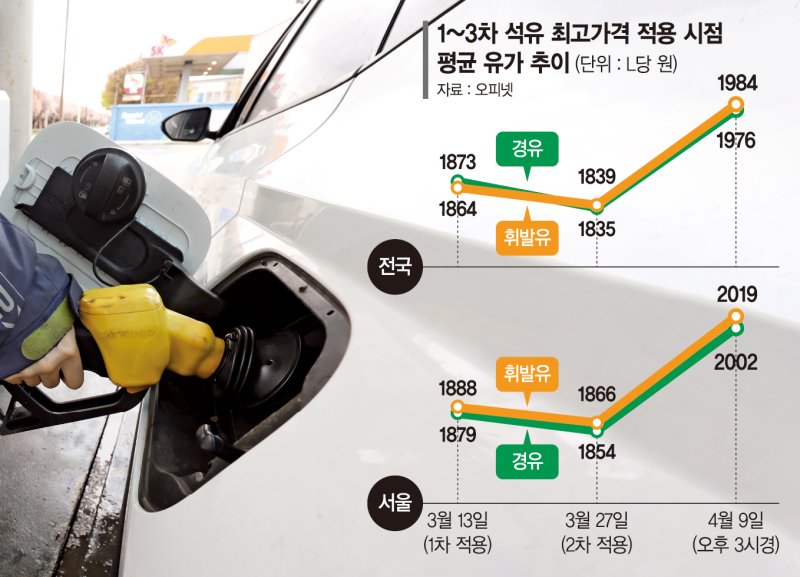
The Ministry of Trade, Industry and Resources believes that prices of petroleum products such as gasoline and diesel have risen more slowly than initially expected since the second phase of the oil price cap system took effect. Even so, the nationwide average prices of gasoline and diesel during the third phase are highly likely to exceed 2,000 won per liter.
According to Korea National Oil Corporation (KNOC)'s Opinet service, as of 4 p.m. that day, the national average prices per liter for gasoline and diesel stood at 1,985 won and 1,978 won, respectively, nearly reaching 2,000 won. In Seoul, the average price has already surpassed the 2,000-won mark.
Yang said, "When we implemented the second phase of the oil price cap system, we expected prices to slightly exceed 2,000 won per liter, but they have not yet reached that level, so the upward trend has been relatively moderate," adding, "Because we have frozen the third-phase cap, the impact on consumer prices will be limited, but the upward trend that began after the second phase is continuing."
Meanwhile, the government plans to continue inspections to identify gas stations that set prices above the capped level.
Since the oil price cap system was introduced last month, the government has carried out special inspections of 4,851 gas stations and uncovered a total of 85 cases of illegal practices. Administrative sanctions have already been imposed in nine of those cases, and authorities plan to swiftly take action on the remaining violations as well.
[email protected] Kim Jun-hyuk Reporter