[Editorial] Separate Bargaining with Private-Sector Subcontractors First Recognized, Follow-Up Measures Needed to Reduce Confusion
- Input
- 2026-04-09 18:08:26
- Updated
- 2026-04-09 18:08:26
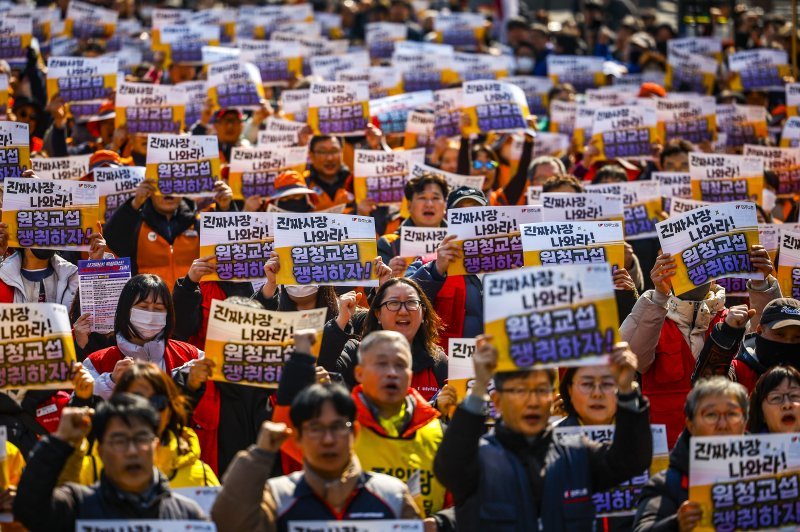
On the 8th, the Gyeongbuk Regional Labor Relations Commission accepted a request from the POSCO Subcontractors Branch of the Korean Metal Workers’ Union under the Korean Confederation of Trade Unions and from subcontracted workers affiliated with the KCTU National Plant Construction Workers' Union. They had asked that POSCO be recognized as their employer and that their bargaining unit be separated. This came roughly one month after the amended Trade Union Act, commonly known as the Yellow Envelope Law, took effect on the 10th of last month.
Until now, bargaining by subcontractor unions has mainly taken place with subcontracting firms that have direct employment relationships with the workers. The labor commission’s decision to allow separate bargaining this time stems from the enforcement decree of the Yellow Envelope Law, which permits the separation of bargaining units based on factors such as the "commonality of interests between unions" or the "potential for conflict between unions." As a result, if subcontractor unions belong to different umbrella organizations such as the Korean Confederation of Trade Unions (KCTU) or the Federation of Korean Trade Unions (FKTU), or if their working conditions differ, they can now be granted independent bargaining rights.
Following this decision, companies will face a heavier burden as they must respond to a multitude of separate demands raised by various subcontractor unions. Concerns over so-called "fragmented bargaining" are becoming a reality. Since the Yellow Envelope Law came into force, a total of 987 unions, representing 144,800 workers, have demanded bargaining directly with prime contractors as of the 7th. The number of prime contractors that have received such bargaining demands has already reached 368.
On the shop floor, there is growing concern that bargaining channels will become fragmented, making negotiation structures more complex and increasing confusion. Depending on which bargaining channel is used, the outcome of negotiations may differ, and decision-making at the workplace could become even more difficult. Initially, bargaining is likely to focus on issues such as safety, where the prime contractor’s responsibility is clear. Over time, however, the scope could expand to demands for direct employment and other matters.
If a prime contractor cannot accept the demands of subcontractor unions, it could be accused of unfair labor practices, or a series of strikes by subcontractors could erupt. In the past, even if a subcontractor union went on strike, the prime contractor was not considered the direct employer and could deploy replacement workers to fill the gaps. With the Yellow Envelope Law now recognizing the employer status of prime contractors, however, it may become difficult for them to temporarily assign other workers even if production lines are halted by strikes. As the number of negotiations increases and bargaining drags on, companies will not only face higher costs but also greater production disruptions and heightened uncertainty in industrial sites.
A particularly serious concern is that efforts to protect the rights of subcontractor unions could trigger conflict between different groups of workers. On the 8th, POSCO decided to directly hire 7,000 subcontracted employees, prompting backlash from the existing POSCO union, which argued that there had been no process to build consensus. There is also a risk that fairness controversies similar to those that arose in 2017, when Incheon International Airport Corporation (IIAC) converted non-regular workers to regular status, could resurface. No matter how well-intentioned a system may be, failing to fully consider its broader impact on society can lead to unforeseen costs.
The changes in bargaining structures brought about by the Yellow Envelope Law will affect not only labor–management relations but everyone whose livelihood is tied to jobs. The government must listen carefully to voices from the field and prepare follow-up measures to ensure a soft landing for the law. Above all, it should clarify the criteria for separating bargaining units and the principles for determining employer status, so as to minimize confusion on the ground and prevent conflicts between unions. It is also necessary to establish systems for mediation and arbitration in case tensions intensify between prime contractors and subcontractors, or between regular and non-regular workers. The success or failure of the system will ultimately be decided in the workplace.